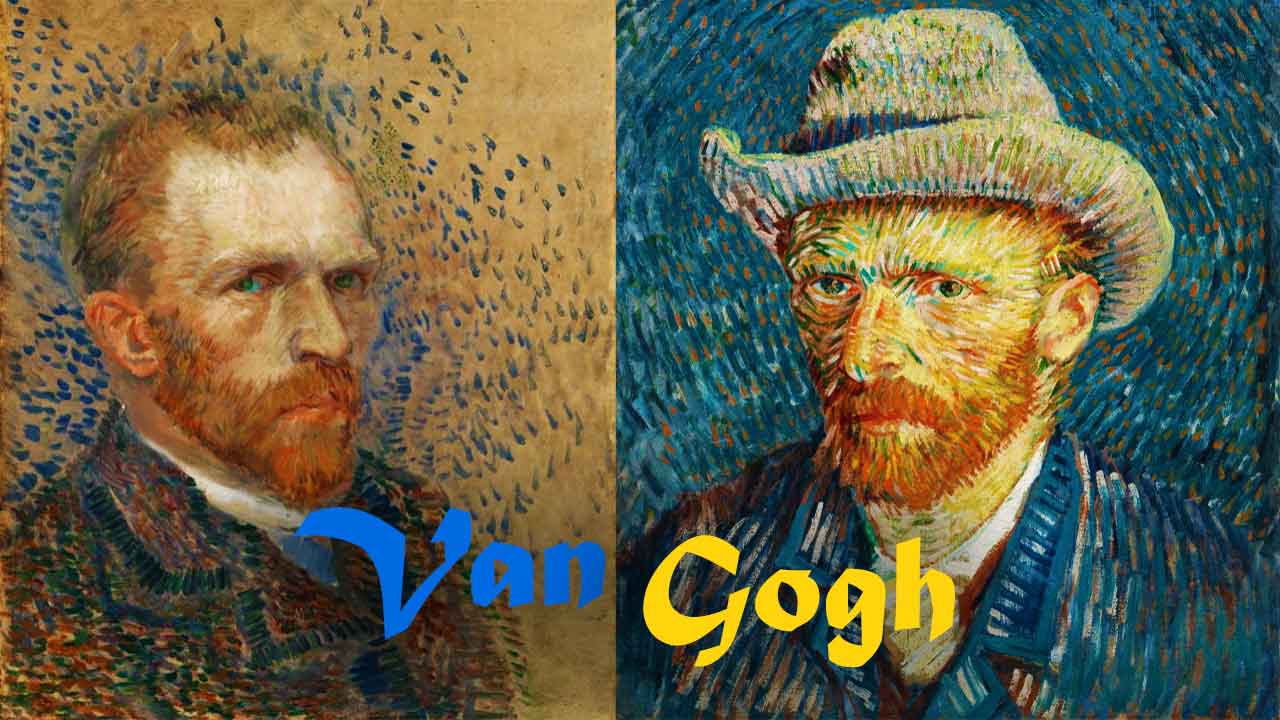
Vincent van Gogh spent his youth trying his hand at many different professions. He worked at an art dealership and even tried his hand at teaching and missionary work. During his time in the town of Borinage, Belgium, he painted portraits of the poor. In 1880, he enrolled at the Brussels Academy of Fine Arts. Having thus begun his career as a painter, Van Gogh would go on to create his masterpiece, “The Starry Night,” in the final years of his life.
The Life of Vincent van Gogh
Van Gogh enrolled at the Brussels Academy of Fine Arts in 1880. In 1885, he had the opportunity to study the works of Rembrandt and Franz Höns in Amsterdam. Realizing the visual impact created by the interaction of certain colors, Van Gogh began to study color theories, a subject that had also interested Delacroix. In 1886, he began studying at the Antwerp Academy of Fine Arts and met the English painter Horace Levens. However, finding the academic art instruction at this academy insufficient, he moved to Paris. In Paris, he worked for a time with Fernand Cormon. Within the Parisian art scene, he met and established connections with figures such as Émile Bernard, Louis Anguet, Paul Gauguin, and Paul Signac. In 1887, he had the opportunity to exhibit some of his works at a gallery named Pere Tanquey. He experienced his first group exhibition under the name “Painters of the Little Boulevard” alongside several painters, including Gauguin and Bernard. By 1888, Van Gogh had left Paris and moved to the Arles region in southern France.
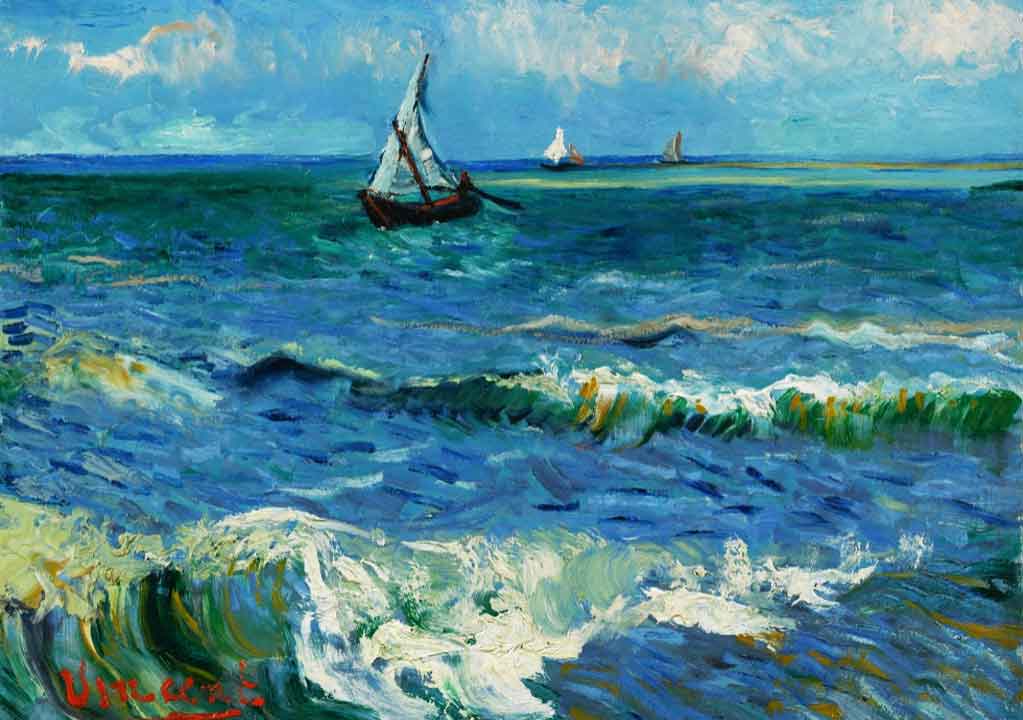
Van Gogh’s reason for going to Arles was actually the idea of forming an artists’ group. There, he painted some portraits and night scenes. In letters to his brother Theo, he described Gauguin as a good painter and friend, and wrote that he wanted him to be one of the leaders of the artists’ group he hoped to establish. His brother Theo took this suggestion seriously and acted as a mediator to facilitate the two artists working together. However, after Gauguin arrived in Arles and worked there for a while, arguments began to arise between him and Van Gogh. During this period, Van Gogh was in a very poor state; chronic insomnia and migraine headaches plagued him constantly. The arguments he had with Gauguin sometimes escalated to physical violence. During another argument between them, Van Gogh attempted to attack Gauguin with a razor and subsequently cut off his own ear with the razor. As a result, Van Gogh was admitted to the Arles regional hospital.
Van Gogh’s health problems grew increasingly worse. He was hospitalized due to the crises he was experiencing. In fact, people in the Arles region were petitioning for Van Gogh to be admitted to a mental hospital. Some time later, he is admitted to the Maison de Sante in Saint-Rémy for treatment. During this time, Albert Aurier’s article titled “Les Isoles” is published in the Mercure de France magazine. Van Gogh, who is the subject of this article and the focus of attention, receives numerous commissions for his paintings as a result. Vincent’s crises continued to intensify. Despite this, he left Saint-Rémy and returned to Paris. There, under a doctor’s supervision, he was placed at the “Ravuox Café.” While there, Van Gogh attempted suicide and was wounded in the chest. Although the wound was not fatal, it was deep; unfortunately, the wound became infected and led to Vincent Van Gogh’s death within a few days.
The Starry Night Painting
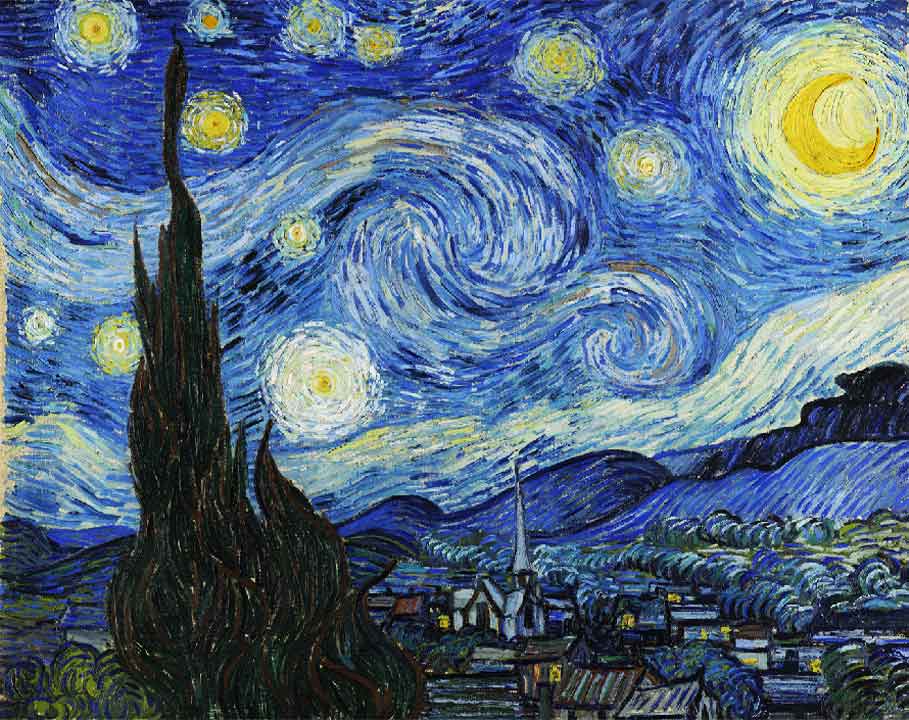
Vincent van Gogh’s artistic career lasted roughly 10 years. During this brief period, Van Gogh created 1,100 pen-and-ink drawings, 500 watercolors, and 420 oil paintings; he produced his most significant works while at the mental hospital in Saint-Rémy-de-Provence, near Arles. One of the works Van Gogh created in 1889 while staying at the mental hospital is the masterpiece “Starry Night.” In “Starry Night,” the artist depicted the mountains as curved and used sinuous lines to portray the stars in the sky. In “The Starry Night,” Van Gogh opted for bright colors and used curving lines instead of straight, short ones. The painting serves as both a depiction of a real night scene and an interpretation created by the artist blending reality with his imagination. Since he created “Starry Night” during his stay in the hospital, we can say that his depressive, restless, and unstable mental state at the time is also reflected in this painting.
The use of white and yellow in the sky of *The Starry Night* is particularly striking. Van Gogh found the best way to convey his emotions through color. His passion for the grandeur of nightscapes is evident in the majesty of the sky depicted in “The Starry Night.” “The Starry Night” can be interpreted in many different ways. For example, some say that the painting generally addresses the theme of hope. We can say that in Van Gogh’s “The Starry Night,” the stars are portrayed as sources of light that always serve as guides. In art circles, Van Gogh’s *Starry Night* is regarded as one of the most powerful works reflecting the artist’s inner world. From this perspective, if we examine *Starry Night*, we can say that it is not merely a depiction of nature but a narrative that reflects the artist’s suppressed anguish and existential anxieties.
The stars depicted in Van Gogh’s *Starry Night* lend the painting a dynamic atmosphere. According to some critics, the spiral-like arrangement of the stars in *Starry Night* expresses the emotional turmoil and inner turmoil the artist experienced as a result of his social ostracism. It could be said that the chaos in this depiction of the night symbolizes not only the artist’s turbulent life and existential anguish but also the pain caused by the label of “madman” imposed on him by society. In contrast to the sky, the town depicted below in *The Starry Night* is quite calm and still. Some critics have suggested that this depiction of the town symbolizes society’s stagnation and indifference. Since Van Gogh generally lived in isolation from society, we might say that this town represents the world he longed to join and become a part of.
It is a plausible interpretation to suggest that, in the painting *Starry Night*, the town is depicted as a metaphor of alienation and inaccessibility for Van Gogh. This is because Van Gogh based *Starry Night* on the night view he observed from the window of the mental hospital where he was staying in Saint-Rémy. Van Gogh’s tragedy could be described as his ability to see far beyond what others could, yet society’s labeling of this as madness and subsequent exclusion of him. The cypress tree motif in the lower left corner of *The Starry Night* is a symbol that frequently appears in Van Gogh’s other works as well. The cypress tree is associated with death and eternity in society. In this context, the cypress tree image Van Gogh used in “The Starry Night” serves not only as a metaphor for death but also symbolizes his effort to transcend death through his art.
The composition of “Starry Night” consists of celestial swirls, stars rendered in a stylized manner, a glowing crescent moon, and the full moon. The painting is adorned with a vibrant and colorful palette. The town depicted in the painting is based on real-life landscapes. Although Van Gogh is known as an artist who generally painted what he saw faithfully, in “Starry Night” he behaved more freely and boldly. The “Starry Night” painting is not merely a landscape depiction but an invitation for viewers to experience Van Gogh’s inner world. Through his distinctive, attention-grabbing brushstrokes, Van Gogh has concealed deeper thoughts and emotions behind the elements of the visible world. The curving lines throughout the painting represent constant flow and movement. When viewers look at “The Starry Night,” rather than receiving a passive impression, they experience Van Gogh’s inner world through their own emotions and thoughts. In this way, viewers discover both themselves and Van Gogh’s inner world with a profound sense of understanding.