
The Bauhaus School of Art and Design was founded in Weimar, Germany, in 1919 by architect Walter Gropius (1883–1969). During this period, Weimar became the center of innovative ideas emerging in Germany. The Bauhaus served as an extension of the earlier arts and crafts movement, which aimed to unite fine arts with applied arts.
The Fusion of Art and Industry
By refining the term “hausbau” (house building), Gropius named this new structure—which brought together the two art schools—“Bauhaus.” The Arts and Crafts movement, which began to emerge in the late 1800s, had adopted socialist principles. This movement brought artists and artisans together, encouraging them to produce simple and decorative projects. Architect Gropius joined the Deutsche Werk Bund (German Work Federation) in 1907 alongside a group of artists and designers.
Years later, Gropius undertook the task of restructuring, reviving, and leading the Bauhaus. During this restructuring process, the Bauhaus adopted the goal of bridging art and industry in a way distinct from other art and design schools. The Bauhaus quickly gained attention, developed further, and became popular. The role of its educational methods and the educators who implemented them was significant in its rapid rise to popularity. Among these educators were artists and designers such as Paul Klee, Lionel Feininger, Marcel Breuer, Josef Albers, and Kandinsky.

Throughout its history, the Bauhaus maintained its presence primarily in three cities. Founded in Weimar in 1919, the Bauhaus relocated to the industrial city of Dessau following the collapse of the Weimar Republic. In Dessau, a modern complex made of concrete, glass, and steel—designed to align with the Bauhaus’s objectives—was constructed, bringing together faculty housing, classrooms, and dormitories under one roof. The Bauhaus was later moved to Berlin in 1932, where it was closed by the Nazis.
The Bauhaus essentially emerged from the merger of the Weimar Academy of Fine Arts and the School of Arts and Crafts. At the Bauhaus, students received both theoretical and practical art education, learning to create products that possessed both artistic and commercial value. Gropius’s vision for the Bauhaus was for it to be a community where students and educators lived and worked together under equal conditions. Through this approach, he hoped to bring art and industry a little closer together.
In his plans for the Bauhaus School, Gropius was also greatly influenced by William Morris, a leading figure of the Arts and Crafts movement. The Bauhaus had embraced the culture of mechanization and mass production that swept through the 20th century. In this respect, the Bauhaus diverged from this earlier movement, as the artists associated with it had always maintained a distance from these principles. The Bauhaus was a pioneer among modern art schools for its integration of fine arts and design.
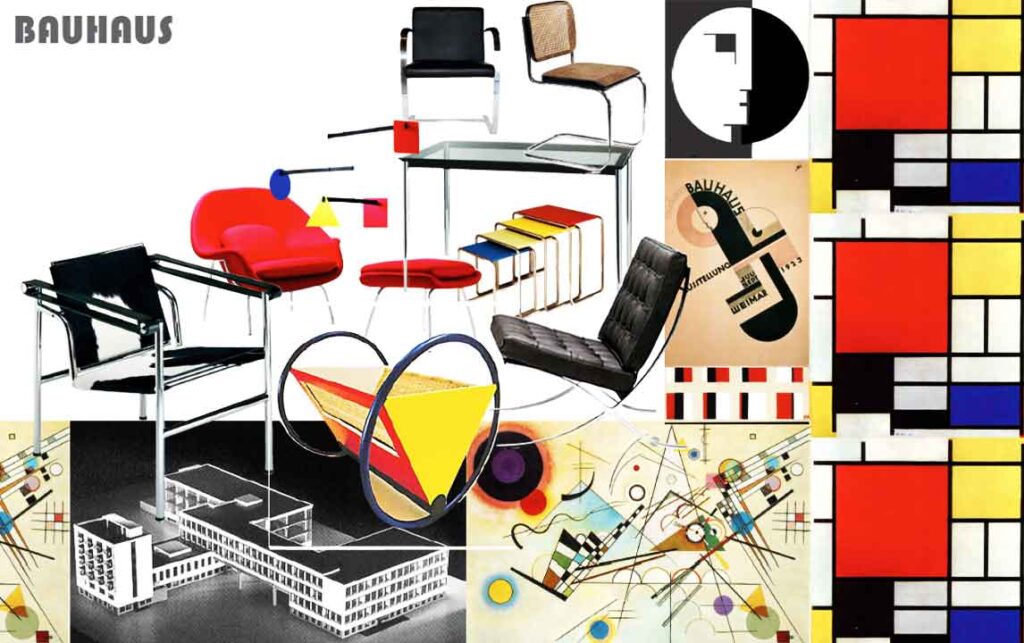
Education at the Bauhaus was structured around the belief that craftsmanship was the foundation of all art forms. Students developed their theoretical and practical knowledge of art, craft, and design through a six-month preparatory course. Students who completed this six-month period then received specialized training for three years in their chosen field under the guidance of several masters, artists, and craftsmen. Some of these specialization areas included weaving, pottery, painting, architecture, typography, carpentry, sculpture, and photography.
The Evolution of The Bauhaus School
At the Bauhaus, students learned to design functional objects and produce them in forms suitable for mass production. By 1923, the Bauhaus had refined its educational approach and adopted the slogan “art for industry.” During its existence, the Bauhaus was led by three architects. These were Walter Gropius, the founding director who led the school from 1919 to 1928; Hannes Meyer, who took over from 1928 to 1930; and Ludwig Mies van der Rohe.
Changes in leadership brought about changes in the curriculum, faculty, and the school’s internal policies. For instance, the pottery workshop closed following the school’s move to Dessau. However, the Bauhaus’s approach to design—emphasizing simplicity, creating products that are both functional and aesthetic, and suitable for mass production—remained consistent throughout.
When the Bauhaus moved to Dessau, Gropius designed a building that would better reflect the school’s revolutionary spirit. The new building became an ideal workspace for both instructors and students. Constructed using modern materials and methods, the building was a complex comprising three wings: the school, workshops, and dormitories for staff and students, as well as administrative offices.
The Bauhaus building, a crucial example of modern architecture, also became one of the most influential examples of the modernist movement. At the Bauhaus School, which quickly gained fame, the typography department became one of the most popular departments under the influence of artists Moholy-Nagy and Herbert Bayer. Gropius commissioned Bayer to design a typeface for the school; as a result, Bayer created a geometric, simple, and serif-less typeface (sans serif) that represented a groundbreaking innovation in graphic design.
Meyer, who took over the leadership after Gropius, made several changes to the curriculum and adopted an approach that focused on the social functions of architectural design. As a result of pressure from the far-right political government, Meyer was removed from his position in 1930 and replaced by Mies van der Rohe. Mies reorganized the curriculum to place greater emphasis on architecture. The reason for the Bauhaus’s move to Berlin in 1930 was the school’s increasingly dire financial situation and the growing political turmoil in Germany.

With this move, the Bauhaus continued to operate on a smaller scale in Berlin. By 1933, the Bauhaus was closed due to pressure from the Nazi regime. Many prominent figures from the school emigrated to other countries, particularly England and the United States. They spread the Bauhaus School’s artistic approach through their students in the places they settled. Thus, the Bauhaus’s functional, simple, and artistic design philosophy became one of the defining influences in art, architecture, and craftsmanship during the 20th century.