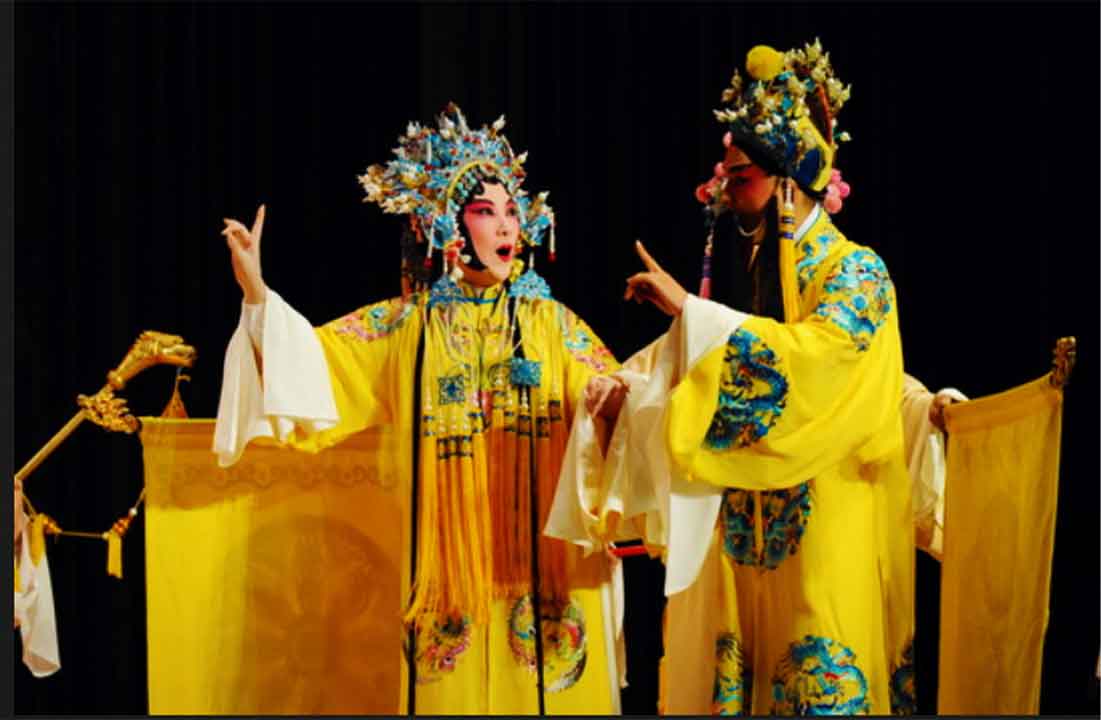
Given its vast territory in East Asia, China is home to many different forms of Chinese theater. The most popular of these is undoubtedly Chinese opera. This widely practiced form of theater combines music, performances, and dance. Dating back to the 1100s, Chinese opera has managed to preserve its unique structure throughout its history. Another form of Chinese theater that became popular after taking root in Chinese culture in the 1900s is “huaju.”
Theater is an ancient art form found in both Ancient Greek and Indian civilizations. In China, we can say that the genre of theater has a history of approximately 1,000 years (dating back to the Jin and Southern Song dynasties). One of the striking features of Chinese theater is that it has been successfully and continuously passed down from generation to generation to the present day. Over this long period, Chinese theater has taken on many different forms, resulting in over 300 genres and tens of thousands of works. In ancient times, within Chinese society—which was clearly divided into ranks and statuses—Chinese theater was used for educational purposes to teach people to follow the laws and respect the authority of the dynasty. For this reason, we can say that the most distinct characteristic of Chinese theater is the clear definition of roles.
Characteristics of Chinese Opera
It is easy to see that roles in Chinese opera are clearly defined. For this reason, certain roles are used to sharpen and clarify other roles more effectively, thereby emphasizing them. The roles frequently used in Chinese opera can be roughly categorized as sheng (male roles); dan (young female roles); jing (painted-face roles); chou (clown roles); and mo (middle-aged or elderly male roles). The second most distinctive feature of Chinese theater is the presentation of a kind of imitation of reality within the framework of aesthetic concerns, rather than reality itself. For this reason, the plays performed do not reflect reality, and this is one of the first characteristics that audiences will notice. This characteristic, particularly evident in Chinese opera, implies that aesthetics are the primary goal in the actors’ physical movements. Consequently, audiences of Chinese theater do not expect a literal depiction of reality. Therefore, actions that embody aesthetic value—such as singing and measured physical movements—are given great importance in Chinese opera.
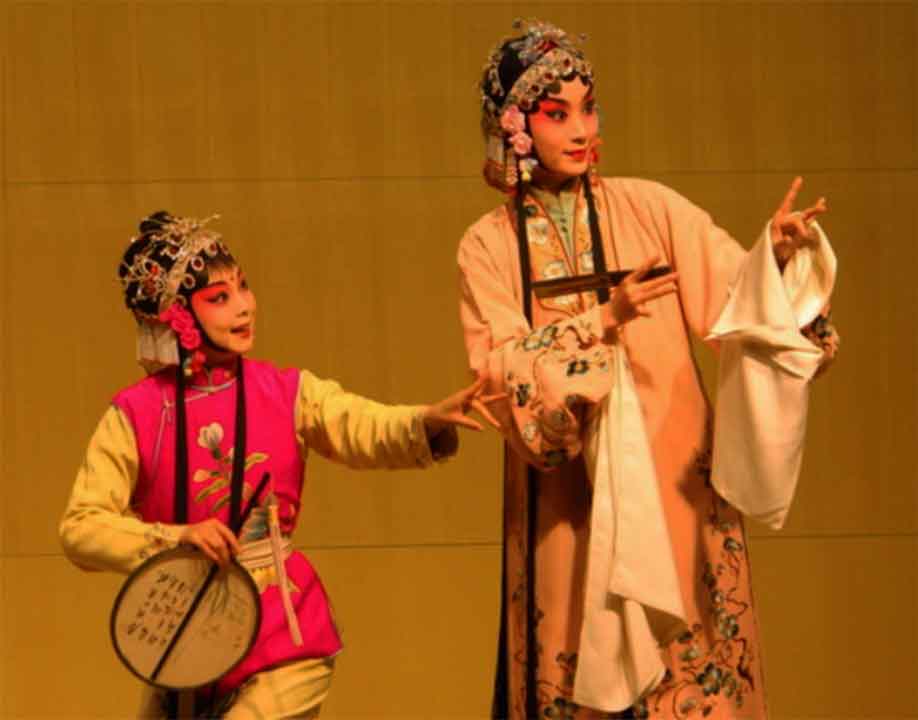
Another key element in Chinese theater is the establishment of strict boundaries in performances and the creation of narratives within these boundaries. For this reason, traditional Chinese opera is divided into four elements: nian (musical monologues or dialogues), chang (singing), zuo (acting), and da (martial arts). Singing performances in Chinese opera are presented within these strict boundaries. For example, in the opera *Guan Yu Goes to a Banquet with a Single Sword*, the character Guan Yu performs a song right at the beginning: “The Yangtze River flows eastward with thousands of waves, and I travel in this small boat, carried by the east wind. I have left my homeland and am now heading to the headquarters of my malicious enemies. As a man of strong will, I have no fear of this banquet.” As seen in this example, this song formula is used in many opera works.
The fourth distinctive feature of Chinese theater is that performances are staged within a simply designed set. For this reason, as few props as possible are used in the set design. Since the primary goal is not to imitate reality as it is, this is quite understandable. Thanks to the principle of simplicity in set design, Chinese theater gains a richness of imagination. In this way, many limitations regarding time and space are eliminated. Performances in Chinese opera are not limited to venues such as theaters (goulan), teahouses, or temples; they can also be staged on temporary stages set up in open fields or in the courtyards or living rooms of people’s homes. In fact, large enough boats, riverbanks, marketplaces, festivals, and fairs can even serve as venues for the necessary performances in Chinese opera.
The History of Chinese Theater
In its early days, Chinese theater was based on a concept that combined song, dance, and the actors who performed them. Actors would don animal costumes and portray specific themes accompanied by harmonious music. Jester actors, who performed comedic acts to entertain the nobility, were quite common. During the Han Dynasty, performances known as “Baixi,” which included various forms of music, dance, acrobatics, and magic acts, were quite popular both at court and among the common people. These and similar performances had a significant influence on the historical development of Chinese theater. By the time of the Tang Dynasty, folk songs and dances such as “Tayaonjang” and “Damian” had become quite popular. These performances incorporated many theatrical elements. Singing and dancing performances had a significant influence on the songs of Chinese theater known as “chang.” Military theater originally emerged from the performances of court jesters during the Qin Dynasty.
The roles of “canjundu”—an official who was often satirized in plays performed in the military theater—and “canghu”—the character who satirized him—were commonly used. The military theater enjoyed popularity both at court and among the common people. As the range of topics addressed expanded, Chinese theater continued to evolve. During the Song Dynasty, Chinese theater manifested itself through the ‘zaju’ and ‘nanxi’ genres. “Shuochang,” which originated in the Tang Dynasty and continued to develop during the Song Dynasty, is significant for the historical development of Chinese theater. Shuochang facilitated the development of the tradition of writing theatrical scripts and the incorporation of song elements into performances. “Zaju” performances—a blend of music, dance, comedy, and acrobatics—matured and gained popularity during the Yuan Dynasty.
Over time, the simple and monotonous roles used in zaju began to branch into distinct roles, leading to the emergence of different acting styles. During this period, numerous zaju playwrights emerged, and zaju plays were written. The most famous zaju playwrights were Guan Hanqing, Ma Zhiyuan, Zheng Guangu, and Bai Pu. Among them, the most popular figure, Guan Hanqing, wrote 18 zaju plays that have survived to the present day, including *Guan Yu Goes to a Banquet with a Single Sword*. There were originally more than 60 of these works, but only about 18 have survived to the present day. In his works, Guan explored various themes and forms, including love, comedy, and tragedy. Thanks to his mastery of language, he portrayed the characters’ personalities in a simple, poetic language that the common people could understand.
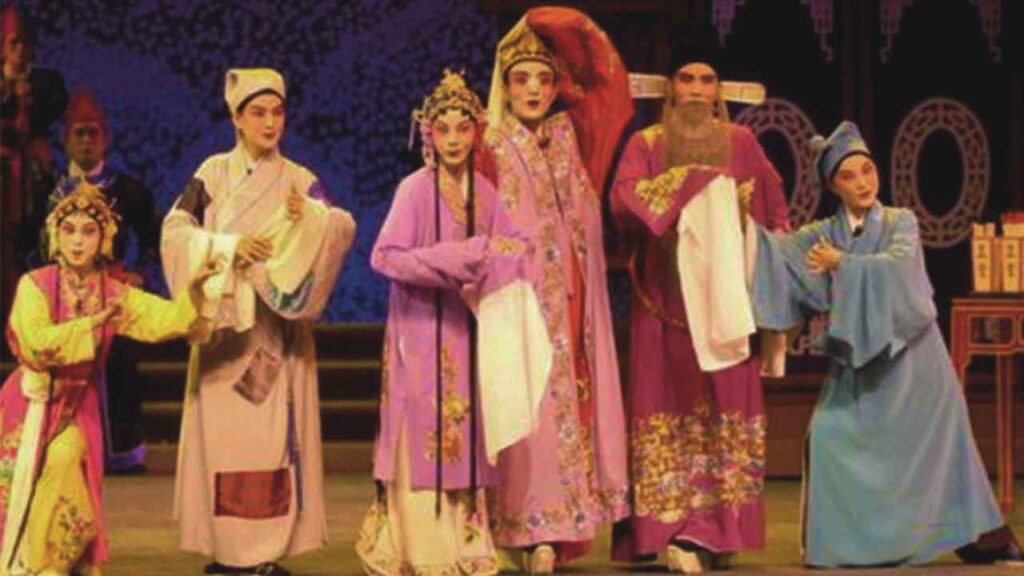
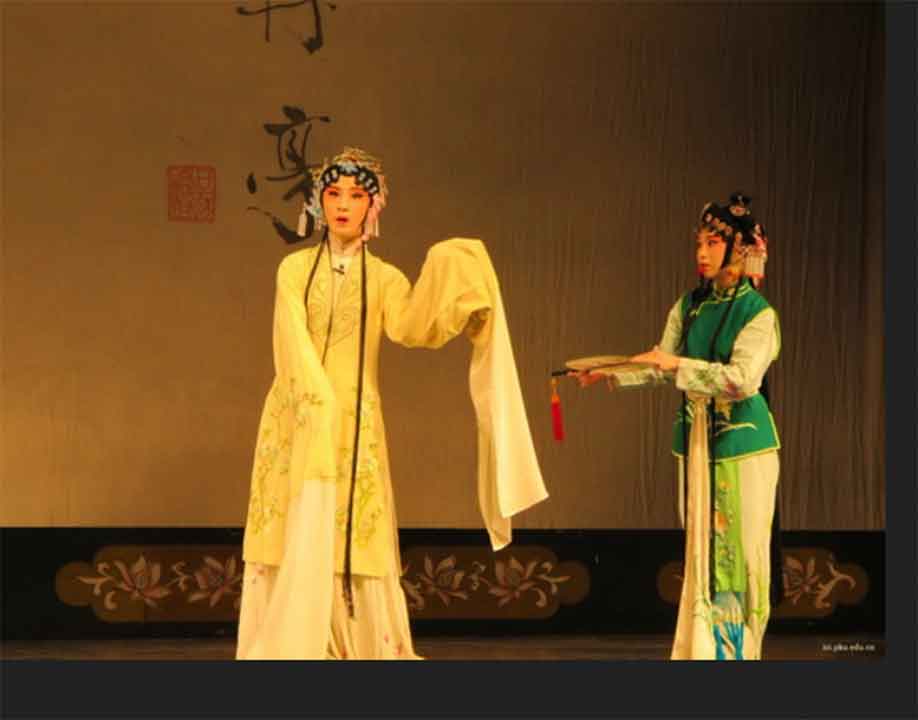
“Chuanqi,” or legend theater, holds an important place in Chinese theater. It became a prominent theatrical genre during the Ming and Qing dynasties. The playwrights of this genre were concerned with establishing a standard for music, and delivering a flawless musical performance was one of their primary priorities. During this period, Wei Liangfu (1489–1566) introduced the Kun singing style to Chinese theater, bringing a distinct musical approach. Legendary plays performed in the Kun singing style are known as Kun Opera. With Tang Xianzu’s (1550–1616) love-themed work *The Peony Pavilion*, the legend theater reached its pinnacle. Even today, Kun Opera remains one of the major genres of Chinese theater and serves as a magnificent example of successful stage performances. For centuries, it has contributed to Chinese theater and the broader Chinese arts through its musical and theatrical productions.