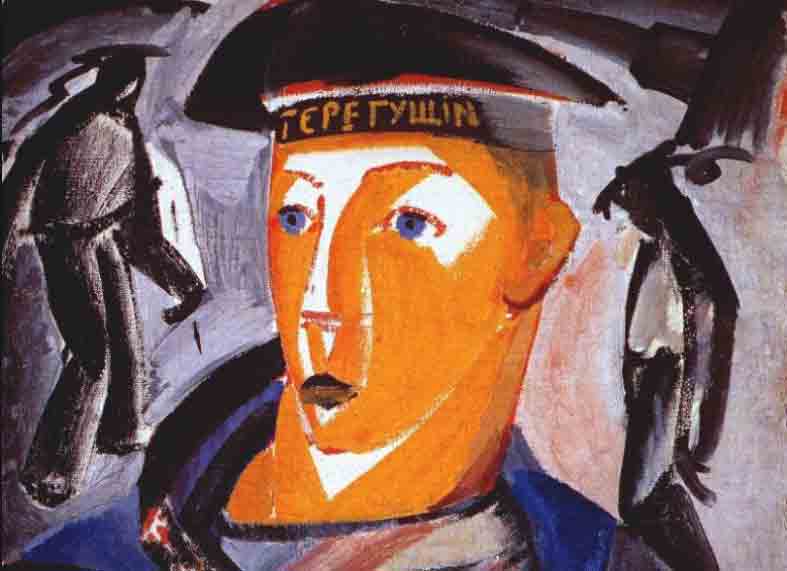
Given that a large portion of the archives and works of art were destroyed in the aftermath of the Russian Revolution, it is not easy to trace the history of the avant-garde art that emerged in Russia at the beginning of the 20th century. Nevertheless, some of the original ideas that emerged had a significant influence on modern art. Two of these were Suprematism and Constructivism.
In the first decade of the century, Russia was still an empire under the autocratic rule of Tsar Nicholas II. By 1918, following the Russian Revolution and World War I, the world had changed irrevocably. In addition to these developments, inventions and innovations such as the Ford Model T assembly line, the escalator, the vacuum cleaner, the light bulb, and color photography were transforming people’s lifestyles. Constructivism, which was influenced by Cubism, Futurism, and Neo-Plasticism—as well as Suprematism—drew its greatest inspiration from Cubist sculpture. In 1913, Vladimir Tatlin (1885–1953), who had traveled from Russia to Paris, visited Picasso and studied his experimental three-dimensional collage works (assemblages). Believing that art should directly reflect the modern industrial world, Tatlin began producing entirely abstract relief constructions using scrap materials after returning to Russia.
From the very beginning, he emphasized that the space between and around objects (negative space) was just as important as the structure itself. Between 1913 and 1917, Tatlin created colorful reliefs and some constructions that made no reference to any identifiable object or representational theme. Beginning in 1915, he collaborated with Alexander Rodchenko (1891–1956). Both artists produced entirely abstract geometric designs and constructions that were clearly influenced by Cubism, Futurism, Neo-Plasticism, and Suprematism. In 1917, immediately after the revolution, more distinctive Russian artists came to the fore. Naum Gabo (1890–1977) and his brother Antoine Pevsner (1896–1962) returned to Russia in 1917 after spending many years in Europe. Kandinsky returned from Munich in 1914. Despite difficult conditions, all these artists expressed their revolutionary ideals through original ideas and individual interpretations.
The term “Constructivism,” coined by Pevsner and in use from the very beginning, had become widely established by 1920. Two distinct approaches prevailed within Constructivism. Tatlin, above all, believed that art had a social purpose and that artists should subordinate their individuality to the interests of society. He aimed to create new forms using new materials in a way he believed was appropriate for the new social order. The second approach aligned with the views of Kandinsky and Malevich, who argued that art was fundamentally an individual rather than a social practice, no matter how broad its ultimate purpose might be. The moral and spiritual undertones of this perspective were later supported by the interpretations of Gabo and Pevsner and continued to serve as one of the foundational elements of a significant portion of the subsequent abstract art movements.
The Impact of Political Conditions on Constructivism in Russia
Hungarian-born painter László Moholy-Nagy (1895–1946) encountered examples of numerous avant-garde movements—including Russian Suprematism and Constructivism—in Berlin in 1922, where he had been living for two years. He conducted experimental work on photography for months and, following Constructivist ideas, began to incorporate architecture and machines into his paintings in an increasingly abstract manner. He later taught at the Bauhaus as well. Under the influence of Constructivism, Moholy-Nagy reduced elements to their most basic solid colors, geometric shapes, and simple lines, which he subsequently spread throughout the world through his teachings. The Tsar’s abdication in March 1917, the overthrow of the provisional government established by Kerensky by the Soviets the following fall, the turmoil of the early years of the Communist regime, and the civil war against the Whites all contributed to the initial development and enrichment of avant-garde art in Russia. Many Russian avant-garde thinkers were appointed to various positions in government agencies. Constructivism, exemplifying this new way of thinking, was promoted as a progressive movement.
Constructivism emerged as a movement aimed at modernizing art, design, and architecture in line with technological advancements and developments in everyday life. Upon their return to Russia, Gabo and Pevsner began actively incorporating more sculptural elements and making greater references to architecture, machinery, and technology. Kandinsky also joined this movement. However, Tatlin believed that, given his overall inclination toward mysticism, Kandinsky would not be able to produce works that were as objective as they should be. Other artists who embraced Constructivism included Liubov Popova, Alexander Vesnin (1883–1959), Rodchenko, Varvara Stepanova (1894–1958), Alexei Gan (1889–1942), and Osip Brik (1888–1945).
In 1922, Gan published the book *Constructivism*, which is generally considered the movement’s manifesto. From 1918 to 1928, Russia was in a constant state of social and economic crisis due to frequent changes in governments and regimes. During this period, official opposition to innovative art intensified, and numerous schools, artists’ organizations, and museums were established and disbanded in rapid succession. Constructivist ideas spread quickly to Germany and the Netherlands and eventually gained international recognition. Complete abstraction was viewed as a fresh idea by forward-thinking individuals who had turned their backs on a society that had given rise to the atrocities of recent years. With its content spanning relief construction, sculpture, kinetic art, and painting—and its experimental and objective themes that rejected emotion and reduced everything to its most basic particles—Constructivism came to be perceived as a progressive and modern movement.
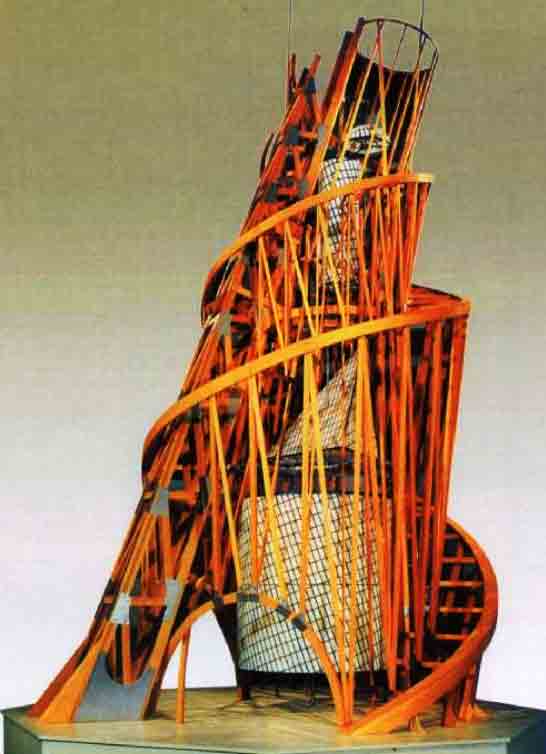
While new and unconventional materials were frequently used, the artists’ methodical approach pointed to their strong tendency to disregard all the factors that had led to World War I, as part of their efforts to promote universal peace and harmony. While heading the Commissariat for Enlightenment in Moscow, Tatlin—who had been commissioned to create monuments celebrating Russia’s achievements—produced a model for his work titled Monument to the Third International (1919–1920), among other works. Also known as Tatlin’s Tower, this monument was to be constructed of iron, glass, and steel, with four large geometric structures suspended from its body, each rotating at different speeds. A few years later, the Soviet regime decided that Constructivism was not suitable for propaganda, and by 1924—thanks to Stalin, who had been leading the Communist Party for a decade—the movement fell out of favor. However, Constructivist ideas continued to influence developments in art, design, and architecture throughout the Western world.