We have only limited information about the family and personal life of Leonardo da Vinci, who is known as an artist. It is possible to see traces of his multifaceted personality in the works he created. These works give us a glimpse into his extraordinary intellect and deep knowledge across various fields, which led to him being recognized as a genius even during his lifetime. This genius left behind numerous scientific and philosophical notes, as well as artistic works, upon his death.
Leonardo’s Life and His Personality
Leonardo da Vinci is mostly known to people as a painter and sculptor. However, throughout his life, he worked in many fields, distinguishing himself in architecture, engineering, anatomy, and the natural sciences. With his death, he left behind a legacy that even his contemporaries would struggle to analyze. The greatest factor driving this genius to work in so many fields and shaping his multifaceted personality was his passionate pursuit of knowledge, which he possessed from his youth. While satisfying this desire, he also took numerous notes and kept records about his work. From his early youth, he began taking notes on various subjects and compiling them in his notebooks. Leonardo da Vinci’s artistic talent was first discovered in the workshop of the Florentine sculptor Andrea del Verrocchio. The young genius, who was apprenticed there, refused to remain in Florence’s artistic circles and among its wealthy, art-loving patrons, choosing instead to go to Milan.
Upon beginning to work for the Sforza family in Milan, Leonardo significantly developed his engineering skills. We can clearly see his confidence in engineering and his desire to work in this field in the letters he wrote to Duke Ludovico Sforza. In these letters, Leonardo da Vinci appears to prioritize engineering fields over artistic ones professionally. He views himself more as an architect and engineer than as an artist. However, many of the machines and devices he designed throughout his life were unfortunately never completed. Had these designs been practically implemented, they might have led to Leonardo da Vinci’s engineering and design aspects being recognized more than his artistic ones. The employers he worked for while in Milan were very wealthy and prominent figures. For example, the Milanese Sforza family, the Medici family, and the King of France at the time frequently sought to benefit from Leonardo da Vinci’s talents and knowledge.
Leonardo da Vinci’s family valued and supported his talents. He spent his childhood in a rural area of Vinci, located in Tuscany. For this reason, he grew up surrounded by nature. The young Leonardo, who was tall and quite handsome, was known as a very kind, charming, brave, and good friend. Throughout his life, he displayed an unconventional and bold attitude regarding his appearance and the clothes he wore . Leonardo da Vinci was also a highly prolific writer. He had his own unique method of note-taking. When writing down his thoughts and plans, he would write backward and with his left hand. We cannot say this was something he did to confuse people, as he intended to publish his scientific writings and notes.
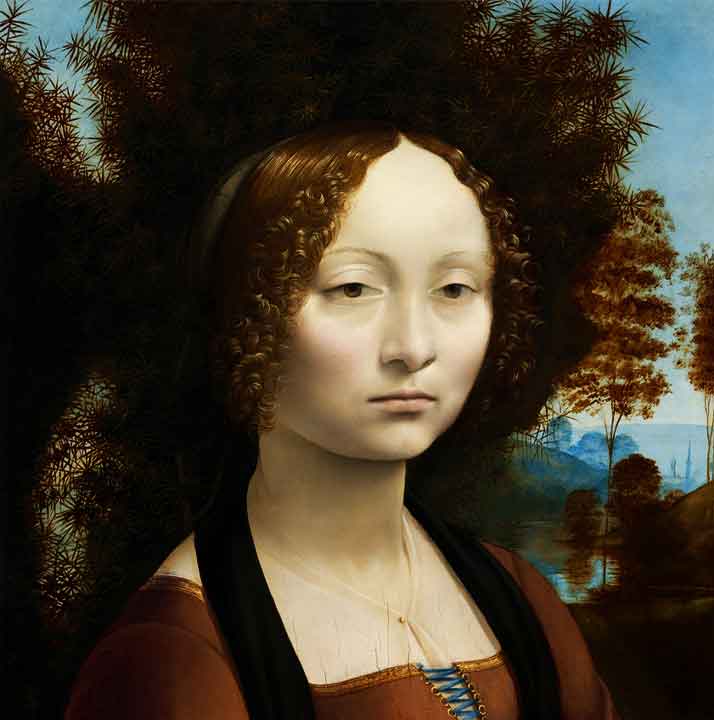
We can witness Leonardo da Vinci’s work across many fields, from canal engineering to defensive fortifications, and from painting to scientific dissection. Throughout his life, he produced only 28 paintings, yet some of these were sufficient to leave an indelible mark on art history. One reason for this is Leonardo’s multifaceted personality, which we mentioned earlier. Only 22 of these paintings have survived to the present day. We know of the other six through his notes and copies. Leonardo da Vinci, who worked with wealthy and noble patrons throughout his life, was regarded as “Leonardo l’uomo universale (The Universal Man)” by noble circles due to his multifaceted work. This is because he was one of the leading figures of the Italian Renaissance, distinguished by his immense talent. We can attribute the reason why Leonardo da Vinci is so widely recognized despite producing so few paintings to the aesthetic depictions and his talent for realism found in the limited number of works he created.
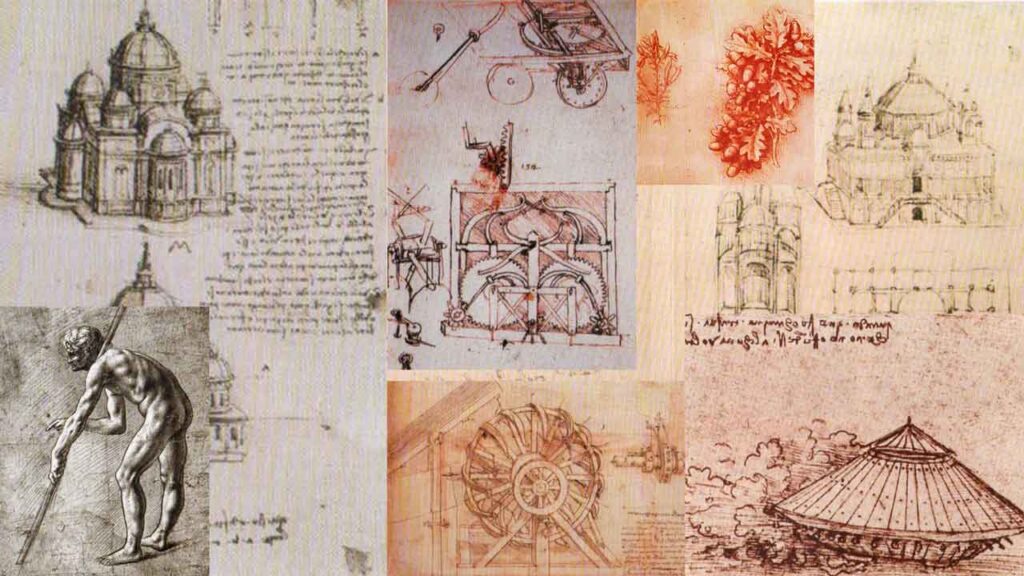
There are multiple sources from which one can learn about Leonardo da Vinci’s personal and professional life. For example, there are two biographical works written after his death. One of these is *Leonardo Vincii Vita*, written by the physician and historian Paolo Giovio (1483–1552). Additionally, the writings by Giorgio Vasari are among the sources that help us understand Leonardo. Upon his death, this genius left behind only about 6,500 surviving sketches, approximately 13,000 pages of notes, a small amount of money and property, and numerous paintings. His notebooks are filled with expenses, commissions, works in progress, and various other matters.
Leonardo da Vinci spent his childhood in the olive groves of Vinci, supported by his grandfather and uncle in the fields that interested him, and even in his youth, he was already demonstrating his superior intellect. Even at a young age, he challenged his teachers with his questions and used a unique, difficult-to-decipher handwriting style. As the first grandson of Ser Piero, Leonardo da Vinci had a great interest in nature. During his childhood, spent in close contact with nature, he had ample opportunity to study animals and plants. He learned reading, writing, and arithmetic from his teachers. Later, he taught himself Latin. Leonardo’s interest in painting and sculpture—and the drive that led him toward these fields—was already very evident even in his youth. For this reason, his father set out to find a place in Florence where he could serve an apprenticeship.
Leonardo’s Artistic Career
Leonardo da Vinci’s apprenticeship with Andrea del Verrocchio played a pivotal role in his artistic career. According to Vasari’s writings, Leonardo—who was already constantly studying things and taking notes—had his sketches collected by his father and brought to his friend, the Florentine Andrea del Verrocchio. Verrocchio, impressed by Leonardo’s intellect, accepted him as an apprentice. Thus, Leonardo’s journey continued in the workshop. The general consensus places the start of his apprenticeship around 1468–9. For Leonardo, who was interested in all branches of art, this workshop was the perfect fit. Later, his life would intersect with that of Michelangelo Buonarroti, and he would gain a valuable rival.
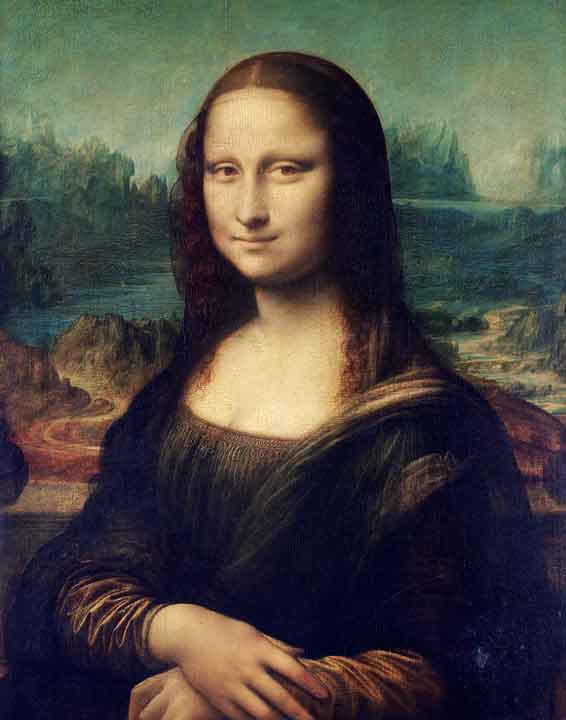
Leonardo da Vinci drew with his left hand and used tools such as quill pens, chalk, and feathers when creating a sketch. He particularly enjoyed using the silverpoint technique. Leonardo da Vinci used sheets of paper larger than 32 x 44.6 cm because they allowed him to draw multiple sketches on a single sheet. It is still debated how many of Leonardo’s sketches have been lost, but there is no definitive number. In 1476, while Leonardo da Vinci was still working in Verrocchio’s workshop, he and a few others were accused of engaging in a homosexual relationship with the son of a noble goldsmith. However, since no evidence was presented, the accusation stood unproven. In fact, the accusation was later withdrawn, and his name was cleared. In Florence at that time, the penalty for homosexuality was death, though sentences could also be commuted to imprisonment or exile.
A Symbol of the Renaissance
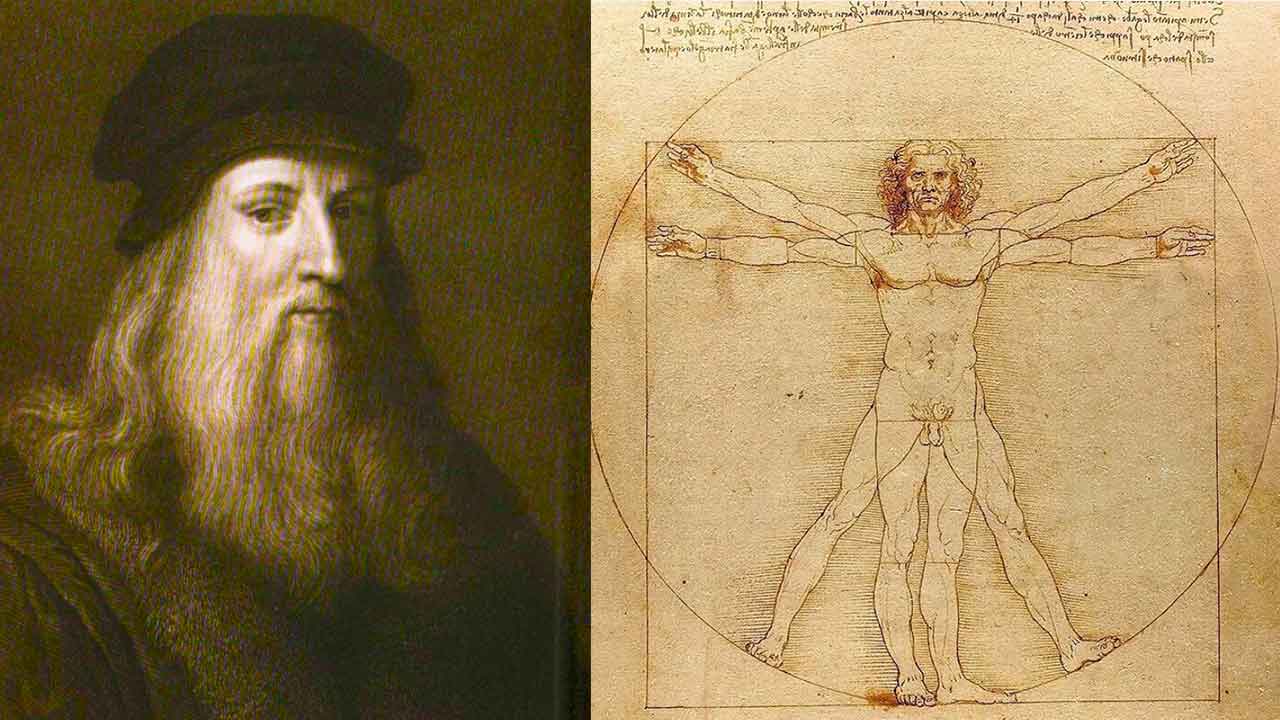
One of Leonardo da Vinci’s most iconic drawings is *The Vitruvian Man* (Proportions of the Human Body), created around 1490 using an ink pen and accompanied by some annotations. Vitruvius, a Roman architect from antiquity, discussed the proportions of the human body and their relationship to geometric order in his work *On Architecture*. Leonardo da Vinci provided an interpretation of Vitruvius’s explanations. Additionally, in this drawing, Leonardo da Vinci visually interpreted the idea—a part of Ancient Greek philosophy—that the human being is a microcosm, or a small part of the cosmos. This reflects the rapidly resurgent humanism in Italy at the time, showcasing the influences of Platonic ideas and Ancient Greek philosophy. Leonardo da Vinci depicted the human figure in two distinct positions— —by inscribing a circle within a square. This iconic drawing became one of the most significant symbols of the Italian Renaissance.