Photorealism emerged in the United States in the late 1960s, alongside many other art movements that opposed the abstract and conceptual art being produced at the time. Photorealism involved painting with extreme precision so that the resulting painting would resemble reality with the sharpness of a photographic image. The artist’s sole aim was to produce works that appeared as realistic as possible.
Although Hyperrealism is generally considered a derivative of Photorealism, it was not as direct. Toward the end of the 20th century, some artists began creating works that were as meticulous and detailed as those of Photorealism, but they generally sought to convey messages that emphasized humanity by making certain subtle changes that were not immediately obvious. Adopting diverse working techniques within their own circles, Hyperrealists employed a variety of themes, including portraits, landscapes, cityscapes, figures, narrative compositions, and genre paintings. Although intended to appear objective and anonymous, these works generally carry a deliberate emotionality and a sense of individual expression as powerful as that found in Expressionism.
Differences Between the Hyperrealism and Photorealism Movements
Photorealism, a movement that emerged from Pop Art in the 1960s, emphasized the masterful and meticulous depiction of themes related to ordinary, everyday life. Artists of the Photorealism movement usually avoided human emotions, political content and narrative elements. In contrast, Hyperrealists were concerned with contemporary culture, politics, and social issues. For these reasons, they explored a wide range of themes in their works, such as the vulgarity of consumer culture, the extremes of suffering, the harsh conditions faced by the working class, and the fragility of the human body. Just as with Photorealism, the first Hyperrealist artists emerged from the United States. Denis Peterson (1945), Richard Estes (1936), Audrey Flack (1931), and Chuck Close (1940) are among them.
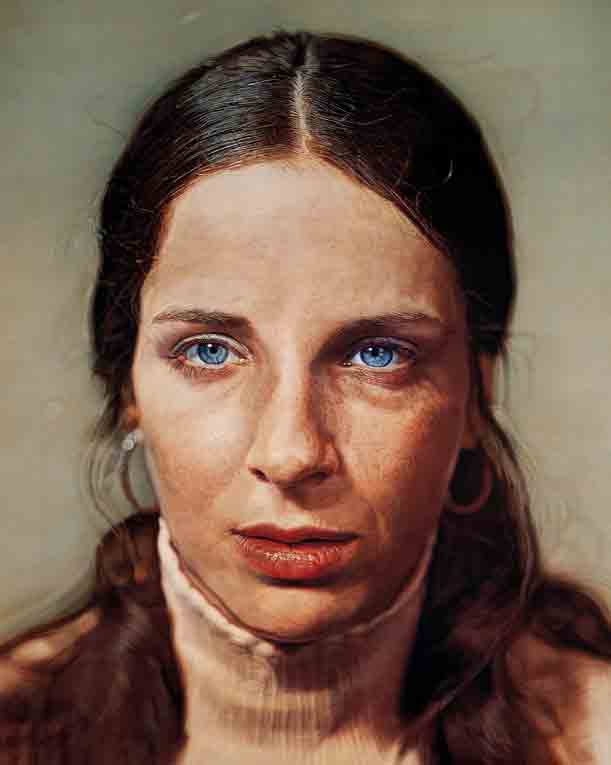
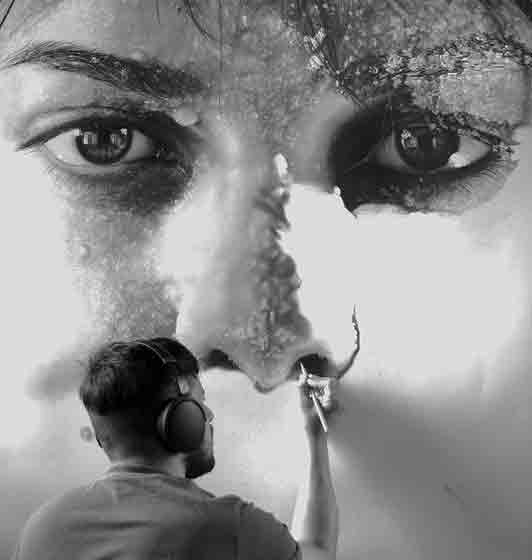
Because the works are created with such meticulous care and attention to detail, they can take months to complete. The paintings are built up from tiny brushstrokes so fine they are barely perceptible. The sculptures, meanwhile, are made from various materials that can be shaped into forms resembling reality. Many Hyperrealists use direct photographic images in their work to create pieces that look as if they were photographs. The fun part of this is that the works encourage viewers to decide whether the image they are seeing is a photograph or a painting created with paint and brushes, or whether a sculpture is real or an artist’s depiction.
The Development of the Social Realism Movement in Russia
Although Hyperrealism requires a high level of technical skill and meticulous work, many artists use mechanical methods—such as photographs or multimedia projections—to transfer their templates onto the canvas during the production process. Others prefer the traditional and painstaking grid system to transfer images onto the canvas while painting. Most artists use airbrushes to blend colors in an indistinguishable manner. Sculptors, on the other hand, often apply polyester directly to the body of a mold or mannequin to achieve the desired shape.
Hyperrealist Artists and Notable Figures
Hyperrealism carries a subjectivity in which, through meticulous attention to detail, illusions of reality are almost always reproduced more distinctly and clearly than in a photograph—or even than in reality itself. The goal here is not to produce an exact replica of a photograph or of reality. The central idea is to draw attention to the aspect of reality that interests the artist by exaggerating it. Textures, surfaces, lighting effects, shadows, and colors appear sharper and more distinct than in the referenced photograph—or even in the subject itself. This style evolved from Photorealism and has been further developed through high-resolution images produced by digital cameras and computers. At the same time, the philosophical works of various theorists—including sociologist, philosopher, photographer, and political commentator Jean Baudrillard (1929–2007), who theorized the contemporary society’s inability to distinguish between reality and fiction—also played a role in its emergence.
Baudrillard and others questioned what is actually “real” in a world where events and our experiences can be entirely shaped by various means of communication. Estes’s eerie cityscapes—which, like de Chirico’s Metaphysical paintings, feature distinctive, contemplative faces and impersonal structures—and Close’s works, which confront viewers with massive portraits characterized by proportions and clarity that are far removed from the natural, and the themes of the Holocaust and Nazism explored by Gottfried Helnwein (1948), or Peterson’s series of paintings that evoke a powerful sense of empathy and depict human suffering with detached precision—the works vary depending on the subjects the artists address.
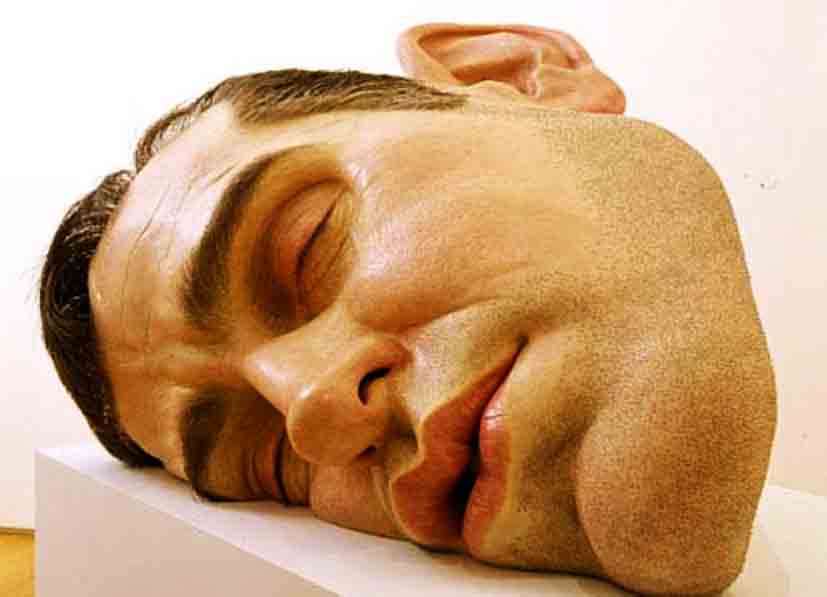
Australian sculptor Mueck (1958) and his works are among the most concrete examples of Hyperrealism. These works—which are astonishingly lifelike and of extraordinary dimensions—whether excessively large or excessively small—confront viewers with a shocking sense of reality. Using materials such as silicone, polyester resin, and polyurethane—which are well-suited for creating fine details—Mueck, through painstaking and meticulous work, renders delicate details such as wrinkles, unkempt beards, skin blemishes, and body hair in the most realistic manner possible. By triggering a sense of unreality in viewers, he unsettles them, prompting them to reevaluate facts about life that they had taken for granted and never questioned. From 1997 to 2000, Mueck participated in the traveling “Sensation” exhibition in England, Berlin, the United States, and Australia. With this exhibition, Mueck began to gain fame, and Hyperrealism began to come to the forefront in the contemporary art world.
Many Hyperrealists created images and objects that expressed their views on political and social issues such as totalitarian regimes, racial and religious intolerance, torture, discrimination, society’s indifference toward vulnerable and disadvantaged groups, and other aspects of the human condition. Hyperrealist images often challenge viewers through unexpected confrontations—such as juxtaposing conflicting elements, highlighting a surprising dimension, or presenting an unsettling truth we might otherwise overlook. For example, Ron Mueck’s *Mask* (1997), as well as his small-scale *My Dead Father* (1996–7), made using silicone, or his large-scale *In Bed* (2005)—which employs a contrasting technique to depict a woman lying in bed—are not only on surprising scales but also strikingly lifelike, compelling viewers to reevaluate what they see.
In contrast, the Hyperrealist sculptures by Duane Hanson (1925–96), which depict ordinary American citizens, were always life-sized and appeared astonishingly realistic even when viewed up close, prompting viewers to reevaluate their perceptions. Most Hyperrealist paintings are created by applying acrylic, oil, or a combination of both using an airbrush. Denis Peterson’s visually striking and often disturbing paintings—which he typically produced in series—focused on unpleasant subjects such as genocide, the struggle for survival, and the pain and suffering that may result from conflict. These provocative subjects featured meticulously rendered details and were often presented with a framing that made viewers feel as though they were peering into situations they might find disturbing to witness. Although his paintings offered interpretations of the subjects they depicted, he deliberately set aside his own emotions to allow viewers to form their own perspectives on these issues.