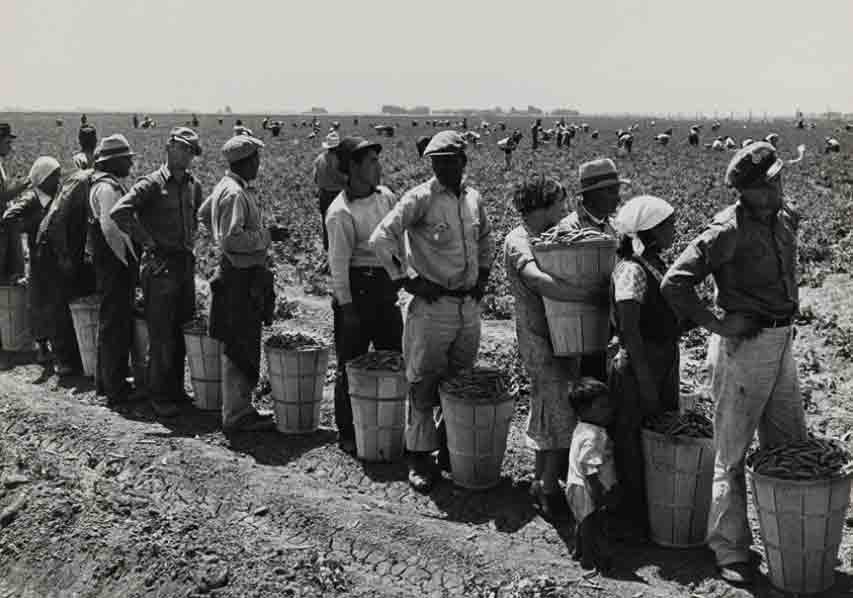
Unlike Socialist Realism—which was designated as the official art form of the Soviet Union by Joseph Stalin in 1934 and later adopted by other communist parties—Social Realism is an art movement that emerged in the 1930s, particularly in the United States. Generally, it has conveyed a message of protest by depicting social, political, and racial injustices or economic hardships.
Since the Industrial Revolution, the living and working conditions of the lower classes have captured the interest of many artists. 19th-century Realists such as Courbet and Millet, as well as British painters like Luke Fildes (1843–1918), Frank Holl (1845–1888), and Hubert von Herkomer (1849–1914), depicted the poor in particular in their works. Many of these paintings were reprinted in the British illustrated magazine *The Graphic* and subsequently served as a source of inspiration for many young artists. Social Criticism In the years following World War I, Social Realism—drawing strength from the social criticism of the Realism movement—further developed as independent painters, printmakers, photographers, and filmmakers reacted against the ways in which other artists idealized the hardships and inequalities of life.
Drawing attention to the daily living conditions of the working classes and the poor, Social Realists criticized the social structures that enabled and perpetuated these conditions. In keeping with their socialist outlook, they often portrayed the poor as noble and dignified individuals who deserved better but who also faced all hardships with great resilience. Although the ideas disseminated by these artists shared some common features with Socialist Realism—the official form of Communist art—Socialist Realism was a state-sponsored, official art movement, whereas Social Realism remained unofficial and, consequently, far more subjective and personal.
Socialist Realism was conceived as a “representation of the proletarian revolution” and emerged as a tool of communist propaganda. Beginning in 1934, all independent art groups in the USSR were disbanded, and only official art was permitted. Socialist Realism was created as an art form that illiterate Russian masses could understand. By depicting their struggle against adversity and their courage, it encouraged the people to be happy and patriotic, and to participate in revolutionary actions and productive labor. Socialist Realism came to an end with the collapse of the Soviet Union in 1991.

Social Dynamics Created by the World Wars and the Great Depression
At the beginning of the 20th century, as slums expanded rapidly in Europe and America, the middle classes also grew wealthier. On the other hand, after World War I, a new kind of social consciousness began to be shared by many people. As these artists, photographers, and writers focused on the harsh living conditions of the poor, they came to be known as Social Realists. Throughout the 1930s, American Social Realists documented, in an impartial and detached manner, the hardships endured by the poor, who were forced to tighten their belts due to the Great Depression. Many were influenced by the Mexican Muralists and the artists of the Ashcan School (a group of American artists who depicted the less appealing aspects of New York city life and scenery in the early 20th century).
Through the urban and rural landscapes he brought to the canvas, Edward Hopper’s (1882–1967) paintings reflected his intuitively powerful vision of American life. Hopper has often been regarded as part of the Ashcan School. However, because his paintings did not focus solely on the desolate aspects of city life, Hopper was not strictly a member of that school. Ben Shahn (1898–1969), who combined lithography and graphic design techniques with his socially documentary-style works, was one of the American Social Realists. Shahn also assisted Diego Rivera when he arrived in the United States. Reginald Marsh (1898–1954) depicted crowds and, in particular, women in the New York subway, nightclubs, streets, bars, and restaurants.
Dorothea Lange (1895–1965) was a documentary and press photographer who captured the plight of people during the Great Depression. She left a significant mark on the development of documentary photography. Although all three Soyer brothers were well-known figures, Ralph Soyer (1899–1987)—who portrayed the ordinary people of New York—stood out among them. Jack Levine (1915–2010) was known for his satirical paintings and prints, while Arnold Blanch (1896–1968) was a painter, engraver, illustrator, printmaker, muralist, and art teacher who gained fame for gently conveying the various facets of American life in his paintings and prints.
Social Realism and Regionalism
Regional Art Like many other art movements, Social Realism emerged not so much as a consciously planned and organized effort, but rather through the simultaneous expression of similar views by a large number of artists and writers, who sought to convey these ideas creatively. Circumstances paved the way for the movement, and differences emerged among the artists’ interpretations. For example, in the United States, American Landscape Painting—also known as Regionalism—intersected with Social Realism. While American Realists depicted slices of American life, unlike Social Realists, they focused on nostalgic representations of rural life.
While Social Realism highlighted the tragic circumstances of the urban poor during the Great Depression, the images created by Regionalists—depicting the unchanging rural life and its hardworking inhabitants—were more positive, reassuring, and hopeful. While the painting style of the Social Realism movement was realistic and objective, Regionalism often blended a combination of different techniques, mixing images that appeared realistic with abstraction. The three artists most closely associated with the Regionalist movement are Thomas Hart Benton (1889–1975), known for his powerful tones and striking, vivid figurative imagery; Grant Wood (1891–1942), known for his depictions of rural Midwestern America and, in particular, his 1930 painting *American Gothic*; and John Steuart Curry (1897–1946), who opposed painters’ involvement in social criticism and political propaganda, as practiced by the Social Realists.
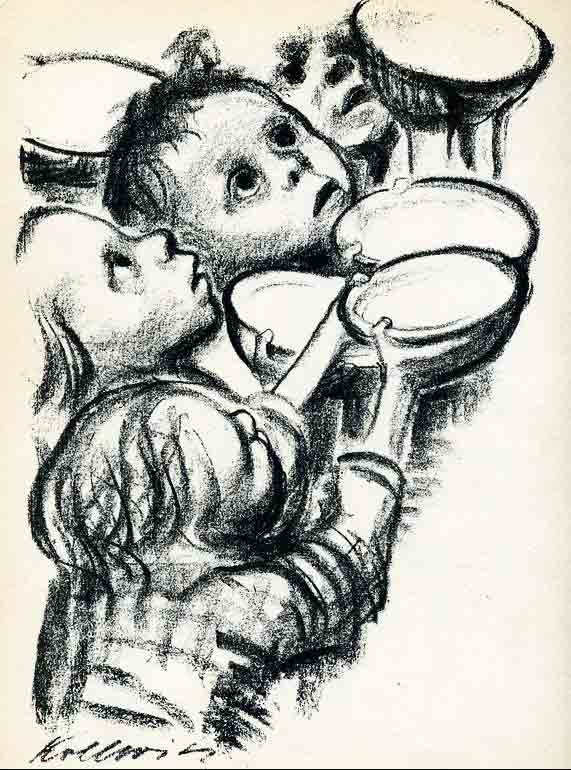
Although Social Realism is generally regarded as an American art movement, similar sensibilities were expressed by some artists in Europe as well. In Germany, artists such as Kathe Kollwitz (1867–1945) and George Grosz, and in England, artists such as John Bratby (1928–1992)—an artist associated with the 1950s Kitchen Sink School in England—created interior and still-life paintings with working-class themes to express their dissatisfaction with the social and moral structure of post-World War II society.