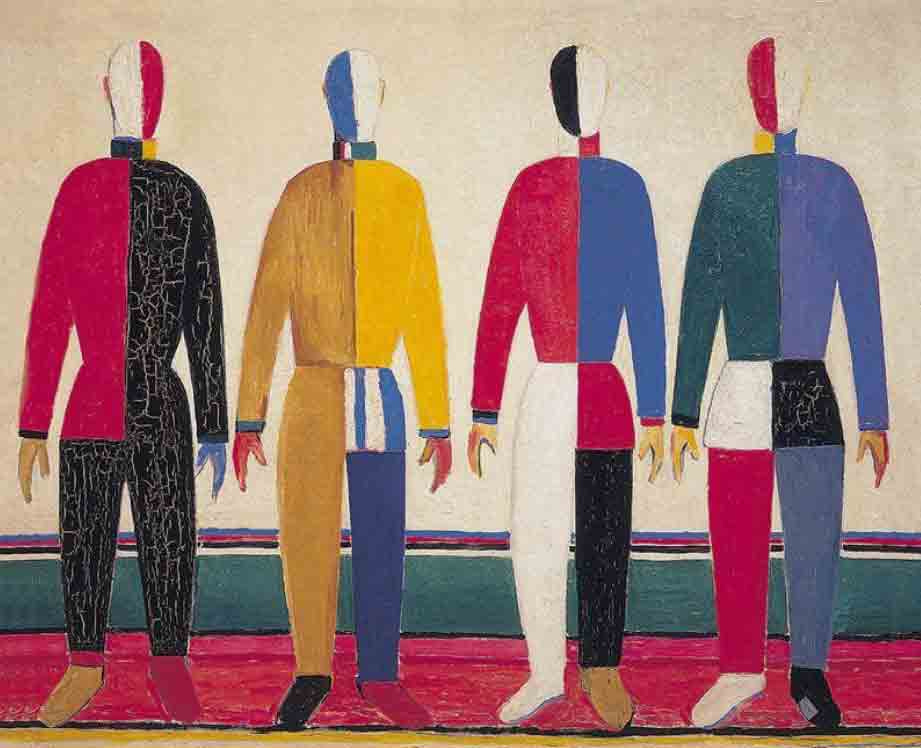
During the second decade of the twentieth century, many art movements dedicated to abstraction emerged. Suprematism, one of these movements that emerged in Russia and derived directly from Cubism and Futurism, was developed by the painter and theoretician Kasimir Malevich (1879-1935).
With the geometric style he invented, Malevich secured a place for himself at the forefront of early 20th-century avant-garde art. Malevich, who named this style Suprematism, stated that his aim was to “free art from the burden of the representational world.” In December 1915, Malevich exhibited his Suprematist works for the first time at the 0.10 Last Futurist Exhibition in St. Petersburg. He exhibited thirty-seven abstract paintings, including *Black Square on a White Background* (1913), which was inspired by the set and set designs he created for the Futurist opera *Victory Over the Sun*. The painting, which was mounted on a door at the 0.10 exhibition and depicted a large black square painted on a white background, resembled a traditional Russian family icon. All of Malevich’s other paintings in the exhibition also consisted solely of rectangular, circular, triangular, and cross motifs, as well as flat, smooth colors without tonal transitions, and contained no depictions of life.
To accompany the exhibition, he published an article titled “From Cubism and Futurism to Suprematism,” which traced the development of avant-garde movements from the beginning of the century. Malevich had previously exhibited his works, influenced by Cubism and Futurism, in 1912 alongside the German artist group Der Blaue Reiter (The Blue Rider) and the Russian artist group The Donkey’s Tail. He believed that by reducing all pictorial elements to simple geometric shapes, plain color blocks, and monochromatic tones, he had reached the pinnacle of artistic expression and stripped painting of all possible political and social meanings and associations. Rather than depicting the things they saw around them, the Suprematists eliminated all indirect, symbolic, and narrative content, reducing all elements to their simplest and purest forms, thereby reaching a point they believed to be a new creative reality.

Kasimir Malevich and the Meaning of Suprematism
Malevich once said that white was “the true color of infinity.” The white backgrounds in his paintings were intended to express space, distance, and continuity. At the same time, by limiting the rest of his palette to just a few colors, he emphasized the simplicity of the shapes that appeared to be randomly placed on the canvas. These abstract and flat shapes, by severing all connections to the outside world, encouraged viewers to shed all expectations in their minds and access mystical feelings and intuitions that were not based on any specific image or consciousness. Although he created all his paintings within a grid template, he succeeded in conveying a sense of movement through diagonals, oblique angles, and shapes arranged irregularly within the empty space.
In addition to Cubism and Futurism, Malevich was also influenced by primitive art; however, unlike these artistic styles, his images contained no references to the external world. In addition, he was influenced by mathematics, philosophy, and theories about the “fourth dimension.” The shapes, lines, and colors he used seemed to float across the canvas, detached from all familiar aspects of life. Malevich believed that by defying conventional patterns—and thereby shocking viewers who expected to see familiar or representational elements in his canvases—the “pure language” of painting reflected the artist’s inner world. Malevich described Suprematism as the “supremacy of pure emotion and perception” in the visual arts. It is no coincidence that this revolutionary art movement emerged around the same time as the 1917 Russian Revolution. Malevich and his followers, who supported the revolution, grounded Suprematism in ideals they believed would contribute to the construction of a new society where spiritual liberation would replace greed.
Suprematism, which sought to eliminate all physical connections with the world, aimed to achieve purity in a society that disregarded ethical values and rules. Malevich was not a religious man, but his approach to art was spiritual. In 1916, Malevich published *From Cubism and Futurism to Suprematism: The New Realism in Painting*, an expanded version of his 1915 essay. In this book—which can essentially be called the Suprematist Manifesto—Malevich stated that the Black Square established a “zero-form” that put an end to past traditions and heralded a new pictorial language. Malevich also addressed the three stages of Suprematism’s development, explaining that the first stage was black, the second was colorful, and the third was white. In 1918, for the final stage, he created a series of “white-on-white” paintings in which he completely eliminated color, though geometric shapes remained visible.
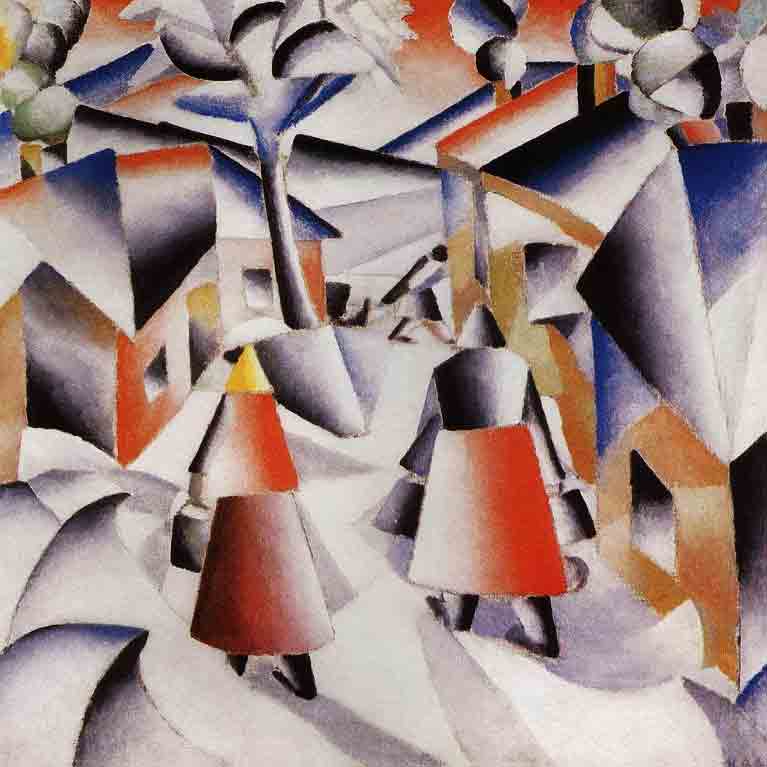
While the ideas underlying Suprematism were universal in some respects, in others they were entirely unique to Russia and lay outside the European tradition. For example, the similarities to Russian icon painting were intentional. Icon painting was a long-standing tradition, and many Russians held these ancient images in high esteem. In his early Suprematist works, Malevich drew black shapes, such as circles and crosses, on a white background. In doing so, he followed the lead of traditional icon compositions by placing the main object in the center of the canvas, opposite a symmetrical cross or a circular “halo.” In 1922, Malevich, along with other Suprematists, worked on three-dimensional pieces. In 1927, the Bauhaus published his book *The Non-Objective World*, in which he explained how his painting *Black Square on a White Background* came to be and outlined his theories on abstract art. Although this movement came under pressure following Stalin’s rise to power in 1924 and the emergence of the Socialist Realism movement in 1934, it nonetheless played a significant role in shaping the future of international art, architecture, and design.