
As an expression of truth and reality, the documentary should be one of the major mainstays of cinema. Bill Nichols, a renowned documentary expert, has argued that every film possesses qualities reminiscent of a documentary genre. This article will provide as comprehensive an overview as possible—albeit limited—of what the documentary style entails in cinema.
In this introductory piece, it would be appropriate to define the dividing lines between the documentary and fiction. The definition of the documentary in the book *An Introduction to Film Studies* is thought-provoking and meaningful: The lines separating the documentary from fiction have become as blurred as possible. Films accepted today under the label of “documentary” push the concepts of “truth” and “authenticity” to their absolute limits. It can be said that the films produced by the Lumière brothers in the early years of the 20th century were the first examples of the documentary genre. In her writings, Stella Bruzzi has noted that the history of the documentary has been misunderstood in most studies and analyses. This is because, in her view, the documentary genre acquires a new meaning with every new documentary film produced. According to Bruzzi, the documentary is a tradition with a very deep-rooted history. There are countless movements within the documentary. And as a tradition in its own right, the documentary has its own actors and artists.
Nevertheless, master directors—such as Robert Flaherty, Albert Maysles, Maya Deren, Errol Morris, Molly Dineen, Chris Marker, Nick Broomfield, Godfrey Reggio, and Frederick Wiseman—who are among the most prominent figures in documentary filmmaking, have brought the stories of “reality,” with its immense potential, to life. As we mentioned earlier, the Lumière brothers produced the first examples of this genre in Paris toward the end of the 19th century. The short film titled “La sortie des usines Lumière” (1895) is widely recognized by many film authorities as one of the earliest examples of this genre. The Lumière brothers’ films can be categorized under “event and live-action cinema.” In films classified under this term, there is no place for narrative techniques or characterization. The term “non-fiction films” was coined by Soviet filmmakers.
The Definition and Vision of Documentary Cinema
We owe the widespread and established definition of “documentary” to British director John Grierson. In a review he wrote about *Moana* (1925), directed by Robert Flathery, he provided the most accurate definition of the genre: “It is a creative approach to reality.” Dziga Vertov, who approached the critical and theoretical body of work on this genre from a new perspective, offered the following definition: “In this genre, the director approaches reality from many different angles to transform it. In his view, a world populated by discerning viewers will approach perfection.” Just like “fiction” films, “documentary” films also have their own distinct language and rules. Robert Flaherty’s use of lenses that allow for long-distance shooting is intended to achieve a distant and holistic view of objects and people standing close to the camera.
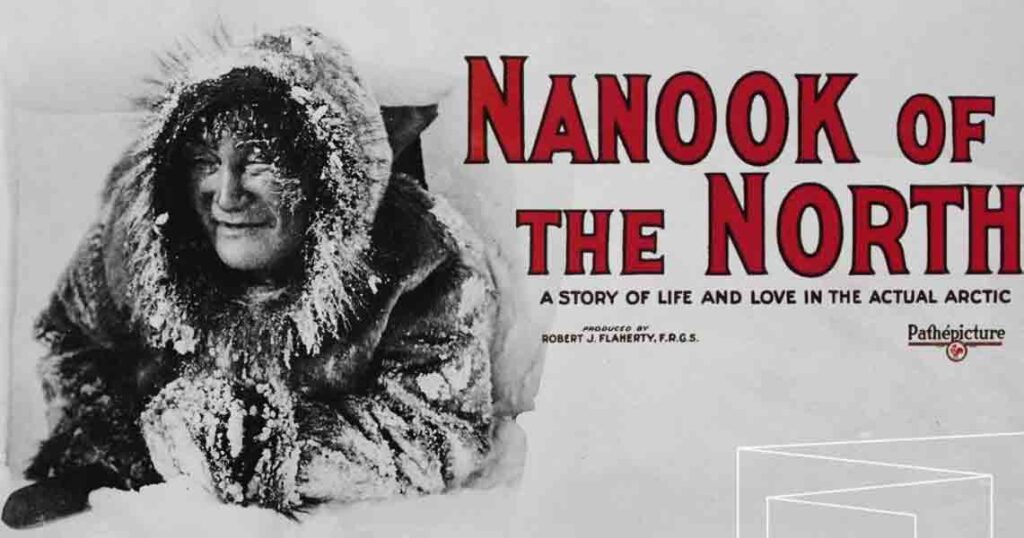
There may also be a sense of temporal distance. In this sense, Flaherty’s film *Nanook of the North* (1922) is based on his memories of the journeys he made from the North to Hudson Bay between 1910 and 1916. The film captures Inuit people hunting with guns during shoots in North America. Consequently, his cinematic practice demonstrates that the authenticity of documentary film could be called into question even in the very early days of cinema. While Flaherty made more humanistic and community-focused films, John Grierson focused on more political subjects and approaches. This approach would later be recognized as a distinct style in cinema; the Maysles brothers would use the term “direct cinema” to describe it. In short, the documentary approach can be summarized as a genre characterized by minimal artificial intervention in its editing, and by a directness rooted in realism, honesty, and a commitment to the location.
It is, of course, easy to list all these general characteristics one after another, but upon reflection, we realize that we have entered a rather controversial territory. In fact, when we delve a little deeper into the subject, we find ourselves right in the middle of philosophical debates about art and truth that have been ongoing for centuries. In their book *Film Art: An Introduction*—widely regarded as a cornerstone of film studies (and, however controversial it may be, serves as an introductory text for those wishing to delve deeper into film analysis)—David Bordwell and Kristin Thompson make the following observations regarding the documentary genre: “Just like fictional films, documentary films also have their own subgenres. Pointing out that fictional films also establish specific, sophisticated connections with contemporary reality, Bordwell and Thompson argue that the claim that the documentary represents absolute truth is highly debatable.
In this introduction, which seeks to define the documentary as a genre, it is also necessary to briefly touch upon the movement known as Third Cinema. This emerges as a form of guerrilla cinema based on collective production and distinguishing itself not so much through aesthetic choices as through areas such as distribution and screening. The following sentences very accurately summarize this approach known as “Third Cinema”: “The anti-imperialist struggles of the peoples of the Third World and of those segments of the colonial powers that share a similar fate with them constitute the main axis of the current world revolution.” Typically, documentary films have been viewed as far more realistic than fictional films. However, practical evidence reveals that this claim is quite controversial: Fiction and structuring are also quite evident in documentary films.
Are Documentary Films Fictional or Realistic
Thomas Austin points out that the way we focus the camera and view the world creates restrictive clichés in the documentary genre in ways never seen before. Bill Nichols points out that “the documentary is also a form of fiction (even if not fiction in the classical sense).” There is a very widespread and entrenched cliché that the documentary is a much more honest and noble endeavor than other “structured and fictionalized” works. However, there is an undeniable reality that my countless studies in this field since my twenties have revealed to me: material in this genre is organized, selected, and manipulated to a degree that is rarely considered.
While such choices are typically made during the screenplay stage in a fictional film, in documentary films they are made during the post-production phase. In recent years, many documentary films incorporating theatrical elements—such as *Roger and Me* (Michael Moore, 1989), *Grizzly Man* (Werner Herzog, 2005), *Into Great Silence* (Philip Gröning, 2005), *Tell Them Who You Are* (Mark Wexler, 2004) Being and Doing (Ken McMullen, 1984), and March of the Penguins (Luc Jacquet, 2005). These works represent instances where the documentary genre has come closer to “cinema” in the classical sense.
In these new wave documentaries, characterized by a diversity of central themes and experimentation with different presentation styles, the documentary genre is approaching “cinema” (fictional cinema) in the classical sense. Most of the documentary films we are discussing here are works that can unabashedly present both dimensions of the story (the real and the fictional). Films such as *The Seventh Seal* and *Roma, città aperta*, which were discussed in detail in previous articles, are fictional films that do not seek to artificially separate the “fictional” from the “real.”