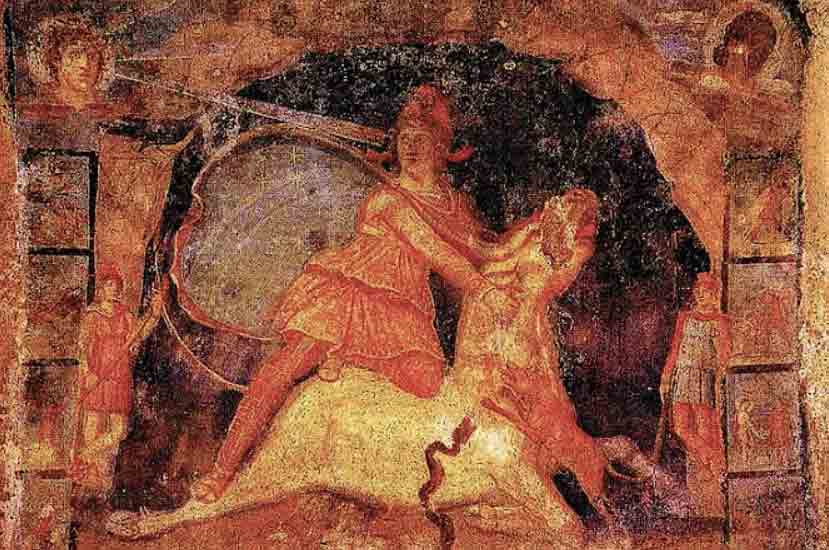
The cult of Mithras emerged as a result of the fusion of certain elements of Indo-Iranian cultures. It subsequently exerted significant influence on many empires, including the Roman Empire. We will examine the foundations of the Mithraism, the sources that influenced it, its institutionalization, and its impact on Rome.
Mithraism (or Mithraism) was a mysterious religious culture that spread throughout the ancient Roman Empire from the 1st to the 4th century. Its origins trace back to the god Mithra in Iran, though the Roman version developed its own distinct mythology and iconography. This religion was particularly popular among soldiers, merchants, and bureaucrats and was a mystery religion characterized by secret rituals that excluded women. Mithraism is associated with the sun god Sol and emphasizes themes of salvation and loyalty. From an etymological and source-based perspective, Mitra appears in Vedic literature, the Avesta, and works from the Achaemenid period, this word—written and pronounced as Mithra in Old Persian inscriptions, Mithr in Pahlavi, Mithras in Latin, and Mihr in modern Persian—has been used for several thousand years as the name of a divine being venerated and praised from India to England.
Today, the word “mihr” in Persian is still used to denote a covenant, a contract, affection, and the sun. It is also known that the seventh month of the Solar Iranian calendar currently in use in Iran, as well as the sixteenth day of each month, is named “Mihr.” In the Torah, the name of Cyrus’s treasurer is recorded as Mitredat. In Zoroastrianism, since Mihr is one of the Yazatas—divine beings—it is known that the name was chosen for many Zoroastrian temples (atashgards), and that practicing Zoroastrians still refer to their temples as the “Gate of Mihr.” The word “mith,” used in India and sharing the same root as “Mitra,” is used to mean “to join,” “to reach,” “to connect,” and “to be placed somewhere.” Similarly, the word “maethanya,” found in the Avesta, is used to mean “home” and “shelter.”
The word “mihen,” used in modern Persian and translated as “homeland,” actually means “home,” “hearth,” and “shelter” and shares a common root with the word “mihr.” The word “mihman,” used today to mean “guest,” also shares roughly the same root, signifying “one who stays,” “settles,” and “takes shelter.” Mithraism is regarded as a religious sect centered around Mithra, the Indo-Iranian god. In Egypt, Osiris; in Syria, Adonis; in Iran, Mithra; in Greece, Dionysus; and in Italy, Bacchus—the theme of the human who dies and is reborn has been portrayed as the “god-man.” However, with the exception of Mithras, all of these are associated with a goddess—such as Isis, Cybele, and Demeter. In Mithraism, there is no female figure. While the narrative of death and resurrection is present in the other figures, this is not the case in Mithraism.
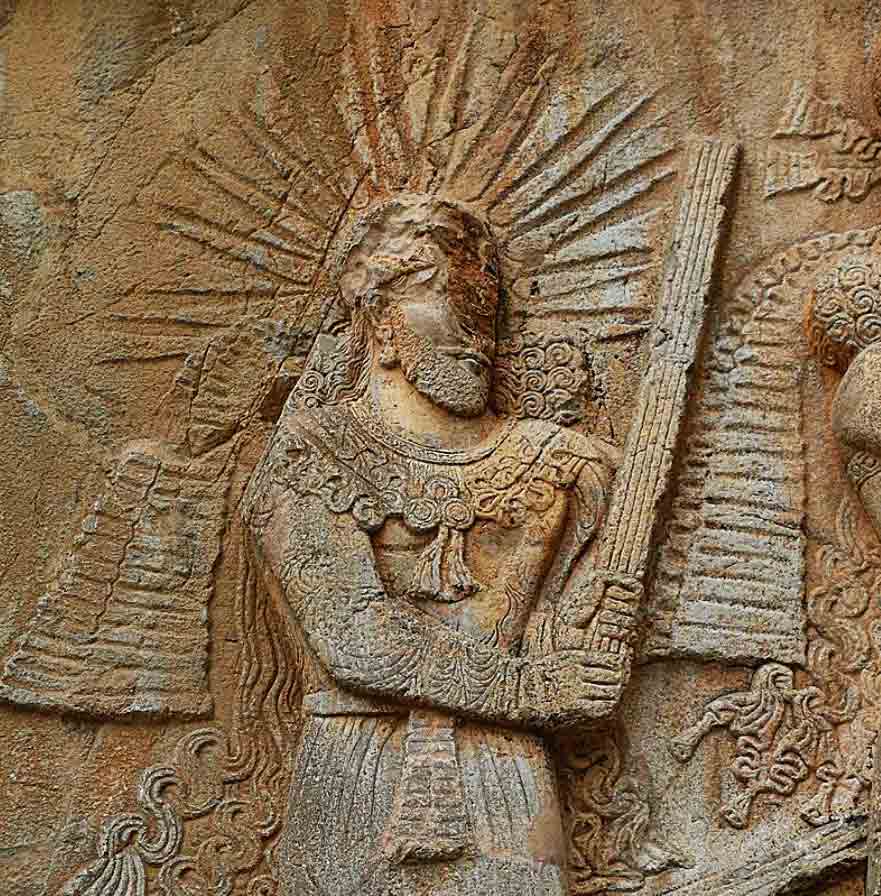
While the other figures are associated with the moon, Mithras is identified with the sun. Mithras is depicted alongside a bull, but he kills and sacrifices it. However, in iconography, the depiction of a lion takes center stage. While wheat ears and grape clusters are prominent in other deities, the symbols in Mithraism are different. The region where Mithra was first encountered is India. He is considered an Aryan god, but some researchers believe that Mithra emerged as a result of the Aryans’ interactions with Mesopotamia. In Hindu mythology, the Vedas are accepted as the primary source. The Vedas—the collection of sacred texts of Hinduism, considered among the world’s oldest religious texts and estimated to have been compiled between approximately 2000 and 1000 BCE—are known as the first source to mention Mithra.
Based on the principle that religious texts in Hindu-Iranian culture should be inscribed only on the tablets of the heart and not defiled by writing—like human laws—so as not to fall into the hands of the unworthy and be trampled underfoot, Mitra appears in the Vedas—which are believed to have been recorded only after being transmitted orally for centuries—as a relatively minor angel, archetype, or divine being. In the Rigveda—the first and oldest section of the Vedas—while there is only one standalone section dedicated to Mitra, he is regarded as a sacred being whose name frequently appears alongside other divine entities throughout the other sections. Although Mitra is sometimes mentioned in the Rigveda texts as a punisher of liars and evildoers, he is mostly portrayed as merciful, protective, and benevolent.
Another stop on Mitra’s journey is Iran. Although it bears similarities to the belief system in India, Mitra holds a different position in Iran. In Iran, Mitra manifested in different forms during the pre-Zoroastrian period, the Zoroastrian period, and the post-Zoroastrian period. In pre-Zoroastrian Iran, Mitra was revered as the god of light and truth, just as in Hinduism. It was believed that he saw everything in the light and judged people equally in this way. At the same time, since “Mitra” also means “covenant” or “agreement,” it is accepted that Mitra was deified in the context of a covenant. Information regarding pre-Zoroastrian Mitra worship is limited. The mention of Mitra in Avesta theology confirms the existence of the concept. The name “Mitra” is encountered in the seven-part Yasna text attributed to believers shortly after Zoroaster. In the Avesta, Mitra is symbolized by the sun. It is accepted that Mithra is not the sun itself, but rather that the sun is a manifestation or embodiment of him; ultimately, he is regarded as a distinct entity from the sun—the invisible source or archetype behind the sun’s active power to heat and illuminate.
The Influence of Mithraism on the Roman Empire
Its mythology draws inspiration from Zoroastrianism but was adapted in Rome; Mithras is viewed as the “Demiurge” (creator) and “lord of procreation.” Astral symbolism is strong; the cave represents the world, and the rituals allude to Zoroaster’s cave blessing. As a mystery religion, Mithraism did not hold public ceremonies; rituals took place in underground temples (mithraea). Mithraea were cave-like structures—converted basements or natural caves—that contained stone benches, water sources, and tauroctony reliefs. An estimated 680 mithraea were concentrated in Rome.
The Roman Empire, which emerged during the Parthian period—the great post-Achaemenid Iranian empire established between 250 B.C. and A.D. 228—shared nearly the entire known world of that time with Iran. Having strengthened their central administration, the Romans advanced eastward with ease through Anatolia. Although Roman soldiers, who rapidly conquered ancient Iranian territories—including Pontus and Cappadocia—returned victorious, they were greatly influenced by Iranian culture, civilization, and beliefs, and carried this legacy with them all the way into Europe. In this context, the spread of Mithraism in the Roman Empire is generally considered to have begun with Pompey’s conquest of Cilicia in 67 B.C. Plutarch wrote that Pompey organized intriguing sacrificial ceremonies on Mount Olympus and performed mysterious rites alongside followers of Mithras. (Plutarch was a Greek historian, biographer, and essayist who lived in the 1st century AD.)
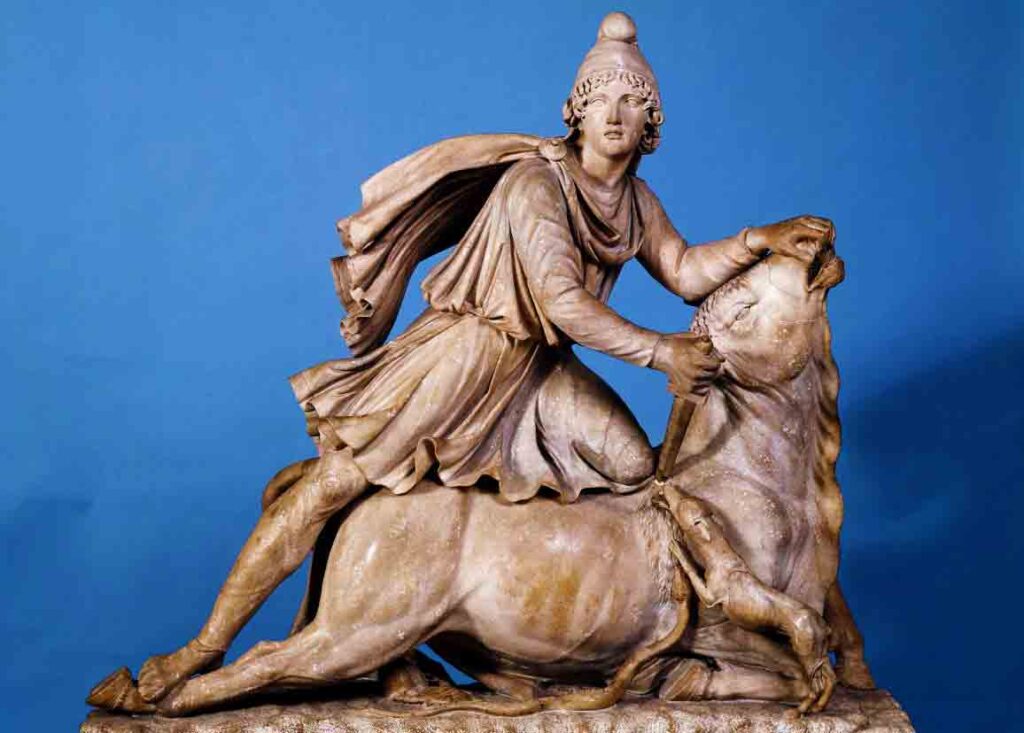
It has been suggested that Iranians lived in the Cilician region during that period and adhered to the faith of Mithras, the invincible god of war; their priests were called magi, and Mithraic beliefs spread to Rome through such kingdoms. The Romans observed that Mithras—the god of light, truth, and justice—was constantly at war with evil; that he instilled in his followers the discipline of an organization that had sworn to keep one’s word, honor one’s commitments, never stray from truth, act with integrity, and live with honor, as if bound together by a sacred oath. They realized just how crucial the loyalty, sincerity, unity, solidarity, and true brotherhood that Mithraism would bring—for both the Roman military and the general populace—would be in safeguarding their vast, scattered, and heterogeneous empire.
Once again, Roman thought adopted Mithraism’s concept of creating an ideal and flawless human being embodying the qualities of purity, cleanliness, spiritual purification, and chastity. As can be inferred from Mithraic drawings, paintings, and inscriptions, the initiation rituals into Mithraism required a process akin to joining a military organization. This is because Mithraists viewed life on earth as a holy war waged in the name of God. With unwavering faith, Mithraists believed they were constantly protected by the god Mithra and that Mithra was with them on the battlefield or while hunting.
Soldiers and warriors, who were generally Mithraists, were conscious that, like Mithra—the god of light, honesty, covenant, and loyalty—they were champions of keeping one’s word, fulfilling one’s oath, piety, virtue, and asceticism. For this reason, Mithraism prepared its adherents to uphold moral values such as honor, dignity, pride, and respect. Its military-style organization and discipline facilitated the rapid spread of Mithraism among the Romans and its attainment of official status. However, since armies based on order and discipline were, at that time, exclusively male domains, no signs or symbols indicating women’s participation in Mithraism have survived to the present day.