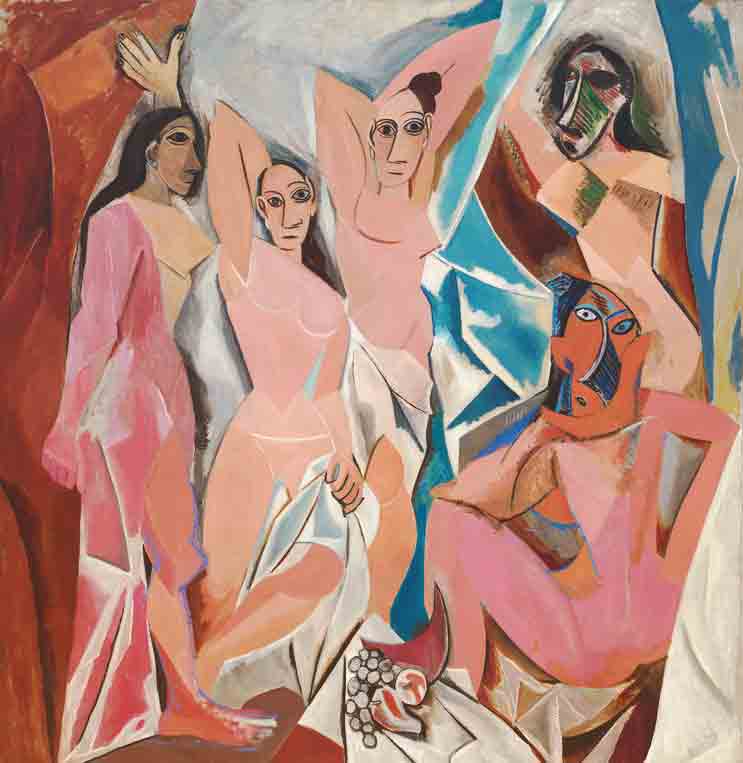
Every avant-garde movement in art has elicited reactions commensurate with the revolutionary upheaval it caused. “Les Demoiselles d’Avignon,” one of the most significant works of the 20th century and a key example of avant-garde approaches that opened new perspectives on artistic and creative freedom, drew strong criticism—even from Pablo Picasso’s close artist friends—due to its creative logic and perspective on nature.
In this work, created in 1907, Picasso was influenced by the works of many artists. As Picasso stated, “I take what I need from other artists’ works,” and it is evident that, alongside these artists’ works, he questioned the connection between these objects and his own life. In the context of art analysis, the period in which the artist lived, his surroundings, and the social, political, and psychological environment all find expression in “Les Demoiselles d’Avignon.” Everything is as it should be in a work of art. Regardless of the extent of its inspiration, this work has succeeded in becoming one of the defining masterpieces of art history by subverting the classical perspective rules of the Renaissance and enriching the range of viewpoints. In the winter of 1906–07, Picasso began working on *Les Demoiselles d’Avignon* and locked himself in his studio to finish the painting. This work, which was based on numerous sketches, was completed by the end of 1907 as a canvas painting measuring approximately six square meters.
The Creation Process and Initial Impressions of Les Demoiselles d’Avignon
When Picasso finished the painting and opened the doors of his studio to his friends, the reaction was one of astonishment, shock, and unease. No words could adequately express the impressions of even his closest friends upon seeing this new painting. Not a single person who saw it liked it. In fact, a well-known art critic politely advised Picasso to turn to caricature. Even Stchoukine, who loved Picasso dearly, said with sadness, “What a great disaster for French art.” No one had expected such a break with tradition in the art of painting. Consequently, the artists around Picasso took a stand, even at the cost of ending their friendships or walking away. Even Picasso’s close friends—such as the poet Max Jacob, André Salmon, and Guillaume Apollinaire; the art critic Maurice Raynal; and the painter Kess Van Dongen—took a negative stance toward this new artistic language, much to the surprise of Felix Feneon, the art dealer Ambroise Vollard, and Wilhelm Uhde.
Braque, who went to see *Les Demoiselles d’Avignon* accompanied by Apollinaire, told Picasso, “With this painting, it’s as if you’re asking us to eat rope or drink kerosene.” Everyone who saw this painting was in a state of shock. Because until that time, no one had ever shown such audacity. Perhaps what Braque said was very harsh coming from a friend—and it was almost as if he were trying to completely destroy the other person in an instant—but the artist was treated unfairly because examining a work’s underlying structure is a crucial factor in its evaluation and interpretation. The “Les Demoiselles d’Avignon,” which occupied Picasso for a long time during his preparatory work, holds a mind-boggling place in Picasso’s life and certainly deserves a section in this narrative dedicated solely to it.
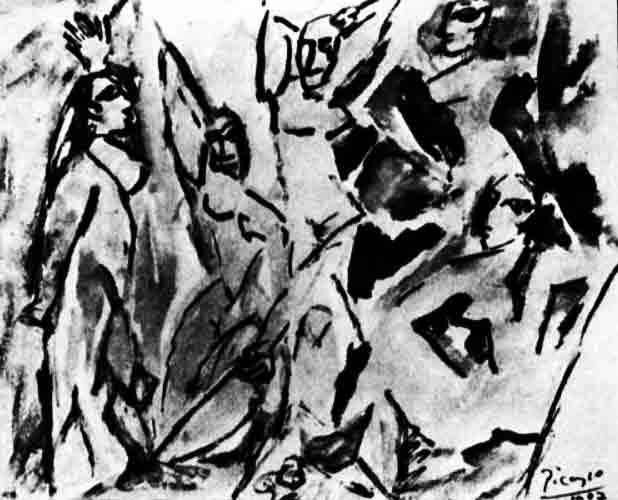
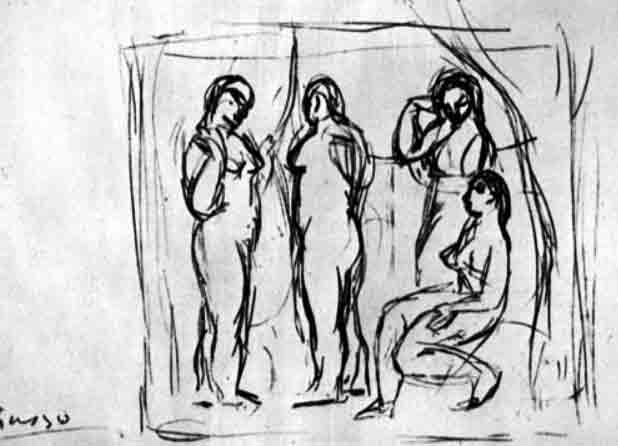
In 1906, when his friends at Betau-Lavoir gathered around some sketches for lunch—that is, during the painting’s incubation period—Picasso, buried deep in his coat and in a reclusive frame of mind, kept scribbling in his sketchbook, intensely focused on the original painting. The painting, which was given various names such as “The Philosophical Brothel” or *Le Bordel d’Avignon* while it hung in Picasso’s studio, was initially a seven-figure brothel composition executed in watercolor. It features five nude women, a sailor, and a medical student. In the next version, the last two figures have disappeared. The student has been replaced by a nude woman lifting a curtain. Norbert Lynton explains that the removal of these figures was intended to reduce the narrative quality of the paintings and to encourage viewers to establish a direct connection with the figures in the paintings rather than simply consuming them passively.
William R. Everdell supports this idea and states that “by excluding two figures—a sailor and a medical student—from the composition, the artist draws the viewers into the scene; ever since then, anyone looking at the painting has been placed in the position of a client facing five enormous prostitutes who stare directly at them.” The reason John Richardson bestowed upon Picasso the title “Painter of Modern Life”—a designation now widely accepted—is this world-famous painting known as *Les Demoiselles d’Avignon*. The title was given by André Salmon when the painting was taken to the Salon d’Antin for exhibition in 1916. In giving the painting this title—and bearing in mind that it was a clear allusion to harem paintings featuring nude women—Salmon had in mind the brothel on Carrer d’Avinyo in Barcelona; he also made an ironic reference to Max Jacob’s grandmother from Avignon.
Picasso was uncomfortable with the title being changed to *Les Demoiselles d’Avignon* in an effort to keep the word “brothel” within the bounds of propriety. He insisted that such a scene could not possibly be found on Carrer d’Avinyo, that it was a fabricated story, that the street was a respectable one, and that the characters depicted were fictional. However, Picasso had originally titled the painting *Mon Bordel* (“My Brothel”; the word *bordel* also means “confusion”), and both Avignons referenced in the work are actually connected to this title. This is because the name Avignon would play—and was playing—a significant role in Picasso’s life and death. Picasso would choose this city for his 1970 exhibition and for the final, magnificent exhibition he organized in 1973; he and Braque would create their last paintings here.
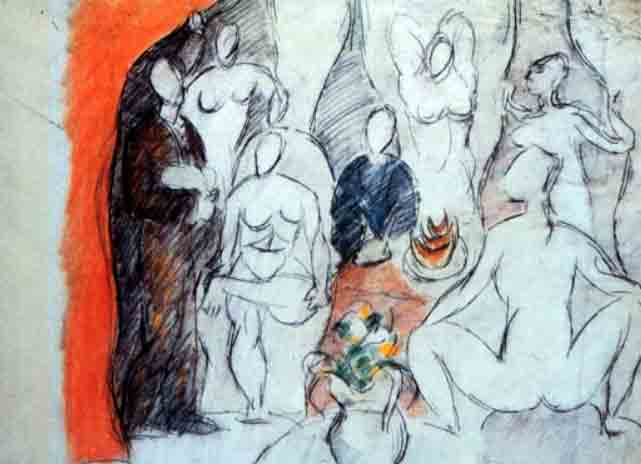
If the inspiration for *Les Demoiselles d’Avignon* had come solely from a brothel in Barcelona, Picasso would have painted Degas-style, uniform prostitutes. In the spring of 1907, Picasso created a nude study with raised arms and sketches featuring hand studies drawn from behind. Meyer Schapiro noted that the figure of the fruit-picker at the center of one of Picasso’s *Nudes with Raised Arms* (1907) drawings—a motif always present in Gauguin’s massive painting *Where Do We Come From? ” into a woman who, in the final years of his life, raised her arms in a sincere gesture, as if in supplication. He draws attention to “the spontaneity of form, purposeful energy” and “the appearance of wildness and intensity, the wild expression.” Picasso drew directly on numerous elements in his painting *The Girls of Avignon*.
Key Figures Who Influenced Picasso in The Girls of Avignon
When his artistic career hit a dead end, he often found a way out by adapting other artists’ visual themes and techniques to his own purposes. The central figures that influenced Picasso and were incorporated into his work *Les Demoiselles d’Avignon* bear a very strong resemblance in posture to the figures in Matisse’s *The Joy of Life*. Picasso seems to have had no qualms about adopting these figure poses in his work. “Matisse caused a sensation in 1906 with his large-scale painting *The Joy of Life*, his sole entry in the Salon des Indépendants exhibition; this work even unsettled his admirers.” It feels as though Picasso—perhaps in reaction to this painting, or perhaps by attempting to turn Matisse’s negative reactions into an opportunity—interpreted his rival’s (with whom he was known to be in a silent competition) negative moment as a positive response for himself.
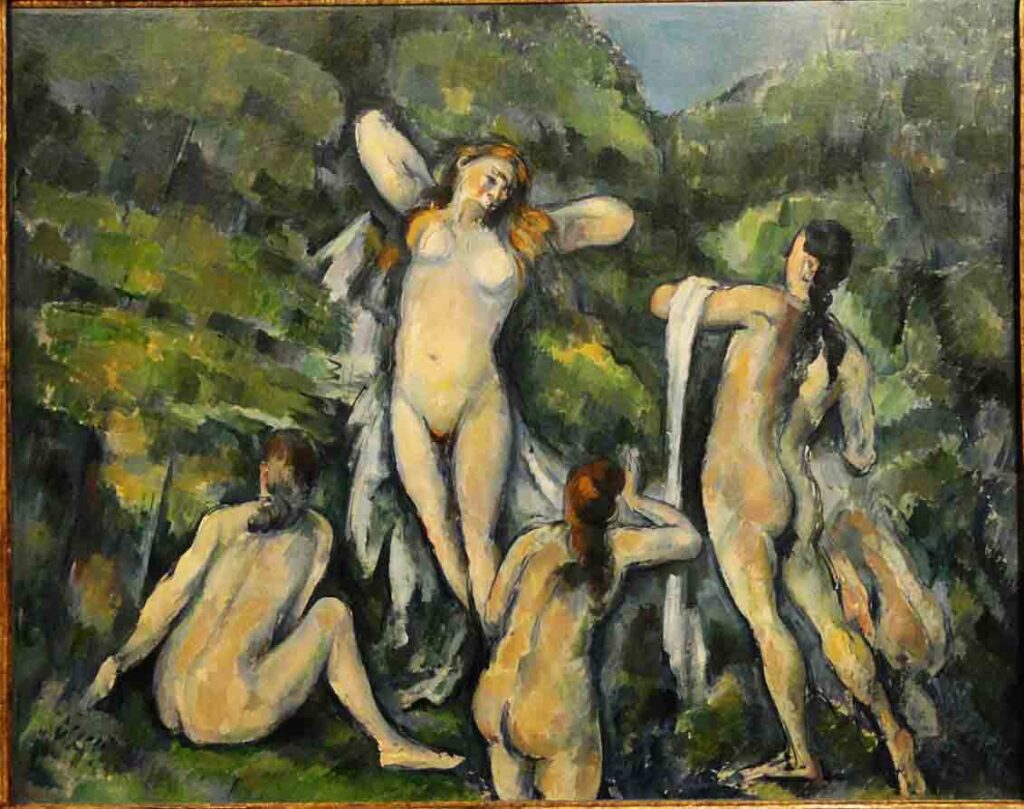
Edouard Manet’s painting *Breakfast in the Countryside* served as a source of inspiration for Matisse, while Matisse’s work, in turn, served as a source for Picasso. In the graphic composition of *Les Demoiselles d’Avignon*, El Greco’s painting *The Visitation* is incorporated: the central figures represent Matisse; the two figures on the right and one on the left represent African busts; and the African-masked figure seated on the right includes a figure from Cézanne’s *The Bathers*. *Les Demoiselles d’Avignon* launched the Cubist revolution—a complete break and a radical renewal unlike anything art history had ever seen. Early analyses of this work indicate that Picasso drew inspiration for the composition from Cézanne and his *Bathers* series. But he took Cézanne’s initiative further—far enough to achieve a genuine qualitative transformation; first, he carried the break from natural forms to its logical conclusion; then, he created human figures within a presentation where the fundamental elements were not detached from reality; and finally, he devised compositions such that the eye is often drawn to the surface of the canvas.
Another aspect of this work reveals the European perspective on a race other than their own. The image of the Black woman—while perceived as feminine—also reflects an impulse to be different, to capture distinct perspectives, and to bring current trends to the forefront, all while emphasizing the Black race, which is treated as second-class in every respect. With this starting point, Picasso attempted a radical return to “the source.” The way he approached life in his works bears a resemblance to the approach of 19th-century exoticist writers and painters toward non-European cultures. However, these artists (Paul Gauguin, Lafcadio Hearn, and Pierre Loti) depicted Japan and the Tropics in particular as a kind of paradise; at times, their own longing to experience these places transformed their works into autobiographical confessions. Of course, Picasso was far removed from this.
“Les Demoiselles d’Avignon” is not a belief in a foreign way of life but rather in a foreign aesthetic. Drawing inspiration from African masks constitutes an attack on the idealistic notions of European art. In Picasso’s creation, the artwork first and foremost becomes a document of rebellion. The forms visible in the painting also signify the destruction of a world of forms: creation and destruction have become one and the same. Picasso’s art retains this dual character until the end of his life. The African influence did not merely attract attention in Europe at that time for its exoticism; it also seemed more fantastical from a sexual perspective. The terrifying power of beauty—the contrast between the beauty of the white race and that of dark-skinned, magnificent, alluring people—spills over into films and cabarets. The fact that this allure is presented within the context of a brothel is a consequence of all these ideas. Many elements have come together in this work through an eclectic logic.
The foundation of this work reveals the influence of the landscapes Picasso brought from Horta in 1909—a time marked by the geometric fragmentation of nature and urban layouts in Spain, where he lived until the age of 21. Gertrude Stein, who took photographs of the locations where these paintings were created, used these photographs—along with the geometric structure of Spanish souvenirs (cadre cadre)—to argue that Cubism stemmed from Spain’s natural philosophy and topography. In *Les Demoiselles d’Avignon*, Picasso depicted women in a more “animalistic” manner than they had been portrayed in centuries. In fact, the seated woman in this painting is a startling replica of the seated female figure in Cézanne’s work *The Bathers*. It is an assault on the desolation, sickness, ugliness, and cruelty of life. It is filled with violence, for its purpose is to shatter and dismantle civilization. The women here are depicted with expressionless faces, devoid of any charm or sadness, their “eyes like stakes gazing toward death.”
This painting marks the beginning of Cubism. Picasso’s genius is close to the primitive and the magical. Picasso commands objects and asserts his ownership by shaping them into whatever form he desires. He plays with them by transforming one object into another. The paintings merge with the viewer. Even a dismembered body establishes a profound sense of intimacy. The distances between them vanish. In Picasso’s work, fragmentation is carried out with the hope of creating a new whole.4 The figure seated in the lower right corner of the painting is the first figure in Western art to be seen from all four sides simultaneously. This section, therefore, would form the logic of the Analytical period in Cubism. As Robert Penrose put it, “When the ‘five prostitutes’ in *Les Demoiselles d’Avignon* appear before the viewer, the perspective system used since the Renaissance is overturned, and everything begins to be seen from different angles. Instead of the single gaze of Manet’s *Olympia*, we see five distinct encounters.”
What makes *Les Demoiselles d’Avignon* significant is not its eclectic characteristics, but the perspective and contributions it offers to modern art. By employing a method of art analysis that integrates all data—including the artist’s memory and the entire social and psychological context of his life—within a logical framework, the artist succeeded in creating one of the most renowned works of modern painting, despite all odds. Despite the reactions to this painting, Picasso earned his status as a pioneer of modern painting by successfully embodying the importance of artistic freedom in creative activity—a status he earned through his ability to successfully integrate science, technology, the developments of his era, literature, his living environment and emotions, the history of art, and the characteristics of following in the footsteps of great artists.