Toward the end of the 19th century, a group of enthusiastic artists and designers set out to create an international and modern style. This art and design movement emerged in many ways as a reaction to the Industrial Revolution. Although its fundamental principles remained similar, as Art Nouveau (New Art) spread throughout the world, it was interpreted in different ways in each country, giving rise to various factions.
Beginning in the 1890s, the idea began to take shape that a completely new style of art and design—one that would herald the new millennium—needed to emerge. Around the world, artists and designers were either embracing new technologies, inventions, and materials or rejecting mass-produced goods in favor of the past. The resulting Art Nouveau was a combination of a wide variety of images and ideas—often contradictory—produced by different practitioners on a global scale. The Art Nouveau movement aimed to take art beyond what people saw on gallery walls and to break down the barriers between the fine arts and the applied arts (crafts). Curved Lines Many Art Nouveau artists and designers passionately argued that decorative arts should be elevated to the status of fine arts and that art and design should move away from retrospective and conservative ideas.
Influenced as much by Symbolism as by Celtic and Japanese art, this movement led to the simplification of many of the flamboyant and overly ornate Victorian styles that were prevalent at the time. Although it had effectively ended by 1905, as a influential and widespread movement, it continued to have significant effects on art and design throughout the 20th century. Interpreted by some as an art form and by others as a design style, Art Nouveau’s characteristic features included highly stylized, curvilinear, flat, arched, and asymmetrical shapes, organic forms, and rhythmic, decorative motifs. The female figure, animals, and plants—particularly flowers, leaves, vine tendrils, flowing hair, and feathers—were frequently used. Among the modern and innovative materials employed, glass, lead-tin alloy, iron, and silver stood out. Colors were used either in a soft and understated manner or, as in Japanese prints, in a bold and vibrant way.
The Emergence of Secessionism
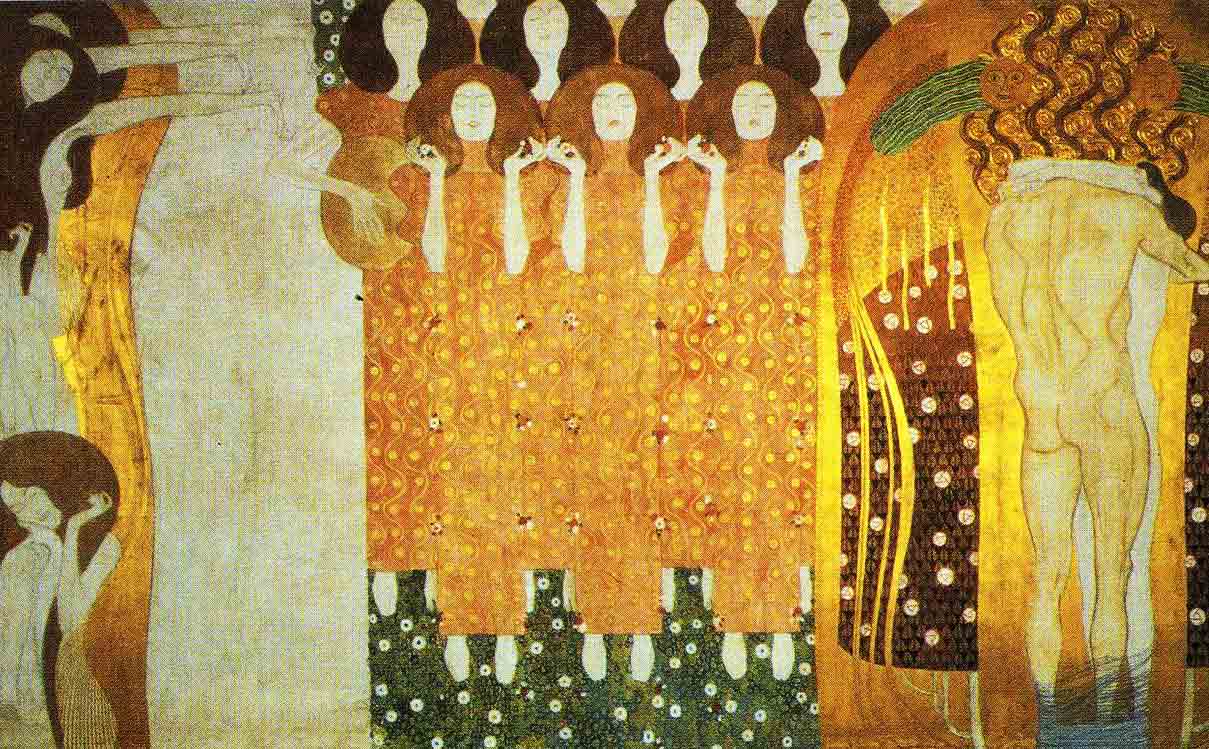
In Austria, a local form of Art Nouveau—also known as Sezessionstil (Secession Style)—was practiced by the artists of the Vienna Secession. This movement, composed of painters, sculptors, and architects, was launched on April 3, 1897, by artists including Gustav Klimt (1862–1918), Koloman Moser (1868–1918) , Josef Hoffmann (1870–1956), and Joseph Maria Olbrich (1867–1908). Klimt became the group’s first president. The Secessionist artists opposed the outdated and rigid conservatism of the Künstlerhaus, Vienna’s official exhibition hall, and strove to showcase the works of more progressive artists. Although the Vienna Secession lacked a unified style, its members were united in their desire to explore artistic possibilities beyond the constraints of the academic tradition. They hoped to create an entirely new style. At the entrance to the Secession building was the slogan, “To every age its own art, and freedom for art.” They disseminated their ideas through a magazine titled *Ver Sacrum* (Sacred Spring), which they adorned with drawings in the decorative Secessionist style.
The name Art Nouveau comes from an interior design gallery specializing in modern art that opened in Paris in 1896. Art Nouveau was known by different names in different countries. In Germany, it was known as Jugendstil, which was also the name of a magazine. In Italy, it was known as “Floreale” or “Stile Liberty,” after the name of the London store owned by Arthur Lasenby Liberty. In Spain, it was called “Modernista”; in France, “Modern Style” (Style Nouille—Noodle Style); and in Austria, “Sezessionstil” (Secession Style).
Art Nouveau is Gaining Acceptance in The Art World
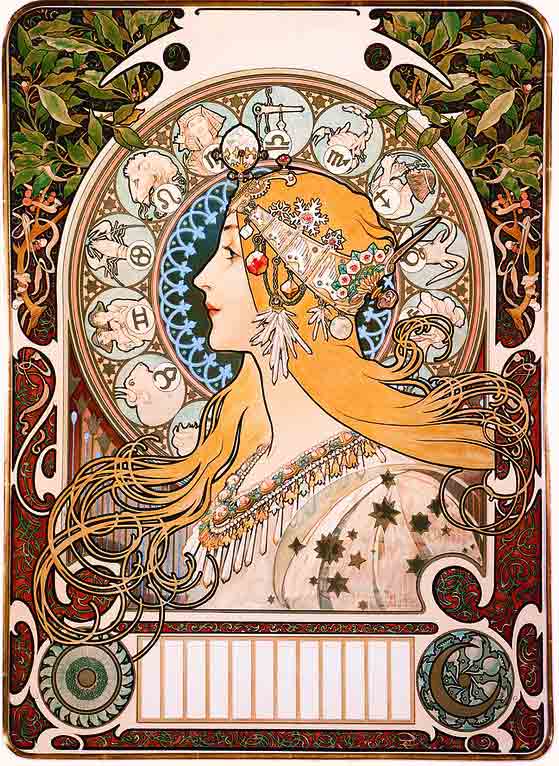
As an international movement that emerged as a reaction to 19th-century academic art, Art Nouveau’s organic, natural, and fluid forms could be seen everywhere—from the visual arts to furniture, and from architecture to jewelry—as art became an integral part of daily life. Arthur Heygate Mackmurdo (1851–1942) and Alphonse Mucha (1860–1939) had a strong influence on this movement in its early stages. In 1883, Mackmurdo’s asymmetrical, curvilinear, and unconventional cover design for the book *Wren’s City Churches* caused a major sensation. In 1894, Mucha created a promotional poster for the play *Gismonda*, starring Sarah Bernhardt. The elongated figures and fluid design heightened interest in this new artistic style.
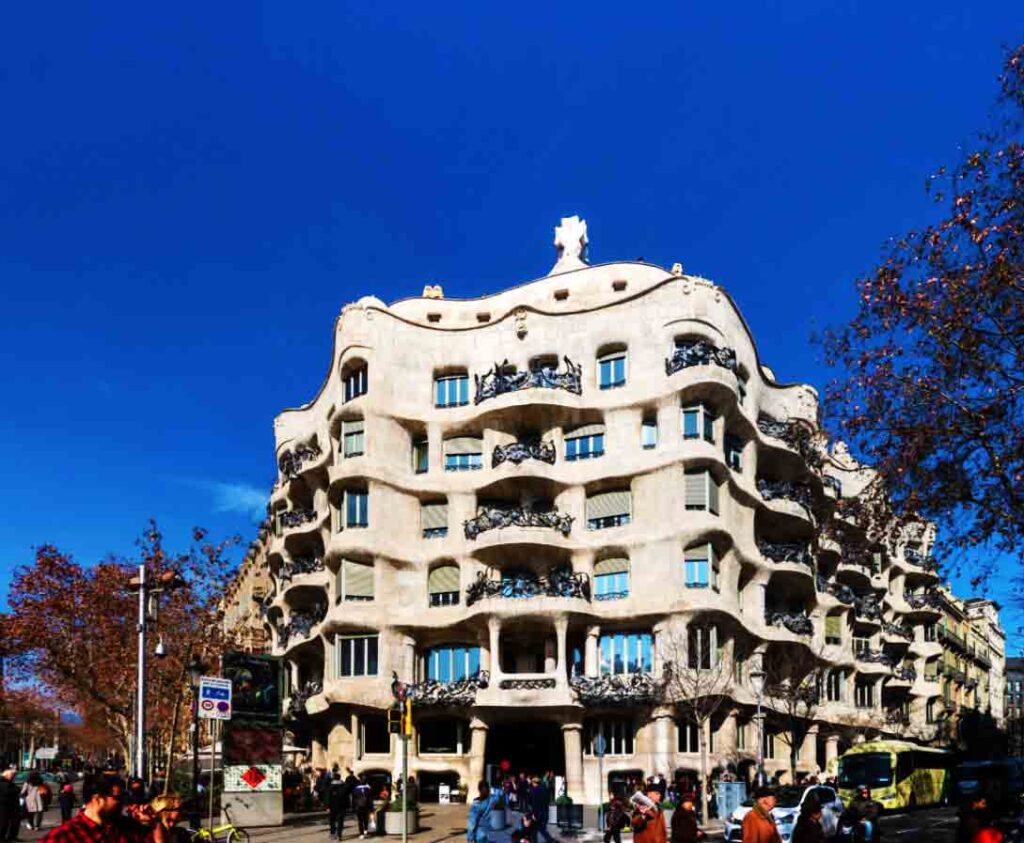
For a time, it was called the Mucha Style in honor of Mucha’s approach. Subsequently, the influence of new Art Nouveau-style works—mostly produced in Europe—spread throughout the world over time. Klimt and Mucha; illustrators Aubrey Beardsley (1872–98) and Walter Crane (1845–1915); architects Henry van de Yelde (1863–1957), Victor Horta (1861–1947), and Antonio Gaudí (1852–1926), Hector Guimard (1867–1942), Louis Sullivan (1856–1924), and architect, designer, and artist Charles Rennie Mackintosh (1868–1928); jewelry designer René Lalique (1860–1945), and glassware designers Louis Comfort Tiffany (1848–1933) and Émile Gaile (1846–1904) are among the iconic figures of this style.
All these artists and designers, hailing from different countries and following the Art Nouveau aesthetic, produced entirely original works and interpreted the style in their own unique ways. Whether it was an advertising poster, a piece of jewelry, a building, or a sculpture, all forms of expression were open to Art Nouveau applications. Art Nouveau was more than just a style for modern society. It was a way of thinking about modern society and new production methods, as well as an effort to redefine what a work of art signifies. The idea that an artistic style could encompass everything from everyday objects to buildings and be considered part of the fine arts was an entirely new concept. It continued to influence various art and design movements of the 20th century.
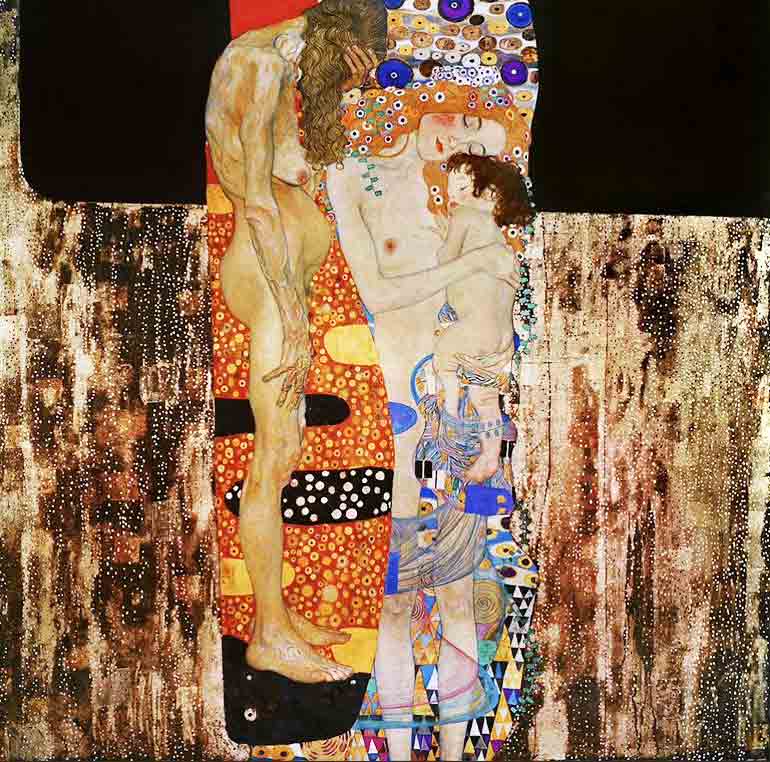
Gustav Klimt’s The Three Ages of Woman
Also known as “Mother and Child,” this painting is Klimt’s first major oil painting and depicts the three main stages of a woman’s life: infancy, motherhood, and old age. Working in the Secessionist (Art Nouveau) style, Klimt elongated the figures while also surrounding them with fluid, undulating contours and decorative effects. This visual is a painting classified under the fine arts category. However, with its patterns, curves, colors, and texture, it also straddles the boundaries of design. The influence of Symbolism is evident. Indeed, Klimt himself said, “Anyone who wants to know anything about me—especially as an artist—should look closely at my paintings and try to see in them who I am and what I am trying to do.”