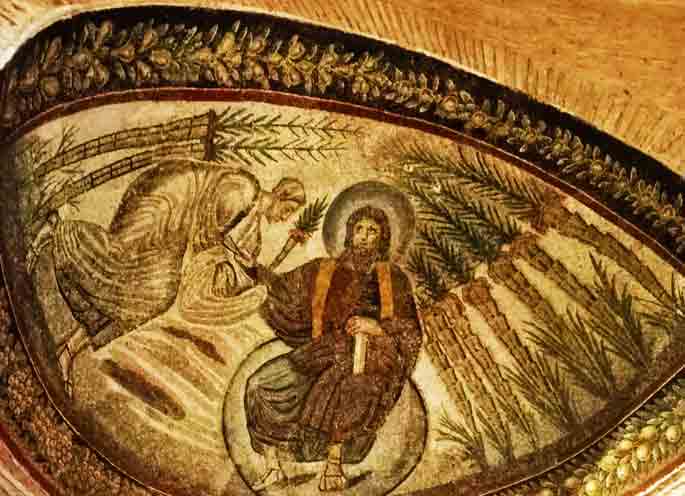
Examples of frescoes and mosaics from the Early Christian, Byzantine, and Roman periods. Artistic works found in architectural structures, including wall and ceiling paintings, frescoes, and mosaics, and their analysis.
During the Greek and, especially, the Roman periods, people were surrounded by images. Homes, tombs, and public buildings were adorned not only with frescoes and stucco work but also with a small number of wall, vault, and floor mosaics. During the Early Christian Period, many churches were added to these structures. In addition, paintings on wooden panels and illuminated manuscripts were also produced. “You shall not make for yourself an idol; you shall not make any likeness of anything that is in heaven above, or that is on the earth beneath, or that is in the water under the earth; you shall not bow down to them or worship them” (Exodus 20:4–5); “You shall not make for yourselves any idols, nor shall you set up for yourselves a carved image or a pillar, nor shall you erect a carved stone in your land to bow down before it; for I am the Lord your God” (Leviticus 26, Deuteronomy)—due to this prohibition, Christians initially opposed the creation of images.
However, beginning in the year 200, the Greco-Roman tradition—which did not impose such a prohibition on depictions as found in the Torah—gradually took hold. Starting in the late 3rd century, homes were adorned with images, followed shortly thereafter by churches. By the 4th century, this practice had become completely widespread. Tombs and church walls were adorned with paintings or mosaics, while ceilings were partially decorated with mosaics. In some regions of the Roman Empire, mosaics were also used in the production of tomb slabs. From the earliest periods onward, sarcophagi, certain sculptures, and various examples of handicrafts were seen to feature pictorial decoration. Although only a small number of fresco remnants remain in tomb structures in other regions of the empire, countless frescoes—including those from the Pre-Constantine Period—have survived to the present day in the catacombs of Rome.
Wall and Ceiling Paintings in Early Christian Architecture
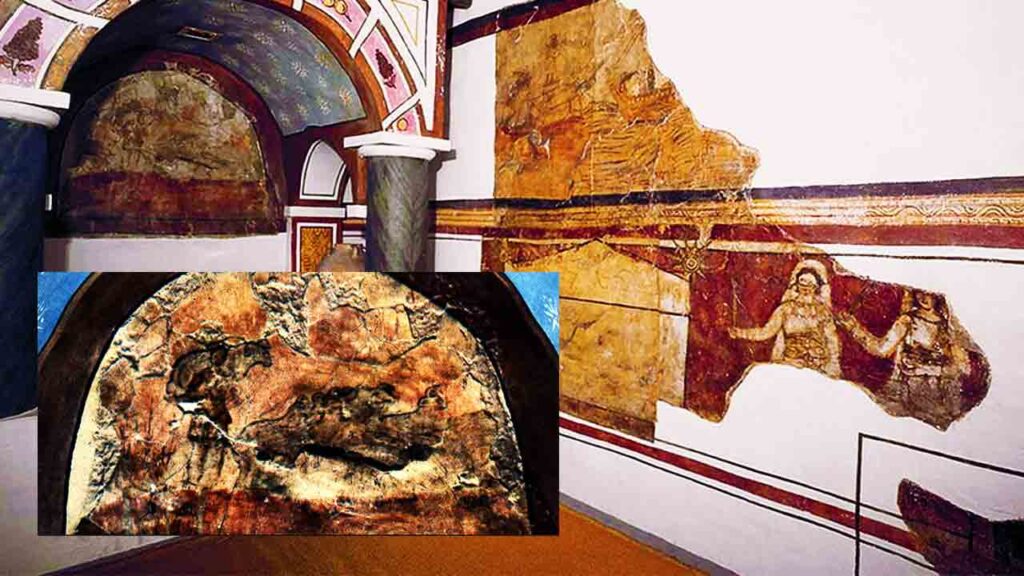
During the Early Christian Period, churches, tombs, and civil and official buildings were adorned with frescoes. The earliest example consists of frescoes depicting scenes from the Old Testament and the New Testament in the baptistery of the massive church at Dura-Europos, located within the borders of the Roman Empire. Outside Rome, in the Catacombs of St. Gennaro in Naples, there are frescoes dating to the 5th–6th centuries—a period when catacombs were no longer in use in Rome—depicting various subjects; similarly, traces of frescoes have been found in a tomb in Alexandria dating to the pre-Constantine period. Near Nicaea, there is a well-preserved tomb structure. (Iznik, 5th century). What is interesting is that the decorative programs of other tomb structures built during the Late Antique period in Nicaea (Iznik), Kaisarcia (Kayseri), Sardis (Sart), and Philadelphia (Alaşehir) do not include subjects specific to the Christian faith.
The numerous small burial chambers found in Thessaloniki (4th century) feature decorative figurative ornamentation depicting scenes from the Old Testament and the New Testament. Gregorios, who served as bishop in Nyssa near Harmandalı from 371 to 395, describes frescoes depicting contemporary subjects in a villa (near the Kızılırmak River)—the exact location of which in Cappadocia or Galatia is unknown—that has not survived to the present day. The frescoes in the “Slope Houses” of Ephesus (Selçuk), contrary to the previously accepted dating of the 5th century, were destroyed in the 3rd century due to an earthquake in the year 262. The ceiling decorations in the banquet hall of the imperial palace, built at the beginning of the 4th century and located beneath the present-day cathedral in Trier, Germany, suggest that the ceilings of other palaces, houses, and villas were also adorned with such decorations. This notion is supported by certain written sources and archaeological finds. Furthermore, geometric mosaic fragments have been discovered during excavations conducted around the cathedral in Trier.
During the Greek and, especially, the Roman periods, people were surrounded by images. Homes, tombs, and public buildings were adorned not only with frescoes and stucco work but also with a small number of wall, vault, and floor mosaics. During the Early Christian Period, many churches were added to these structures. In addition, paintings on wooden panels and illuminated manuscripts were also produced. “You shall not make for yourself an idol; you shall not make any likeness of anything that is in heaven above, or that is on the earth beneath, or that is in the water under the earth; you shall not bow down to them or worship them” (Exodus 20:4–5); “You shall not make for yourselves any idols, nor shall you set up for yourselves a carved image or a pillar, nor shall you erect a carved stone in your land to bow down before it; for I am the Lord your God” (Leviticus 26, Deuteronomy)—due to this prohibition, Christians initially opposed the creation of images.
However, beginning in the year 200, the Greco-Roman tradition—which did not impose such a prohibition on depictions as found in the Torah—gradually took hold. Starting in the late 3rd century, homes were adorned with images, followed shortly thereafter by churches. By the 4th century, this practice had become completely widespread. Tombs and church walls were adorned with paintings or mosaics, while ceilings were partially decorated with mosaics. In some regions of the Roman Empire, mosaics were also used in the production of tomb slabs. From the earliest periods onward, sarcophagi, certain sculptures, and various examples of handicrafts were seen to feature pictorial decoration. Although only a small number of fresco remnants remain in tomb structures in other regions of the empire, countless frescoes—including those from the Pre-Constantine Period—have survived to the present day in the catacombs of Rome.
Byzantine and Roman Mosaics and Frescoes
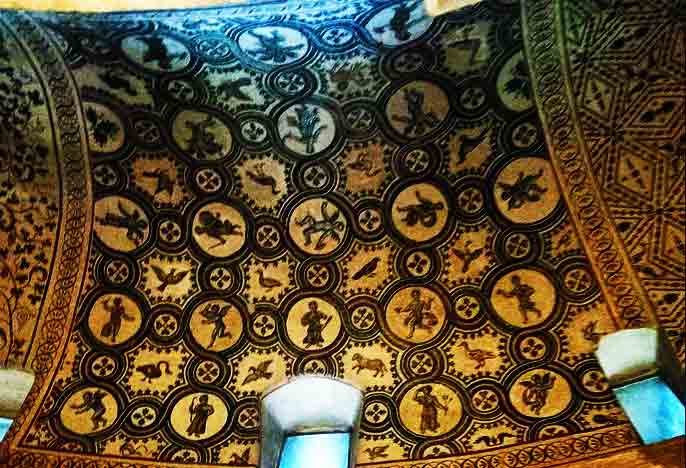
During the Early Christian Period, churches, tombs, and civil and official buildings were adorned with frescoes. The earliest example consists of frescoes depicting scenes from the Old Testament and the New Testament in the baptistery of the massive church at Dura-Europos, located within the borders of the Roman Empire. Outside Rome, in the Catacombs of St. Gennaro in Naples, there are frescoes dating to the 5th–6th centuries—a period when catacombs were no longer in use in Rome—depicting various subjects; similarly, traces of frescoes have been found in a tomb in Alexandria dating to the pre-Constantine period. Near Nicaea, there is a well-preserved tomb structure. (Iznik, 5th century). What is interesting is that the decorative programs of other tomb structures built during the Late Antique period in Nicaea (Iznik), Kaisarcia (Kayseri), Sardis (Sart), and Philadelphia (Alaşehir) do not include subjects specific to the Christian faith.
The numerous small burial chambers found in Thessaloniki (4th century) feature decorative figurative ornamentation depicting scenes from the Old Testament and the New Testament. Gregorios, who served as bishop in Nyssa near Harmandalı from 371 to 395, describes frescoes depicting contemporary subjects in a villa (near the Kızılırmak River)—the exact location of which in Cappadocia or Galatia is unknown—that has not survived to the present day. The frescoes in the “Slope Houses” of Ephesus (Selçuk), contrary to the previously accepted dating of the 5th century, were destroyed in the 3rd century due to an earthquake in the year 262. The ceiling decorations in the imperial palace—built in the 4th century and now located beneath the cathedral in the German city of Trier—suggest that the ceilings of other palaces and homes might also have been adorned with similar decorations. This notion is supported by certain written sources and archaeological finds. Furthermore, geometric mosaic fragments have been discovered during excavations conducted around the cathedral in Trier.