The Last Supper concept refers to the final meal that Jesus shared with his 12 apostles before his crucifixion, as described in the Bible. During this final meal, Jesus distributed bread and wine to those at the table. Pointing to the bread he distributed, he said, “Take this and eat it; this is my body,” and pointing to the wine in the cup, he said, “Take this and drink it; this is my blood.” This story from the Holy Bible has been a subject explored by artists across many artistic periods.
Two main themes dominate the paintings depicting this story. The first is Jesus’s revelation that one of the 12 apostles at the table would betray him; the second is the portrayal of this Last Supper as a religious ritual. This subject was frequently explored in works of art during the Renaissance, a period of immense significance in the history of art. It can be said that in paintings depicting The Last Supper produced during the Early Renaissance, perspective was not given much importance, whereas in later periods, it was given greater emphasis. This narrative from the Holy Scriptures was also explored by many artists in Byzantine art. In other words, there are numerous works created based on this concept, dating back to the Byzantine-Roman period. However, we will focus on works produced within a shorter timeframe that have become quite popular.
Different Interpretations of The Last Supper
Duccio di Buoninsegna
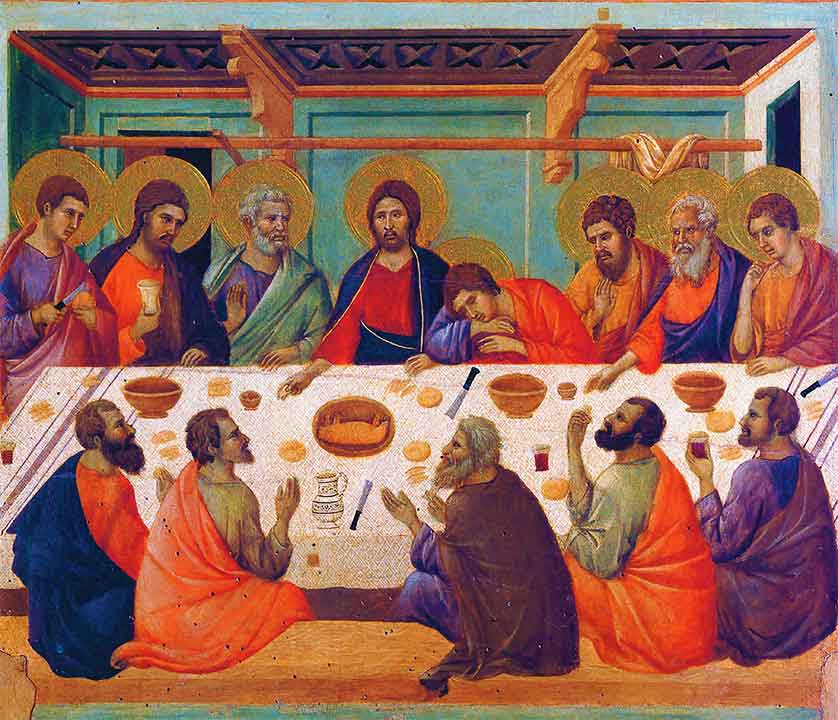
One of the best-known artists to depict “The Last Supper” during the 14th-century Gothic period is Duccio. Duccio was an Italian painter and the founder of the Sienese school, and he created his version of “The Last Supper” in 1308. In this painting, the spatial composition is quite dense, and perspective is not used. For this reason, it can be said that the aim was to create a two-dimensional rather than a three-dimensional effect. In this work, the subject of The Last Supper is depicted as a kind of religious ritual. For this reason, we can observe a “halo” around the figures’ heads in the painting. This form frequently appears in Greek-Roman and Buddhist art. Additionally, the lack of emphasis on a sense of volume—a characteristic often seen in Byzantine art—is also evident in this painting. Furthermore, the table where Jesus and the apostles are seated does not adhere to the rules of perspective. The artist intended to depict the table from a bird’s-eye view.
The picture plane is organized in three distinct layers: foreground, middle ground, and background. In the foreground, the figures of the five apostles stand out. The middle ground features the surface of the table, and finally, in the background, the figure of Jesus is depicted alongside the figures of the seven apostles. To draw attention to the center of the painting, the figure of Jesus is placed exactly in the center, with a space between him and the apostles. The Siena School commonly used portable wooden panels. These panels were generally made of poplar wood, and their surfaces were smoothed and gilded with gold leaf. The figures were painted using a green-toned paint known as “tarra verte.” In addition to the tempera technique, the fresco technique was also used. In the Last Supper painting, we can see that Duccio adhered to the general principles of the Sienese School and incorporated gold leaf and bright colors, which were frequently used in the Byzantine tradition.
Andrea del Castagno
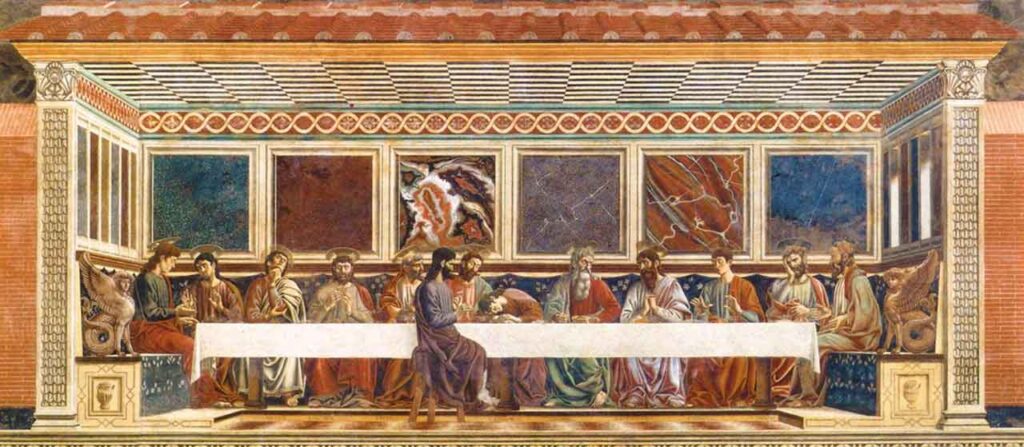
Another artist who explored the theme of The Last Supper in his works is the Early Renaissance artist Andrea del Castagno. In this fresco, Castagno chose to use illusionistic perspective. In the interior design of the painting, the walls and ceiling are treated as a unified whole. The table is positioned parallel to the picture plane in accordance with perspective. Similarly, the religious figures in the painting are also parallel to the picture plane. The apostle John, who acted as the informant, is depicted sitting alone at the table, facing the viewers, while the other apostles and the Prophet Jesus are portrayed on the same plane. In this painting, the artist has created a compositional structure that brings John to the forefront in a way that evokes his betrayal of Jesus. For this reason, the narrative in this painting centers on the theme of John’s betrayal. In this masterwork, Castagno employs a style that demonstrates his emphasis on perspective and anatomy. By placing the central figure—the Prophet Jesus—at the center of the painting, the artist also adhered to the compositional principles of Renaissance art.
Leonardo da Vinci
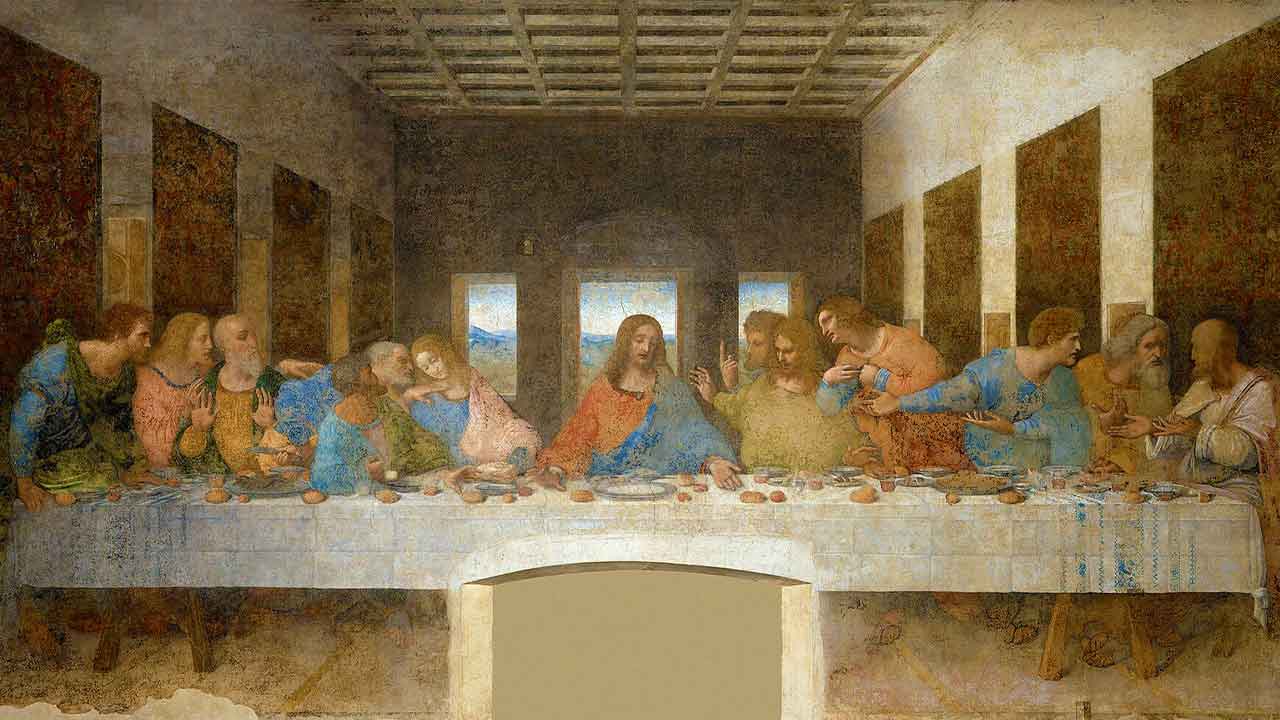
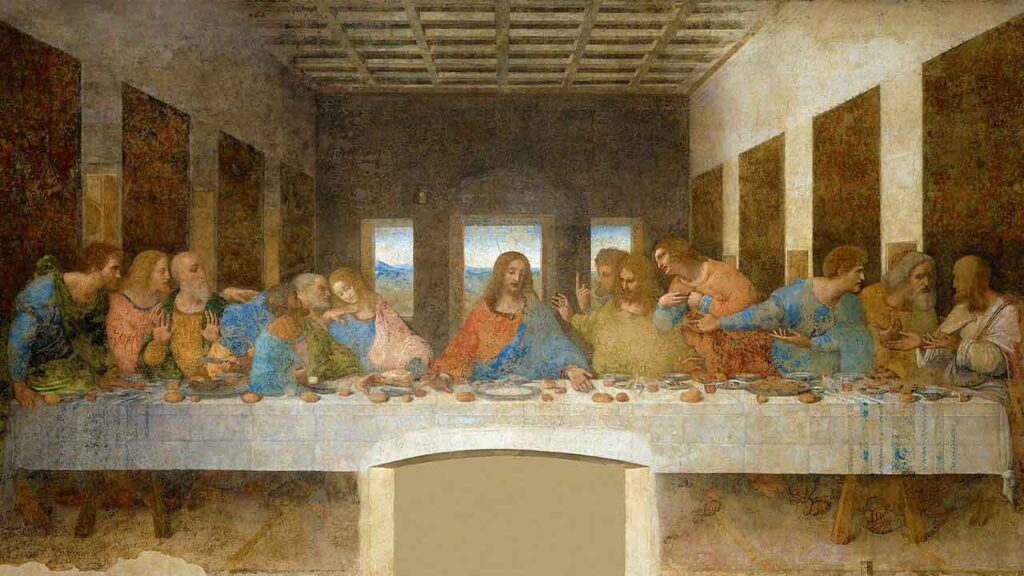
The most popular and well-known work depicting the Last Supper, dated 1495, was created by the High Renaissance artist Leonardo da Vinci. This fresco took approximately five years to complete. Considered the most accomplished work among Christian art pieces depicting The Last Supper, this painting uses oil paint applied over a mixture of tempera, pitch, and gum. This mixture, applied underneath to help the oil paint adhere, caused the paint to dry out prematurely. In this painting, the figures take center stage rather than the setting. In this Last Supper composition, all the figures are depicted behind the table, and the figure of John—who was previously often depicted separately from the other apostles in paintings of the Last Supper—is also drawn alongside the other figures behind the table. In this regard, John, who is depicted as a symbol of betrayal, does not attract much attention in the painting.
A Masterful Portrayal of Leonardo da Vinci
In his painting *The Last Supper*, Leonardo employed a trompe-l’œil perspective and depicted the figures on a large scale. In accordance with the principles of Renaissance art, the table is parallel to the picture plane. In Leonardo’s *The Last Supper*, Jesus is placed at the center, and the other apostles are arranged symmetrically around him. In this regard, Leonardo adhered to symmetry, one of the fundamental elements of the Renaissance. While Jesus is depicted alone at the center, the other apostles are depicted in groups of three. At the same time, Leonardo succeeded in drawing attention to the center of the composition by drawing three windows in the background to further emphasize the figure of Jesus. In earlier depictions of The Last Supper, Jesus had not been portrayed as the central element of the painting to such a degree. The key feature of this painting is that the central figure stands out against the background in a harmonious manner.
Compared to his earlier versions of The Last Supper, Leonardo explored the sense of space in greater depth and achieved a realistic depiction by creating a space within a space, going beyond mere decorative intent. This composition was commissioned for the refectory of a monastery in Milan, and Leonardo created this work while taking the architectural features of that hall into account. This depiction of The Last Supper differs from other paintings in many respects. Leonardo produced a work that is very distinct in terms of its powerful use of light and shadow, sense of deep volume, technique, and the painting’s dynamic structure. There is a sense of dynamism in Leonardo’s The Last Supper, and this dynamism is easily felt through the natural movements of the figures and the realistic composition woven throughout the entire painting. Today, Leonardo’s masterfully executed “The Last Supper” is open to the public for only fifteen minutes at a time, with a maximum of 1,300 visitors, and continues to inspire new artists to this day.