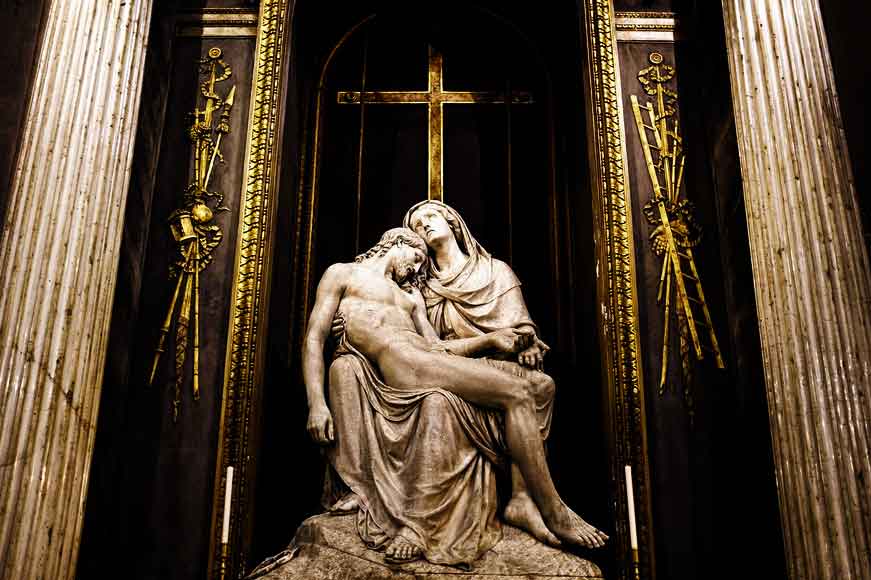
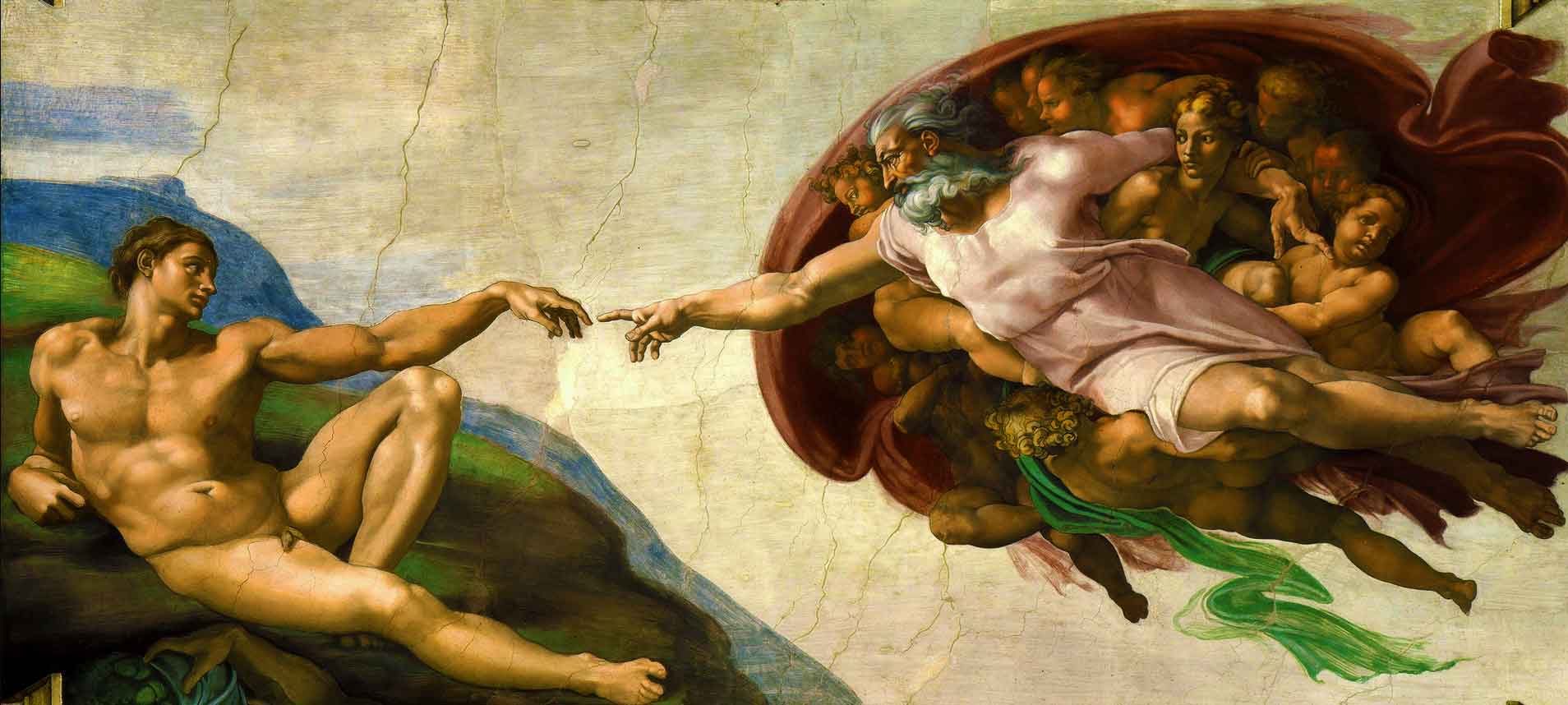
The life of Michelangelo Buonarroti, one of the brightest stars of the High Renaissance, has profoundly influenced artists, architects, and art historians since the 1500s. The catalog of unique works he created throughout his life showcases one of the greatest artists of his time.The Black Death and Rebirth
The Black Death and Rebirth
Through the painter Michelangelo Buonarroti (1475–1564) and his works, we can learn a great deal about the Renaissance period. More than 300 of Michelangelo’s poems have survived to this day. This reveals Michelangelo’s literary side and allows us to glimpse into the inner world of a great man. In addition, we can observe his social life through the letters he wrote to his friends, colleagues, and loved ones. In particular, the Florentine poet Dante Alighieri inspired great respect in Michelangelo and served as a source of inspiration for him from time to time.
Historically, the Early Renaissance period can be traced back to the early 1300s in the city of Florence. The High Renaissance, on the other hand, was a period dominated by Rome during the time Michelangelo and Raphael were working in the Vatican, a period dedicated to the pursuit of artistic perfection. This period came to an end in 1527 following the sacking of Rome by the Holy Roman Empire.
Michelangelo was born in Florence in 1475. He earned his reputation in the arts primarily in Rome and Florence. By that time, Florence had entered a period of “rebirth” over the previous 100 years. The main reason for this was that the Black Death, which had ravaged all of Europe in the 1300s, had claimed the lives of more than half of Florence’s population. After the Black Death, the city embarked on a process of reconstruction with the help of aid.
This reconstruction process encompassed both cultural and architectural aspects. Ancient Roman and Greek culture was becoming increasingly popular in Florence, and ancient texts were being studied, particularly by the nobility. In this way, movements such as Neoplatonism and Humanism began to develop. These developments were also reflected in art. Artistically, there was a return to Roman and Greek art and architecture. It was during this time that Michelangelo was born.
The Life of Buonarroti
Michelangelo grew up in a family involved in stone carving, which is why he began to show an interest and curiosity in the art of carving. This interest shaped the first steps of his artistic journey. As a young man, Michelangelo had a great passion for painting and spent a great deal of time exploring the chapels and churches in the streets of Florence. In fact, Michelangelo spent his early years not with his biological family but with a foster family.
This was because his mother faced difficulties and needed a wet nurse. When he turned seven, his family sent him to a school in Florence to learn to read and write. Although his biological family tried for a time to redirect Michelangelo’s interest in painting toward other pursuits, he never gave up his passion for art. He refused to take up his father’s profession of moneylending or any other line of work.
Despite pressure from his family, Michelangelo did not give up and eventually, with his father’s approval, began an apprenticeship in the studio of the Florentine painter Domenico Ghirlandaio. Michelangelo’s father was hesitant about his son’s desire to pursue a career as a sculptor. As a member of the Buonarroti family—which came from a relatively middle-class background—sculpture was viewed by society as a humble profession, on par with blacksmithing or cooking, and this cast doubt on Michelangelo’s future.
At least, that was his father’s view. During this period, as Michelangelo studied the city’s architecture, one of the factors that fueled his passion for art was the marble and bronze sculptures by masters such as Verrocchio and Donatello, located in the Orsanmichele building. Finally, after his apprenticeship at the Ghirlandello brothers’ workshop came to an end, Michelangelo became part of the Medici family about a year later following an offer from the newly established Medici sculpture school.
During this period, when Michelangelo had the opportunity to wander through the sculpture gardens of the Medici palace, his lifelong collaboration with the Medici family began with his meeting with Lorenzo de’ Medici. From then on, Michelangelo resided at the Medici family’s home for about four years. During this time, he produced masterpieces using the “rillievo schiaciato” technique, a method employed in relief sculpture. One of these is the “Madonna of the Stairs.”
This technique, which Michelangelo employed, had essentially been perfected by Donatello, and traces of Donatello’s influence can be seen in Michelangelo’s work for this reason. Lorenzo de’ Medici was Michelangelo’s first patron. For as long as he lived, he supported Michelangelo’s passion for art and encouraged this young artist to master the craft of sculpture. Constantly encouraged to become part of the Medici family, Michelangelo found himself caught in the middle of the disputes between the Medici and the Church following Lorenzo’s death.
Following Lorenzo’s death, the Medici rule collapsed, and the Republic of Florence was established, marking the beginning of a new era. During this time, Michelangelo spent his time in Bologna and Venice. Having abruptly left the Medici household, Michelangelo was forced to find new patrons and commissions, and his passion for sculpture was further ignited. When Michelangelo went to Venice, things did not go very well for him.
His artistic approach, which drew on the ancient world, did not particularly capture the interest of the Venetians at that time. For this reason, he decided to stay in Bologna. However, unable to settle in Bologna either, Michelangelo eventually returned to Florence. Not all members of the Medici family had left Florence; some were still there. Those who remained were sympathetic to the new republic, and Michelangelo was warmly welcomed by them.
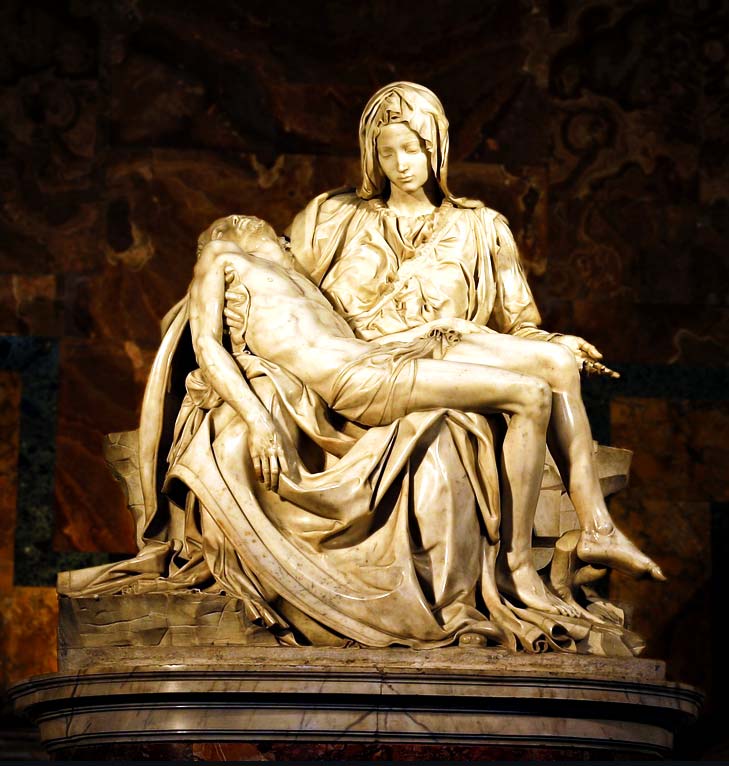
The impact of religious and political pressures in Florence on cultural activities must have troubled Michelangelo, as he eventually decided to go to Rome. There, a French ambassador commissioned Michelangelo to create a religious sculpture. Upon completing this commission, Michelangelo would establish himself as a master sculptor and prove his worth. This great masterpiece is the Pietà. She holds the body of the dead Christ in her virgin arms and gazes downward with a sorrowful expression.
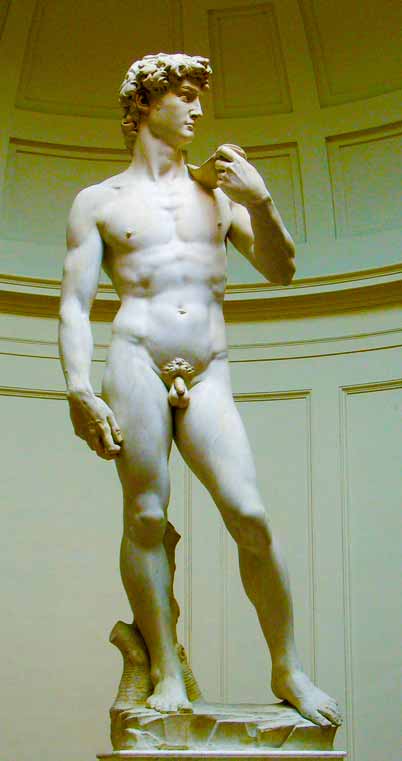
Having gained fame with this sculpture, Michelangelo returned to Florence once again. In Florence, the Guild of Wool Merchants commissioned another major work. They requested a statue of David of a beauty befitting the city. In 1504, the colossal statue of David was completed. The cathedral’s custodians decided to transport this great statue to the Palazzo della Signora to display it on scaffolding. This was a great honor for Michelangelo.
There is an age difference of about 20 years between the young Michelangelo and Leonardo da Vinci. In addition, the two great artists worked in different cities. However, there were quite a few points where their lives intersected. Florence would be the place where they would have their first opportunity to work together. There, they had been commissioned for a project for the Salone dei Cinquecento.
However, Michelangelo was forced to go to Rome due to other pending commissions, and someone else completed the project in his place. During Michelangelo’s time, there were two other figures in Italy—particularly in service to the Pope—who were rivals and served as the cornerstones of the High Renaissance. These were the architect Donato Bramante and the painter Raffaello Sanzio. Michelangelo was in constant competition with these two great figures.
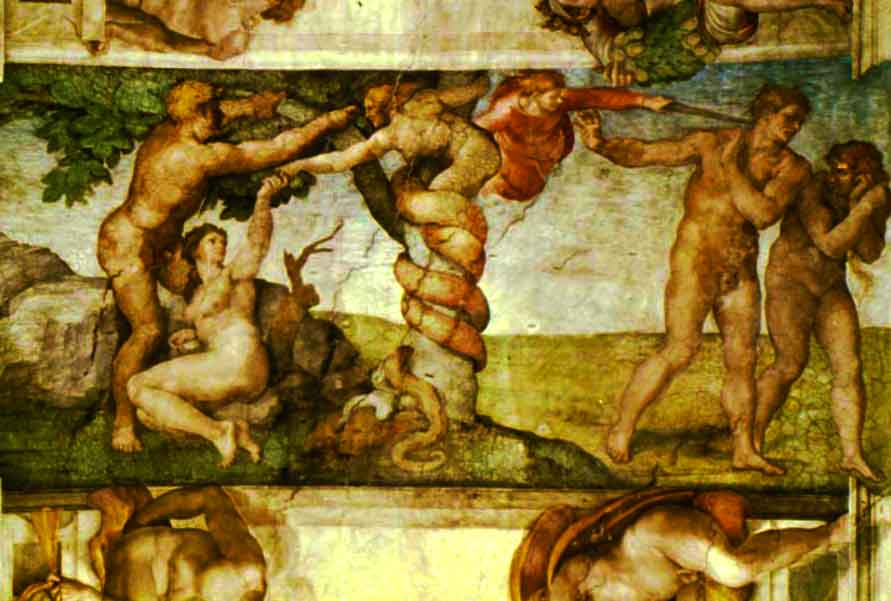
In 1508, Pope Julius II commissioned Michelangelo to design the ceiling of the Sistine Chapel. Although Michelangelo wanted to refuse the commission, doing so could have strained his relationship with the Pope. The reason he hesitated to accept was that he lacked confidence in his ability to create large-scale paintings. Despite everything, he successfully completed the work, and the result caused a sensation.
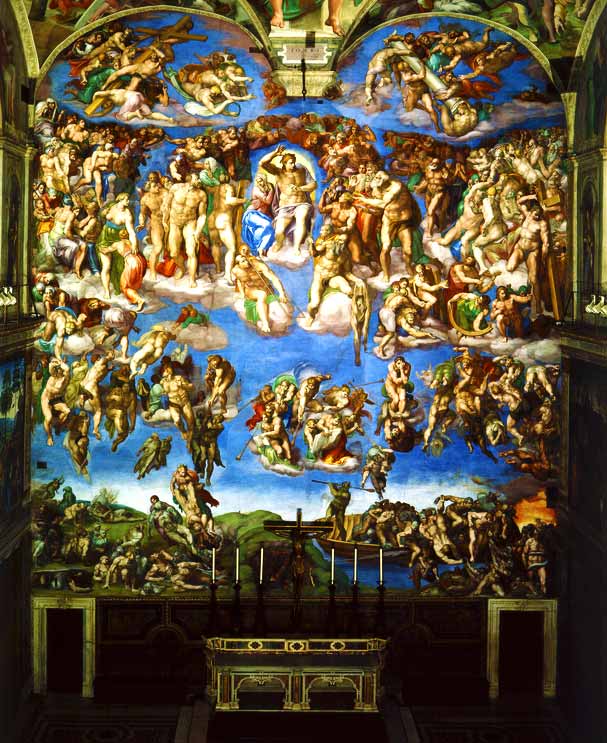
The Sistine Chapel, on which he had worked for approximately four years, ultimately added to Michelangelo’s fame. In 1534, he was invited back to Rome to paint another fresco in the Sistine Chapel. This move meant Michelangelo’s complete departure from Florence, and he would never return to that city again until his death. In Rome, he was granted honorary Roman citizenship by the papacy.
Michelangelo’s Death in Rome
He continued his work here until his death. He received numerous commissions from the papacy in Rome. The first project he worked on in Rome was the fresco of the Last Judgment for the Sistine Chapel. In addition, he was involved in the Chapel of St. Paulina, commissioned by Pope Paul III, served as chief architect of St. Peter’s Basilica, and participated in many other artistic projects. In Rome, he forged many new relationships and put his name to numerous projects. As time went on, Michelangelo began to take an interest in various hobbies.
Horseback riding was among them, and it was an activity he truly loved. In his final days, Michelangelo had begun to grow very frail. He was struggling even to perform simple tasks. For this reason, he had called his nephew Lionardo to his side. In 1564, Michelangelo’s body was ravaged by illness and edema. This painful ordeal also prevented him from sleeping. At times, he lay feverish and was unable to move. His assistant Tiberio Calgani, along with his relatives and friends, supported him as much as possible during this time.
When Michelangelo Calgani found him on a rainy day—despite his poor condition—he was unable to walk. Calgani carried him to his bed. Despite everything, that day was Michelangelo’s last. His nephew and friends came to see him. That same day, the great artist’s body was taken to SS Apostoli. While he was still alive, Michelangelo had expressed his wish to be buried in his hometown of Florence. For this reason, his nephew spoke with high-ranking officials and worked to have his uncle’s body interred in Florence.
The funeral took place in Florence in 1564; to the people of Florence, he was a cherished son of the city. Michelangelo left behind a legacy of works in painting, sculpture, and architecture, along with the immense contributions these works made to art. These works have served as a source of inspiration for sculptors and painters around the world and for generations to come. Many Italian artists, such as Antonio Canova and Auguste Rodin, were inspired by Michelangelo, who was highly respected even during his lifetime.