The Assyrians were a people of Semitic origin who lived in ancient Mesopotamia. Geographically, they emerged in the city of Assur, located in northern Iraq on the banks of the Tigris River, and eventually developed into an empire. In this article, we will examine Assyria’s relationship with the Arameans and its mythological and religious culture.
Religion and Gods
The concept of the “king as the representative of the gods,” which was common in many states established in ancient Mesopotamia, underwent certain changes with the Assyrian dominance in the region. In the Assyrian conception of kingship, the idea of the king as the “representative of the god Assur” was combined with that of the “ruler of the world,” giving rise to the “Strong King” archetype, who embraced an imperialist policy. Relying on the military power at their disposal, the first act of the Assyrian kings upon coming to power was to proclaim themselves sacred kings. The concept of “Ensi,” which was observed during the Sumerian City-State Period and referred to a figure responsible solely for temple affairs and acting in accordance with the commands of his god, was expressed by the Assyrians as “Išši ak Assur,” meaning “governor/steward of the god Assur.”
An important point to note here is that while the Assyrian kings were referred to as “the governor/steward of the god Assur,” the city god Assur was referred to as “lugal (Sharrum),” meaning “the true king of Assur.” The three most important duties of the kings, who were regarded as the stewards or representatives of the gods, were interpreting the will of the gods, representing their people before the gods, and governing the country. The primary reason Late Assyrian Period kings who fulfilled these obligations referred to themselves as the “sangu of the god Assur” or “priest” was their desire to imbue their earthly power with a divine dimension. This understanding also served as the fundamental rationale for these kings’ self-designation as high priests.
In the self-description used by Shamshi-Adad I—“Shamshi-Adad, the mighty man, king of the universe, appointed by the god Enlil, deputy of the god Assur, beloved of the goddess Ishtar…” 9 It is clearly evident that the Assyrian kings defined themselves as both “King of the Universe” and sacred figures chosen and appointed by the gods. The kings, who played significant roles in the cult rituals held in the country and were depicted wearing various religious garments, were not only political figures but also religious leaders. By consolidating both religious and political power through these methods, the kings’ practice of going to the temple to take oaths before the god Assur upon ascending the throne was of great importance in instilling in the minds of all citizens the idea that the king had ascended the throne with divine support and by divine choice.
The most commonly used title was “sangu of Assur,” meaning “Priest of Assur,” which likely carried a certain administrative function. The most fundamental conclusion that can be drawn from the coronation ceremonies of kings who used this title during the Middle Assyrian Period is the understanding that, in both the Middle and New Assyrian Periods, the kings were merely the administrators of the Assyrian state, whereas the god Assur was the true owner and king of the country. Cuneiform documents record that during the Neo-Assyrian Period, Assyrian kings made numerous visits to the city of Babylon to participate in the rituals held there. Based on these records, we can glean important information about the kings’ purposes in attending these festivities.
The National God of Assyria: The God Ashur
There is a mythological reference in Ezekiel’s comparison of Assyria to a mighty tree. The Hebrew prophets drew upon the characteristic beliefs of the peoples to whom they made direct allusions in their poetic descriptions. The “owls,” “goat-men,” and “dragons” mentioned by Isaiah are drawn from Babylonian mythology. Therefore, when Assur is compared to a cedar tree—larger than the chestnut and fir trees—we understand from the mention of birds nesting in its branches, animals giving birth to their young beneath it, and “abundance of water” as the source of its grandeur, we understand that the Assyrian religion—as reflected in its symbols—also encompasses a belief in trees, birds, animals, and water. The Assyrian tree symbol (“world tree”) appears in the text as “the pillar of my wrath . . . the thing in their hands”—that is, the war banner symbolizing Ashur. Thoth and Osiris were not only Egyptian gods but also tree gods.
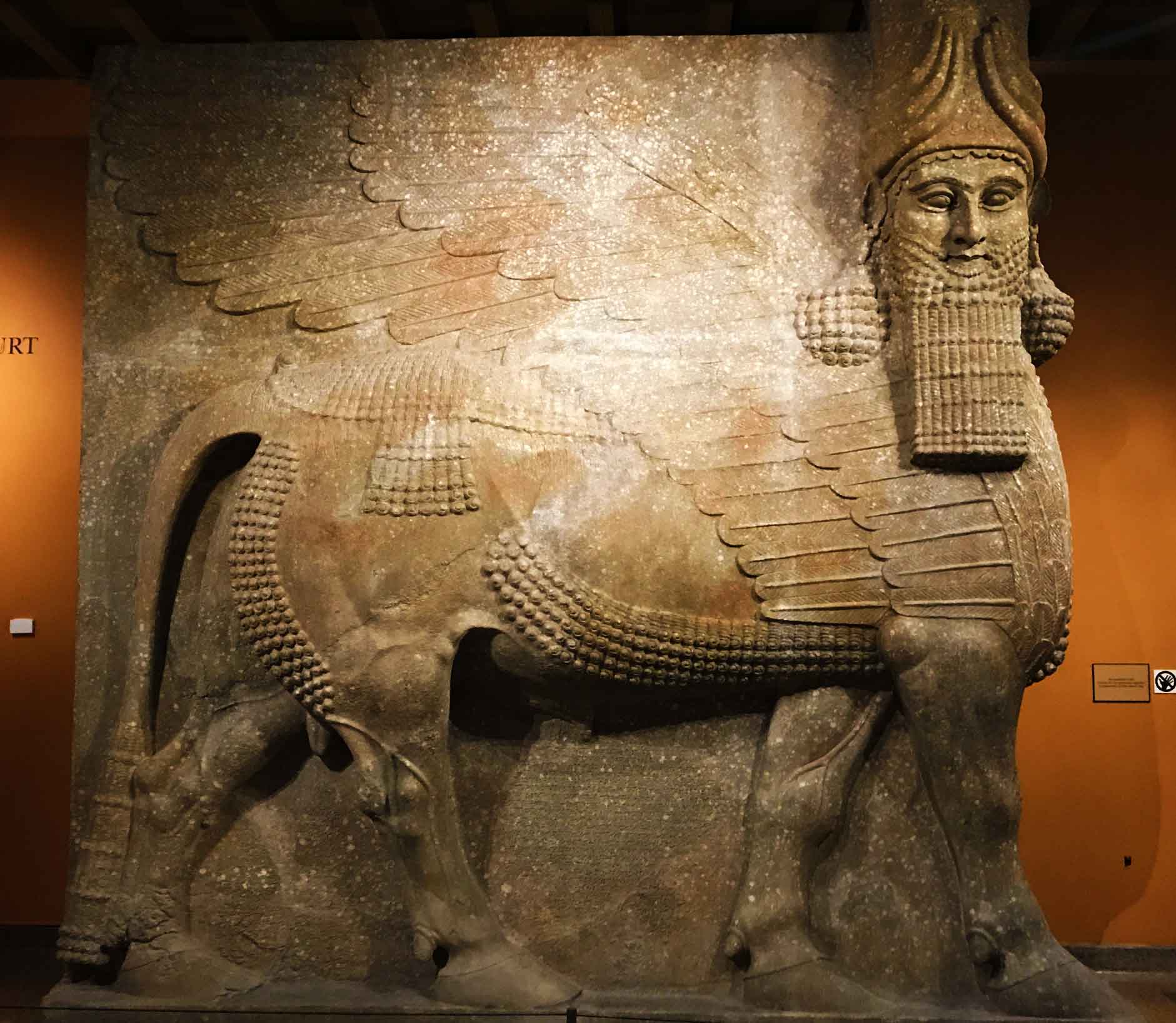
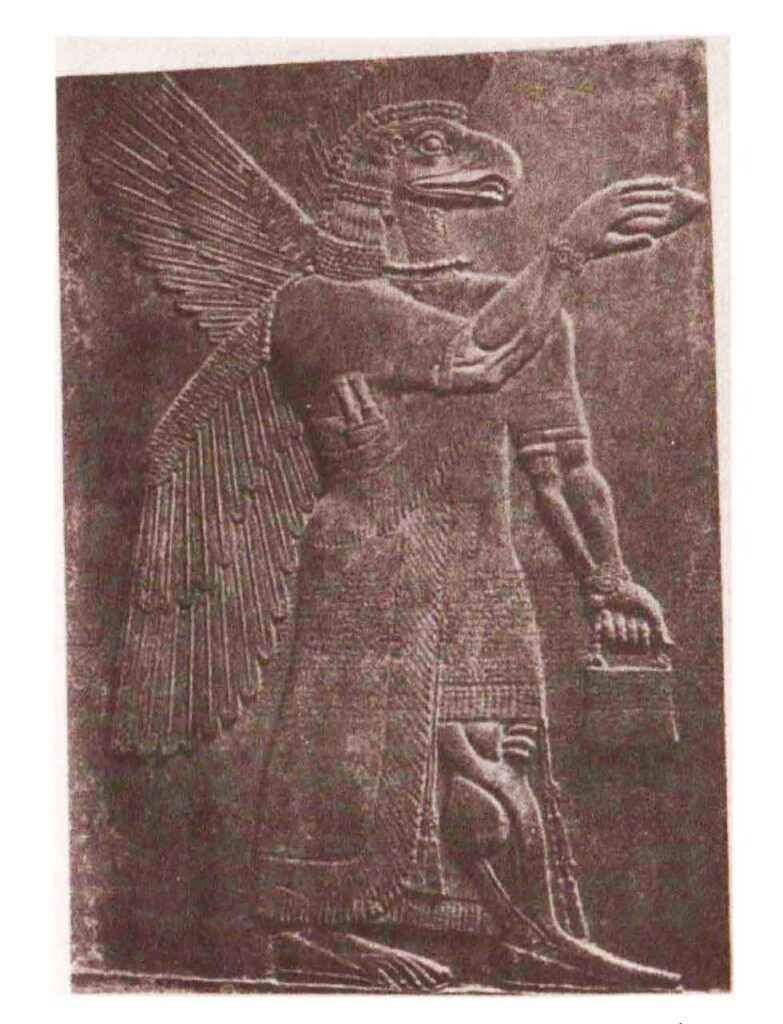
In Assyria, various primordial gods were depicted as a winged bull, a winged bull with a human head, a winged lion with a human head, a winged human, a god with a lion’s head and an eagle’s claws, and a winged figure with an eagle’s head, feathers, and a human body. Generally, in one hand they held a metal basket containing two winged humans worshiping the sacred tree, and in the other, a fir cone. Since the eagle gained significance in Sumerian and Assyrian mythologies as a god embodying the qualities of the sun and the atmosphere, it is likely that the symbol of Ashur represents life, fertility, and destruction through its wings. The idea that this symbol represents a solar eclipse and the sun’s rays during that event seems far-fetched. This is because eclipses were seen as signs of disasters and the wrath of the gods.
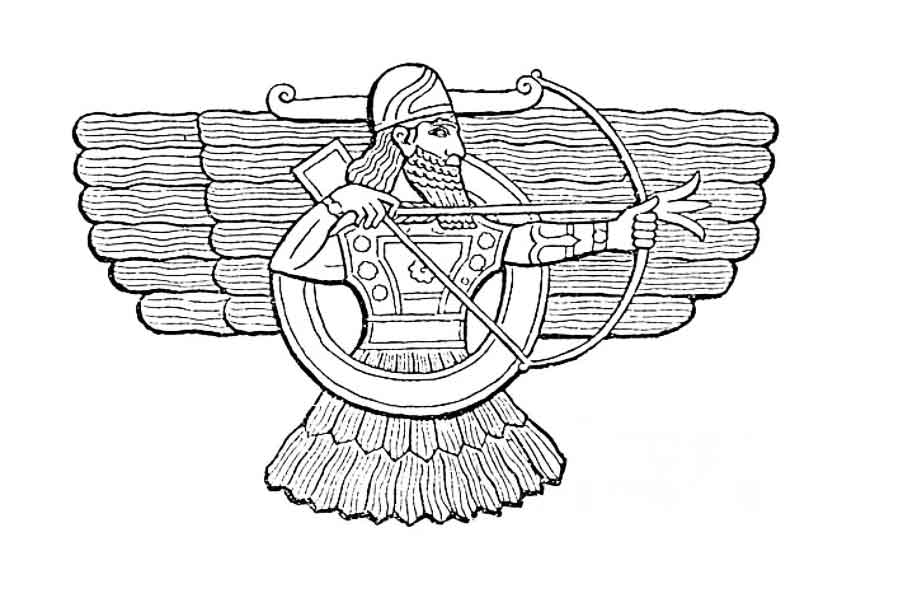
Ezekiel drew upon Assyrian symbolism while prophesying to the Israeli captives in Tel-abib “by the banks of the Chebar River.” He most likely met with priests who had fled the Assyrian cities to Babylon. This important prophet also made interesting references to the “four living creatures” with “four faces” (a human face, a lion’s face, an ox’s face, and an eagle’s face): “On their four sides, beneath their wings, were human hands. All four had faces and wings… Their wings were spread upward. Two wings of each creature touched the wings of the adjacent creatures, and two wings covered their bodies… The living creatures looked like burning coals of fire or torches. . . The creatures moved back and forth as swiftly as lightning.
Another description of the angels is as follows: “Their backs, hands, and wings—and all four had wheels all around them, full of eyes. I heard the wheels called ‘spinning wheels,’ and the angels ascended.”) The wheel (or circle) was a symbol of life. The Assyrian figure enclosed by this circle and covered in feathers was the god of war and fertility. His forked arrow resembled a symbol of lightning. Ezekiel’s references are quite meaningful in this context. When the angels “ran back and forth,” they “looked like flashes of lightning.” The “sound of their wings” was “like the sound of the waves of the sea.” Their bodies were like “burning coals.” Gods of fertility were identified with fire, lightning, and water. The Indian Agni, the Anatolian Sandan, and the Phoenician Melkarth were highly developed gods of fire and fertility. The cult of fire was also represented among the Sumerians.
In the Indian epic Mahabharata, a circular ring or wheel protects Soma, the elixir of immortality to which the gods’ existence is bound. The eagle-giant Garuda attempts to steal it. The gods arm themselves and gather to protect the life-giving elixir. Garuda approaches, “darkening the world with the dust raised by the whirlwind created by his wings.” “Enveloped by this cloud of dust,” the gods faint. Later, Garuda takes on a fiery form and appears like a “mass of dark clouds.” Finally, his body takes on a golden, radiant appearance, like “sunbeams.” Soma is protected by fire. But it is extinguished by the waters that the birds “drink from many rivers.” Garuda notices “a sharp-edged steel wheel spinning” above Soma. “This object, possessing a terrifying form and the brilliance of the fiery sun, was created by the gods to shatter those who attempt to steal Soma.”
The Persian god Abura Mazda is depicted in sculptures as flying above the king inside a winged wheel. He holds a ring in one hand, while his other hand is raised as if to bless his worshippers. The Babylonian sun god Shamash, the goddess of heaven Ishtar, and other gods also carried rings. Egyptian gods also carried the ring-shaped cross, a symbol of life. Shamash is depicted seated on his throne inside a large tent held up by a column featuring a sun disk in front of it. The spokes of the wheel are formed by a star symbol. All of the young gods who succeeded the older ones were gods of fertility, war, lightning, fire, and the sun.
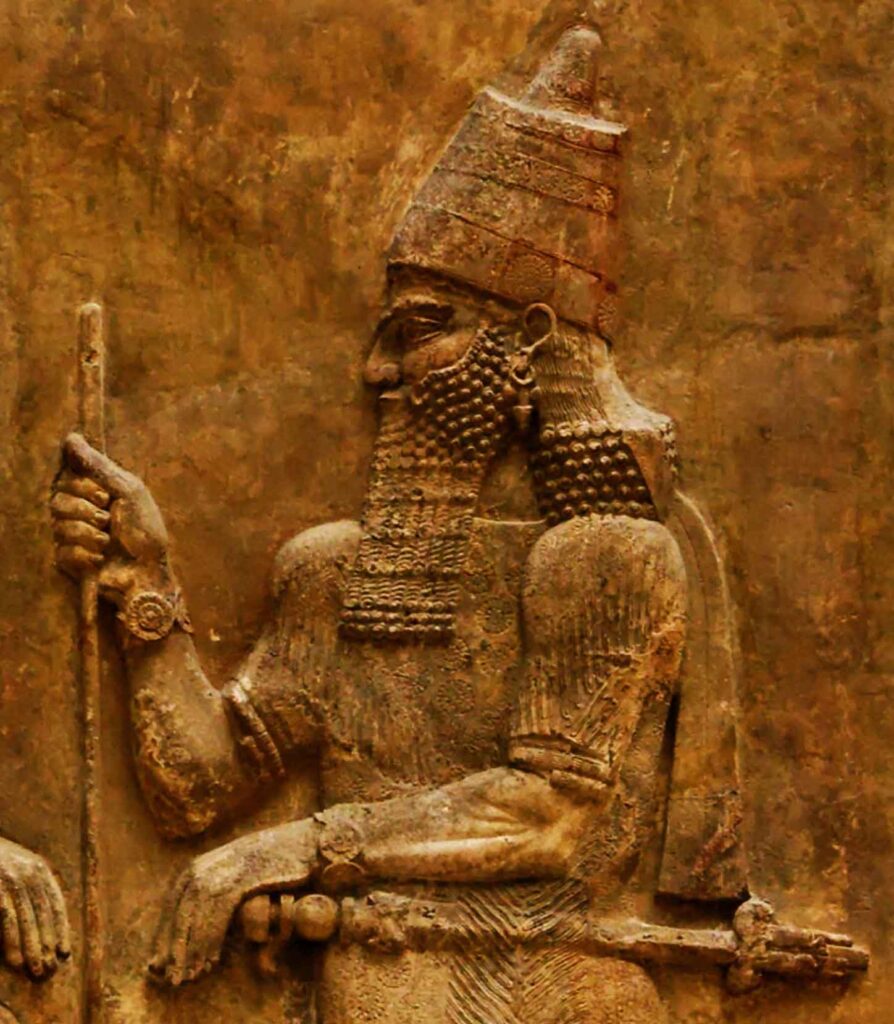
Therefore, it is likely that Ashur, like Marduk—the son of Ea, the god of the depths—was, in origin, a form of July. His spirit resided within the sun wheel, which rotated during times of seasonal change. In Scotland, it was believed that the sun rising on the morning of May 1st rotated three times. The young god was the god of the spring sun and fire. Great festival fires were lit to strengthen him. The old year was burned as a rite of rebirth. In other words, the old (elder) god was also burned so that he could renew his youth. Melkarth was burned in the city of Sur. Hercules burned himself on the summit of a mountain, and his spirit ascended to heaven in the form of an eagle.
Sometimes, worship of Ashur also took place in the temples of other gods. In an interesting inscription, he is identified with Nannar (Sin), the moon god of Harran. It is believed that King Esarhaddon of Assyria was crowned in this city. Professor Pinches stated, “It is clear that the author is addressing ‘the great and noble Asnapper,’ Assur-ban-apli”: When our lord, the king’s father, went to Egypt, he was crowned in the cedar temple at the ganni of Harran. The god Sin remained upon the sacred banner. He wore two crowns on his head. The god Nusku stood beside him. Our lord, the king’s father, entered, and the priest of Sin placed the crown upon his head and said, ‘You shall go and conquer the central lands.’ He went and conquered the lands of Egypt. The Lord of Kings will conquer the remaining lands that have not been surrendered to Ashur and Sin.”
The Heritage of Assyria
The Assyrian religion was polytheistic, and these gods symbolized elements such as nature and human life. The chief god of the Assyrians was Ashur. Ashur was the god of the empire and was associated with wisdom and kingship. Ashur was also influenced by Sumerian gods such as Anu and Enlil. In addition to Ashur, the Assyrian pantheon included Ishtar, who symbolized love and fertility; Marduk, who was adopted into Assyrian culture from Babylon; Adad, associated with storms; and Shamash, the god symbolizing the sun and justice. Assyrian kings were viewed as representatives of the god Ashur. For this reason, they conducted rituals and offered sacrifices.
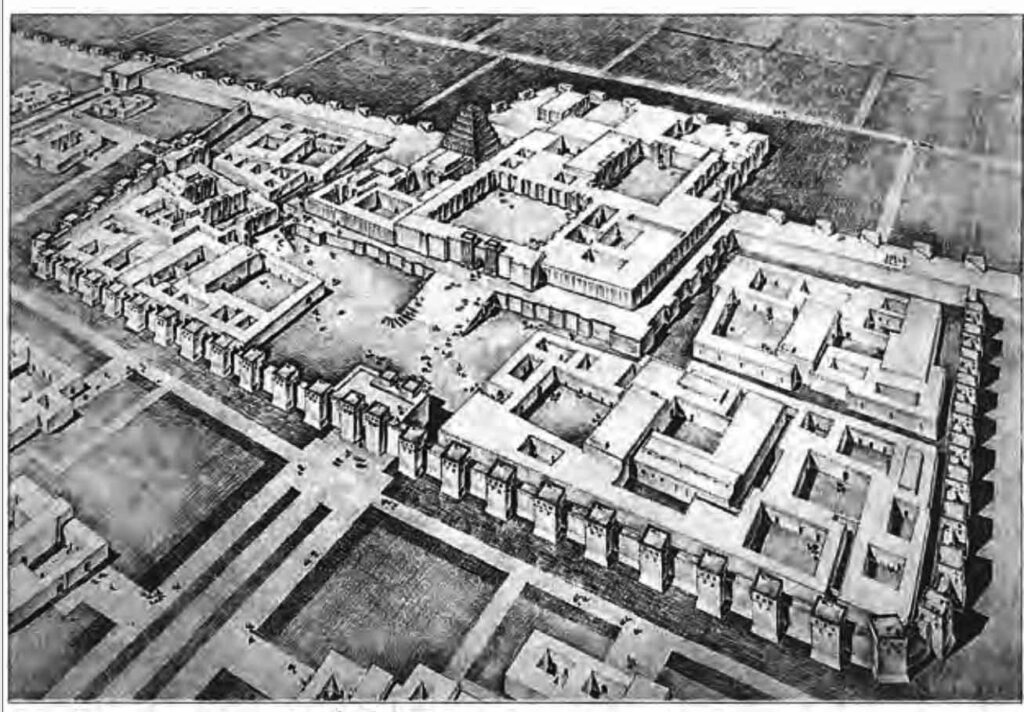
During the post-imperial Assyrian period (1st century A.D.), the Assyrian people gradually adopted Christianity. Today, the Assyrians—who still reside primarily in the Middle East—trace their origins to the Assyrian people, an ancient civilization. The Assyrians truly made significant contributions to human history. For example, it was the Assyrians who brought cuneiform writing to Anatolia and facilitated its spread. Furthermore, the first known library was established in Nineveh during the Assyrian period. Approximately 30,000 clay tablets from the Assyrian civilization have survived. Reliefs and sculpture played a prominent role in Assyrian art. It can be said that the main symbols of Assyrian architecture are the winged bull statues (lamassu) and monumental palaces. Many more examples of Assyria’s contributions to human history could be cited.