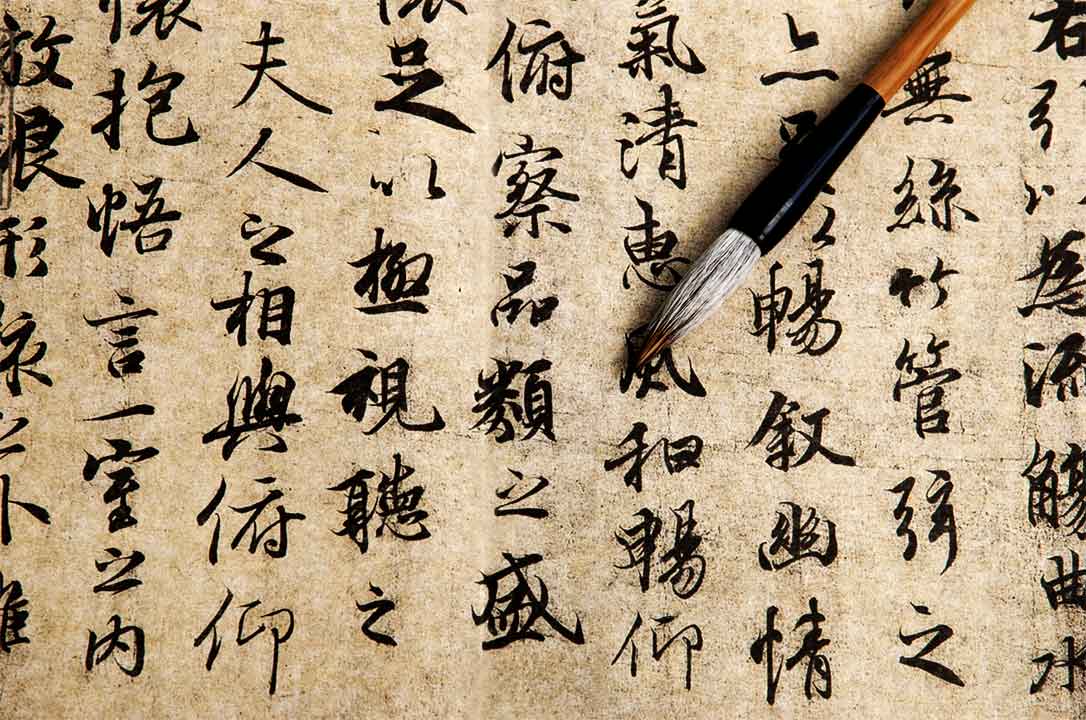
The primary reason for the emergence of Chinese calligraphy lies in the unique way Chinese characters express their spirit and the artistic understanding they thereby evoke. In essence, we can say that the art of calligraphy, which is unique to China, emerged from the distinctive nature of Chinese characters. Having emerged over a long historical process and continuously evolving, the art of calligraphy has enriched itself by incorporating numerous material and spiritual elements. In this article, we will discuss the art of calligraphy and its history.
We can see Chinese characters depicted in artistic forms on many objects. If we go back to ancient times, the earliest examples of Chinese characters used in this way are found on Chinese pottery. For example, Chinese pottery inscribed with Chinese characters dating back to around 3000 BCE has been discovered in the Shandong region. We can say that Chinese characters evolved from pictographic-based images over the course of history and developed into the concept of ideographic writing. There are two objects that provide us with significant data regarding the ancient Chinese writing system and characters: tortoise shells and animal bones. Many examples of tortoise shells with characters carved on them from ancient times still exist today.
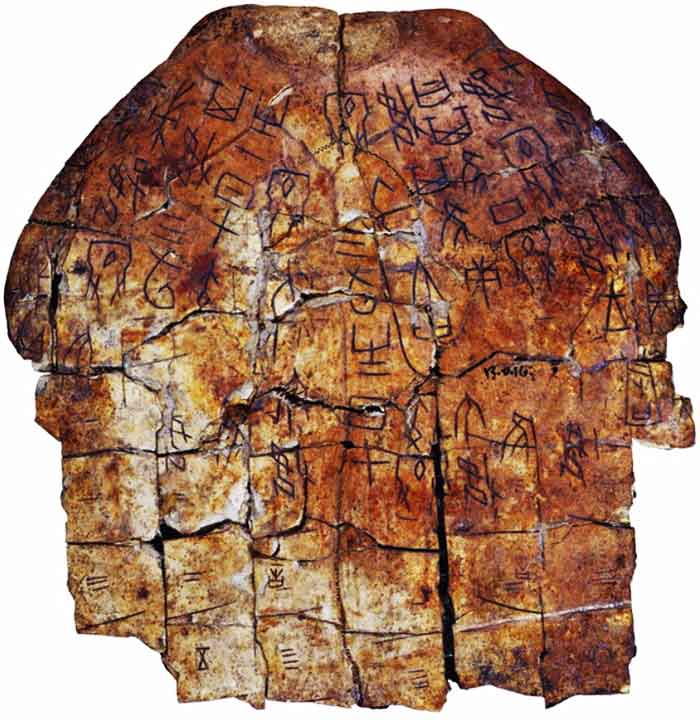
Characters Carved into Turtleshells and Bones
During the Shang Dynasty (1600–1046 BCE), inscriptions were carved onto turtle shells and animal bones to record prophecies and various pieces of information. Today, thanks to archaeology, we know that there are approximately 150,000 tortoise shells inscribed with various Chinese characters. The inscriptions carved on tortoise shells and bone objects are of great importance for the development of the Chinese language. In addition, the inscriptions on these objects also contain the most important elements of the art of calligraphy. We can categorize these elements as the use of writing brushes, the structure of brushstrokes, and compositions. For this reason, the roots of the art of calligraphy go back a very long time. In fact, it can even be said that calligraphy is one of the oldest forms of Chinese art.
Qiu Xigui, a philologist, writes the following on this subject: “Even if we start counting from the late Shang Dynasty, Chinese characters have a history of 3,300 years. Over this long period, Chinese characters have undergone significant changes in both form and structure. In terms of form, Chinese characters have generally undergone a shift from complex to simple shapes, and this change is reflected in the style and pattern of the characters. In terms of structure, Chinese characters have undergone three main changes: 1. The proportion of phonetic characters has gradually increased; 2. The vast majority of ideographic characters have evolved from pictographic forms to meaning-based elements; 3. The number of logographic and semi-logographic characters has steadily increased.”
Different Calligraphy Styles
Chinese characters have undergone constant change throughout history. These changes in characters have also led to changes in the art of Chinese calligraphy. Among these changes, shifts in calligraphic styles can be considered the most significant. The styles generally observed in Chinese calligraphy can be divided into five distinct groups. The first group is seal script, which can be found in examples of ancient Chinese calligraphy and comes in both large and small sizes. Large seal script emerged during the late Western Zhou Dynasty (771 BCE) and was widespread in the Qin state during the Warring States period (475–221 BCE). Examples of seal script can be found particularly on stones in the Taishan and Kuaiji Mountains, as well as on objects such as Qin measuring vessels and edict tablets. During the periods when these examples emerged, Chinese writing had become standardized.
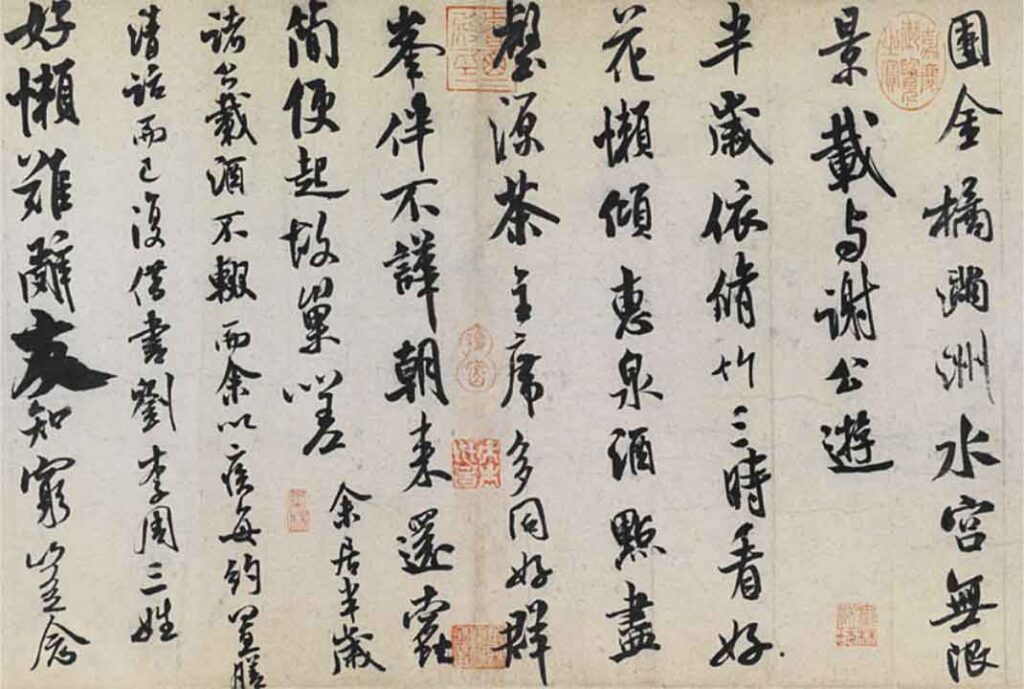
The second group consists of official script that emerged during the Warring States Period. Unlike seal script, examples of official script feature straight brushstrokes and do not use curved forms. Mature examples of official script generally come from the Western Han and Eastern Han dynasties. These examples are typically in the form of tablet inscriptions and writing panels made of long bamboo strips. The stylistic features and structural forms of these inscriptions may vary. For example, while some tablets are square and regular, others are wide and circular. The style found in bamboo writing panels is generally unadorned, open, natural, and lively. The use of official script declined after the Jin Dynasty (265–317) and was largely replaced by standard script, though it continued to be used on stone tablets.
Our article on Chinese Painting
The third group is the standard script we just mentioned. This type of script is also known as Zhengkai, Zhenshu, or Zhengshu, and it evolved from official script. It uses simple brushstrokes, and the characters are square in shape. First used during the Han Dynasty, standard script spread throughout China during the Three Kingdoms period (220–280). It is said that the originator of this script was Zhong Yao (150–230). Ouyang Xun (557–641), Yan Zhenging (709–784), Liu Gongquan, and Zhao Mengfu—known as the “Four Masters of Standard Script”—are famous masters who carried on the tradition of standard script. The standard script style is still used today as the standard style in the art of calligraphy. The fourth group is cursive script. Cursive script differs from the other groups in aspects such as connected brushstrokes and rapid writing. It emerged during the Han Dynasty. This style, characterized by a fluid style, was not bound by strict rules.
The fifth group is cursive script. Derived from standard script, cursive script is a fluid calligraphic style used in daily life. This calligraphic style is both suitable for general use and possesses qualities that make it efficient for writing. Used since the Han Dynasty, the cursive script style has evolved over time to achieve great diversity and has become the longest-used calligraphic style. Cursive script became quite popular during the Eastern and Western Jin Dynasties. In fact, many emperors used cursive script. Wang Xizhi (303–361), Yan Zhenqing, and Su Dongpo were renowned calligraphers and masters of cursive script. We have categorized calligraphy into groups because these groups possessed distinct stylistic characteristics.
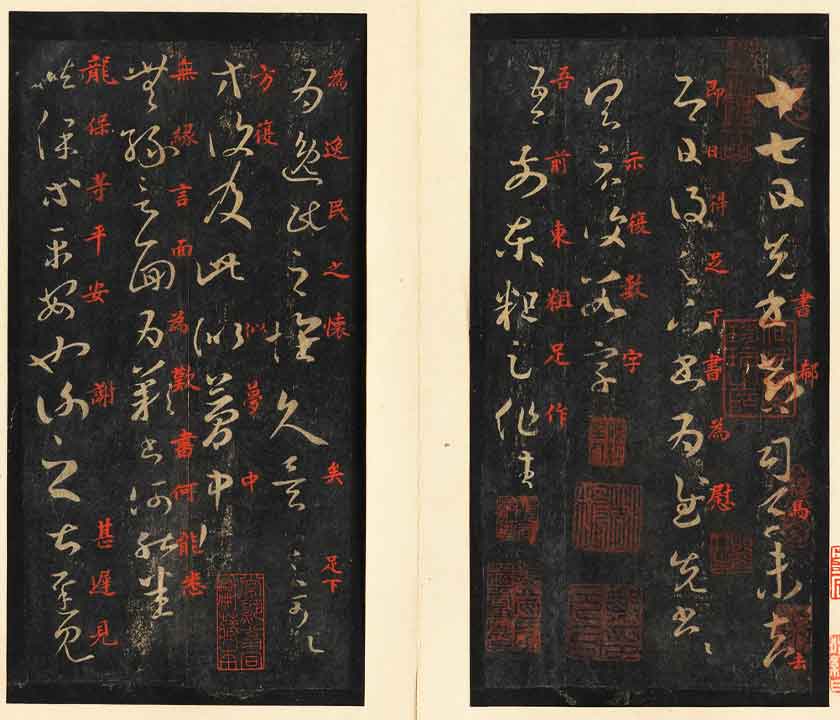
The differences between these calligraphic styles naturally gave rise to distinct writing styles over time. For this reason, different calligraphic characteristics have come to the fore in different eras. As a quote regarding the art of Chinese calligraphy: “Calligraphy critics have thoroughly summarized the calligraphic characteristics of all dynasties from the Jin Dynasty to the Qing Dynasty: The people of the Jin Dynasty advocated for the elegance of writing, the people of the Tang Dynasty advocated for adherence to values, the people of the Song Dynasty emphasized meaning, the people of the Ming Dynasty advocated for beauty, and the people of the Qing Dynasty advocated for change. The widespread and influential connotations of the terms “grace,” “values,” “meaning,” “beauty,” and “change” vividly illustrate the history of development and transformation in Chinese calligraphy from the Jin Dynasty to the Qing Dynasty. Today, just as in the past, the art of calligraphy is ripe for new changes and developments.