With their vibrant colors and striking brushstrokes, van Gogh, Gauguin, and the Fauves paved the way for Expressionism. Emerging and flourishing amidst the climate of unrest in early 20th-century Germany, Expressionism emphasized powerful, sincere, and individual depictions that reflected the artists’ own perspectives. It was an entirely subjective movement lacking a single, unified style, giving rise to distinct groups such as Die Brücke .
It is believed that the term “Expressionism” was first used in 1910 by the Czech art historian Antonfn Matejcek (1889–1950) to describe a new art style he viewed as the antithesis of Impressionism. According to him, Expressionists set out to express the feelings within the human psyche, rather than adopting the Impressionists’ approach of objectively depicting external appearances. Two years later, in 1912, the term was used again by writer and editor Herwarth Walden (1879–1941) in the magazine *Der Sturm* (*The Storm*), which he owned. Moods and Emotions The term “Expressionism” was used to describe the moods, emotions, and ideas that some artists revealed through vivid, powerful, intense, and distorted images.
A work of art was subjective and personal, rather than objective and detached. Like most art movements, Expressionism was not the product of a single, unified group. Painters who used colors haphazardly and created unsettling compositions did not strive to create images that looked realistic or were pleasing to the eye. Their goal was to capture emotions through bold colors and dynamic compositions. Many artists labeled as Expressionists did not know one another and did not accept this label. Expressionist art emerged almost simultaneously in various cities across Germany, alongside the public’s growing unease and anxiety in the face of the modern world. While the Expressionists opposed traditional notions of art on the one hand, they also supported movements such as Symbolism and artists like van Gogh, Edvard Munch (1863–1944), and James Ensor (1860–1949).
The Die Brücke Group and Expressionist Artists
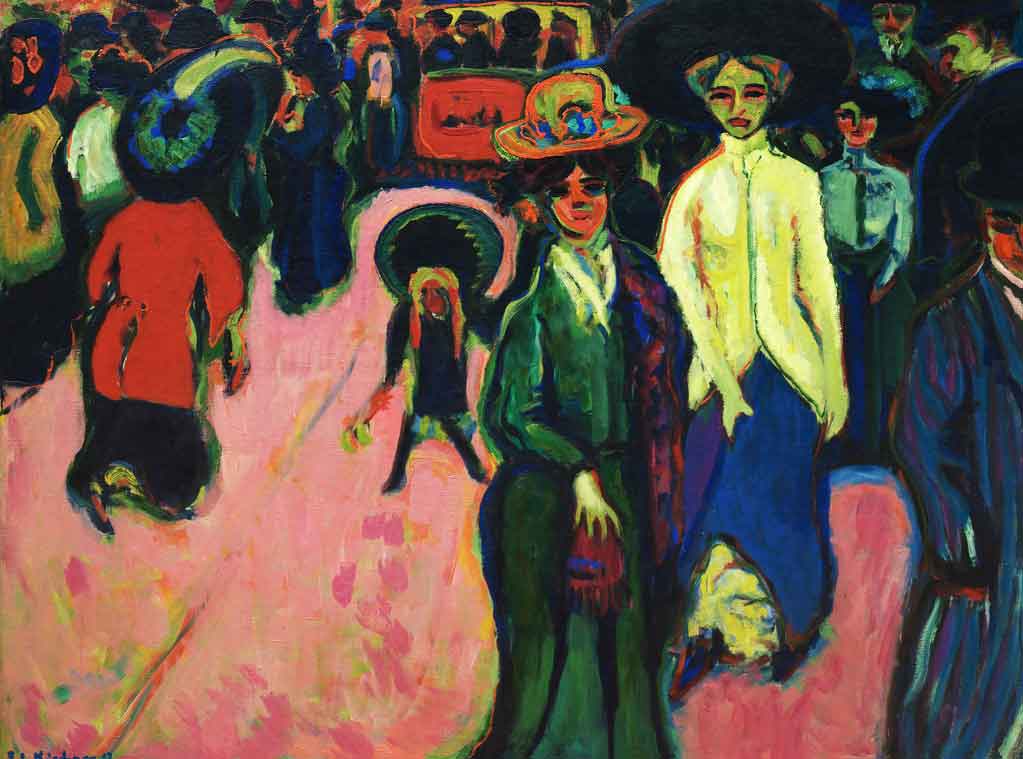
The goal of most painters was to move viewers not through their technical skills but through the powerful emotions they depicted. Many Expressionist groups emerged. In 1905, in Dresden, four German artists—led by Ernst Ludwig Kirchner (1880–1938)—founded the group, including Max Pechstein (1881–1955), Kees van Dongen (1887–1968), Emil Nolde (1867–1956), Karl Schmidt-Rottluff (1884–1976), and Erich Heckel (1883–1970). The Die Brücke artists aimed to challenge and confront the traditionally accepted styles of fine art, which by that time had come to include Impressionism and Post-Impressionism. They believed their works would serve as a bridge between the art of the past and modern art.
In 1906, they held their first exhibition and published a group manifesto. Many of them developed a style in which they intentionally left paintings in a simple and rough state, emphasizing and exaggerating certain elements to meaningfully distort objects and colors. They typically produced images of modern cities to depict a world that was becoming increasingly aggressive and intimidating. Although Nolde was briefly associated with Die Brücke, he was better known as an Impressionist who worked primarily on his own.
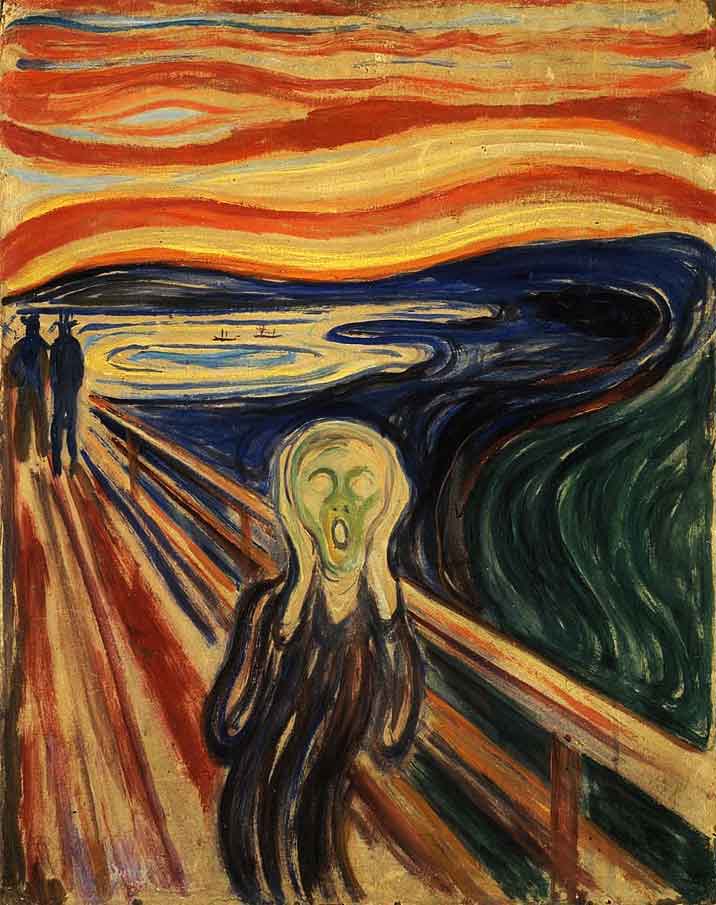
The Die Brücke artists were also influenced by African and Oceanic art—considered direct, unpretentious, and natural—a movement also known as primitivism. They believed that modern life, cast in the shadow of World War I, had become unbearable; that people were insatiable, selfish, and ruthless; and that by vividly visualizing this, they could bring about positive change in society. The vast majority of Die Brücke artists moved to Berlin between 1910 and 1914. One of the sources of inspiration for Expressionism was the Norwegian painter Edvard Munch. In 1893, Munch created a painting and lithographs featuring a figure in agony against a crimson sky. In the background is a view of Kristiania—now Oslo.
A New Movement: The Blue Rider Group
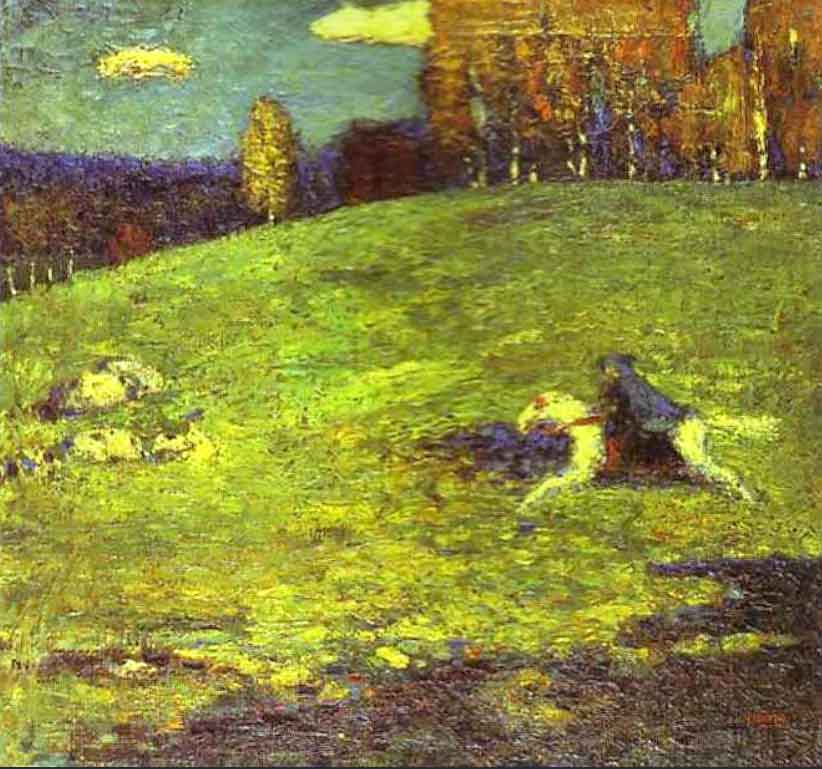
In 1911, another group of artists founded the Blue Rider (Der Blau Reiter) in Munich. Wassily Kandinsky (1866–1944), Franz Marc (1880–1916), Paul Klee (1879–1940), Alexej von Jawlensky (1864–1941), and Auguste Macke (1887–1949) were among the group’s members. The group’s name, which aimed to reveal spiritual truths, was taken from Kandinsky’s 1903 painting *The Blue Rider*. Kandinsky and Marc were fascinated by the power and beauty of horses and believed in the mystical power of the color blue. They were influenced by Gauguin, Van Gogh, Munch, and primitive art. They believed that art could imbue people’s lives with profound meaning. Kandinsky stated that he was striving to create “a new relationship with nature.” Der Blaue Reiter was not as organized a group as Die Brücke and never published a manifesto, but Marc and Kandinsky collectively published their essays on art in 1912.
Kandinsky, the group’s leader, believed that moods and emotions could be depicted through simple colors and shapes that rendered the subject itself superfluous. This made him one of the first artists to produce abstract works. The members of Der Blau Reiter created simple, vibrant, and colorful images to convey their emotions and interpret the modern world. In 1914, with the outbreak of World War I, Marc and Macke were drafted into the German Army and were killed in action shortly thereafter.
All of the group’s Russian members—Kandinsky, von Jawlensky, and others—were forced to return home. Shortly thereafter, Der Blau Reiter disbanded. Impressionism has often been associated with the ideas of the German philosopher Friedrich Nietzsche (1844–1900). In his work *The Birth of Tragedy* (1872), Nietzsche divides the experience of visual art into two categories: Apollonian and Dionysian.
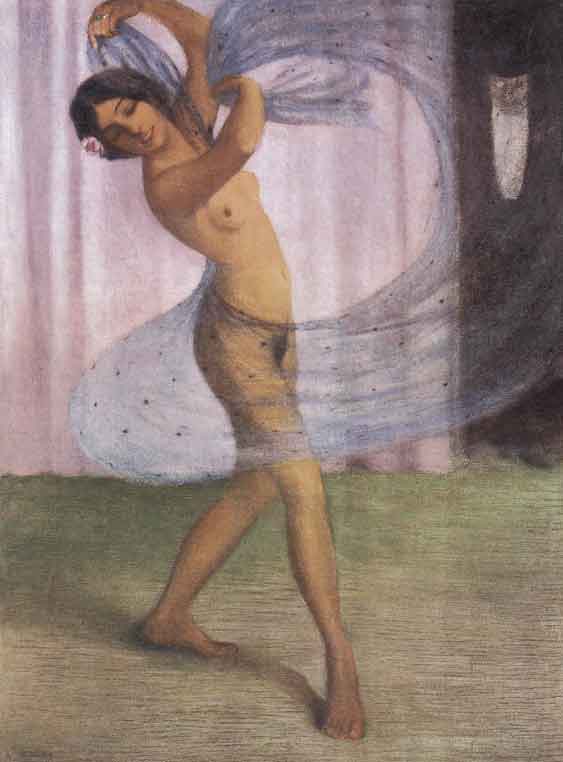
While Apollonian art symbolizes order and carefully considered ideals, Dionysian art possesses a more subjective character—featuring chaos and intense emotions rather than rational thought. With their bold colors, distorted forms, and passionate imagery, the Expressionists fall into the Dionysian category. Other important German Expressionists who worked independently to express powerful emotions—primarily the horrors of war—include Otto Dix (1891–1969), Lionel Feininger (1871–1956), George Grosz (1893–1959), and Max Beckmann (1814–1950). Among the Expressionist painters working in other countries at the same time were Georges Rouault (1871–1958) in France, and Oskar Kokoschka (1886–1980) and Egon Schiele (1890–1918) in Austria.