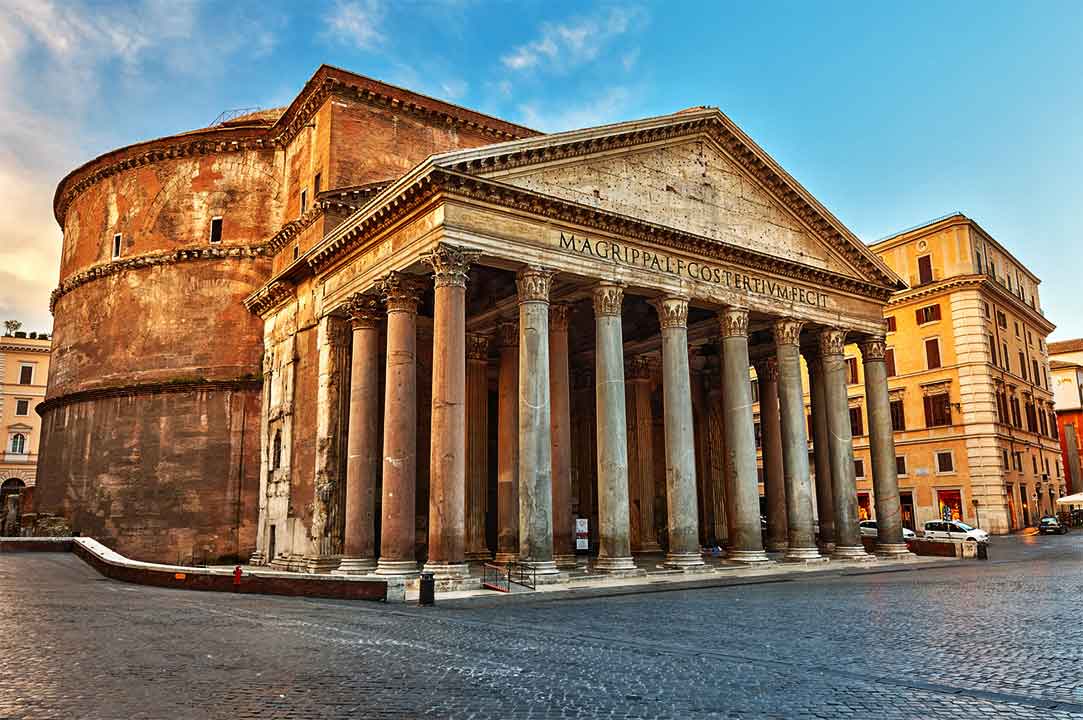
The Etruscans’ influence on Roman architecture is also evident in Roman temples. Starting in the 6th century B.C., as the city of Rome began interacting with the Greeks, elements characteristic of Greek architecture began to appear in Roman temples. Subsequently, Rome synthesized these cultures and developed its own distinctive temple architecture beginning around the 3rd century B.C.
Around the 7th century B.C., architectural styles in Rome were transformed by the influence of Etruscan culture, taking on a more universal and multicultural character. During this period, the Etruscans spread from Rome to the northern regions of Italy, evolving into a powerful civilization. For a long time, the Etruscans interacted with the Greeks and other Near Eastern peoples. This interaction led to the presence of Greek influences in Etruscan religion and culture. The elements of Greek culture visible in Etruscan art are of utmost importance in understanding Rome’s interaction with Greek culture. This is because Roman temples were constructed based on Etruscan architecture. Therefore, if we can understand Etruscan temple architecture, we can also grasp the distinctive features of Roman temples.
Rome was first founded in 753 B.C. on the Palatine Hill. The 250-year period from its founding until 510 B.C. is known as the Roman Kingdom. During this period, when the Republic held sway, seven kings reigned. Nearly half of these kings were of Etruscan origin. For this reason, temple architecture during the Roman Kingdom Period developed under Etruscan influence. The Etruscans’ affinity for Greek art facilitated Rome’s adoption of this culture. In Roman temples of this period, the pronaos and naos—structures also found in Greek temples—were situated on a high podium. The walls were constructed of wood and covered with earthen tiles. The cella consisted of three sections. The temples were surrounded by walls known as the peribolos. The structure was designed to be nearly square in shape. The side and rear walls of the temple were windowless, just as in Greek temples.
Roman Temples Under the Influence of Different Cultures
The Temple of Mater Matuta in the Satricum region serves as an example of temples from the early period. There are two forms of this structure. Although these forms were built at different times, they follow one another. Both forms are prostylos structures. The Roman Kingdom Period ended with the fall of the monarchy, and the Roman Republic Period began from this date, namely 510 B.C. The Republic Period lasted until 27 B.C., when the Empire was established. The Senate was established during this period. The people were divided into two distinct groups: the patricians and the plebeians. During this period, just as in the Roman Kingdom period, Etruscan culture left its mark on architectural elements.
During the Roman Republic, the pantheon expanded to include many new deities. Jupiter, Saturn, Mars, Vesta, and many other new figures were embraced by the people. Some of these deities originally belonged to Etruscan and Greek cultures. In Rome, alongside city-specific guardian deities, homes featured sacred spaces dedicated to the spirits of ancestors (lares) and the guardians of the household (penates). Temples during the Roman Republic were not administrative centers; they were simple structures housing cult statues and altars set up for the offering of sacrifices. The 2nd and 3rd centuries B.C. became a source of new structural techniques and diverse design concepts in Roman architecture. While many Greek architects were involved in building the temples, the engineers were Roman. Even when we look at the Imperial Period that followed the Republic, we can see that the foundations of Roman architecture were rooted in Eastern civilizations and Hellenistic traditions.
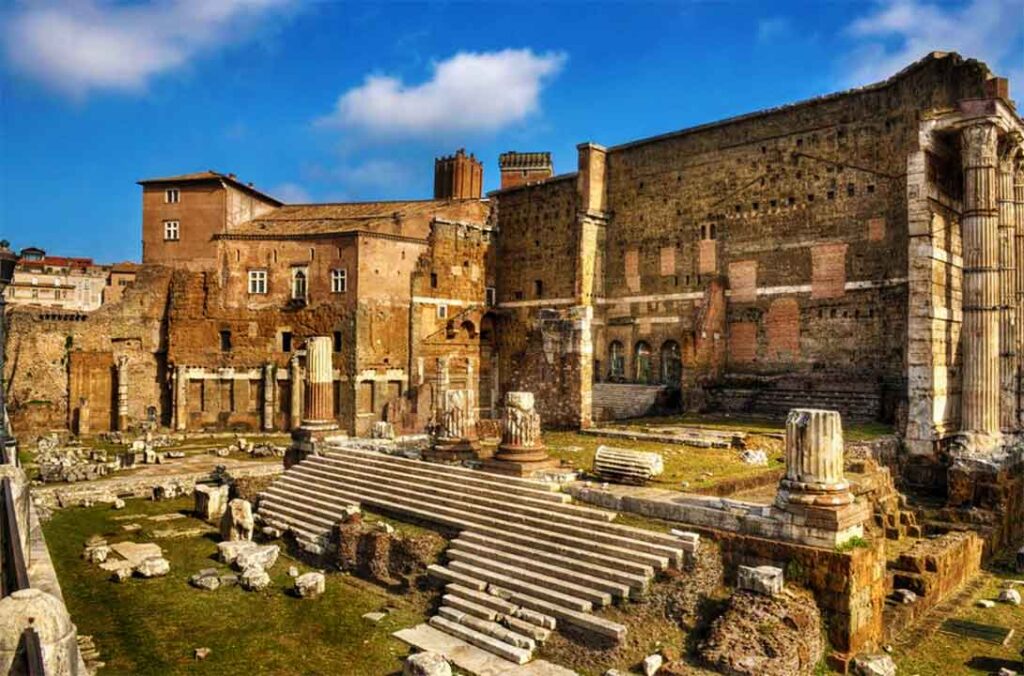
The Roman Temple of Magna Mater, built on the Palatine Hill in 204 BCE, is an example of how the cult of the Great Mother Goddess began to spread and gain prominence in Rome during the 2nd century BCE. Theaters in Rome were frequently used for religious purposes. For this reason, the relationship between theater and temple is quite significant in Rome. Theater-temple complexes evolved into public centers where traces of official religious policies and political propaganda could be observed across various periods and regions. These complexes became particularly widespread in the Latin-origin cities of Italy during the 2nd century BCE. Moving to the Roman Republican period, theater-temple complexes were used not only for religious purposes but also for commercial ones; the Temple of Gabi serves as an example of this. The gods for whom rituals were held in these complexes could also be associated with the origins of the city where the structure was located. The use of circular floor plans in temple architecture during the Roman period can be observed between the 3rd and 4th centuries B.C.
Examples of Roman Temples
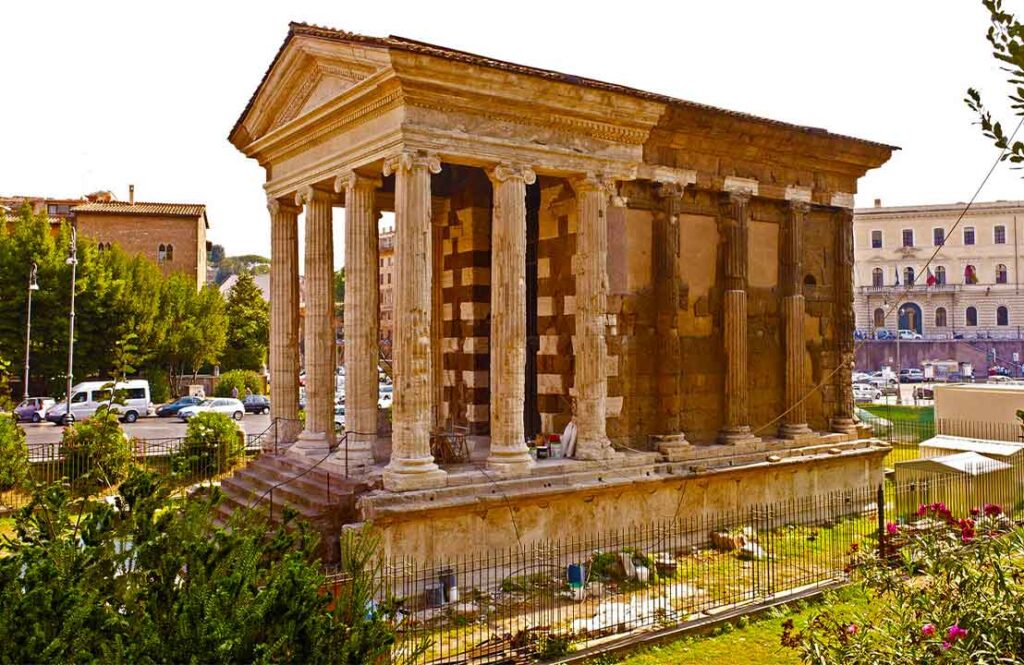
Dating back to 120–80 B.C., the Temple of Portunus was built on the banks of the Tiber River and remains intact to this day. The temple features traditional Roman architecture. Its cella consists of a single chamber. It has a deep portico supported by six columns. Stairs are located in front of the temple, which rises on a podium. In terms of its features, it resembles an Etruscan temple. Additionally, like the Greek temples we are familiar with, this temple is also surrounded by columns. These columns are attached to the temple walls. The walls of the Temple of Portunus are constructed of tuff and covered with white stucco. In this respect, the Temple of Portunus has a travertine structure. In appearance, it also resembles Greek temples. The temple, which was converted into a church in later periods, has thus survived to the present day.
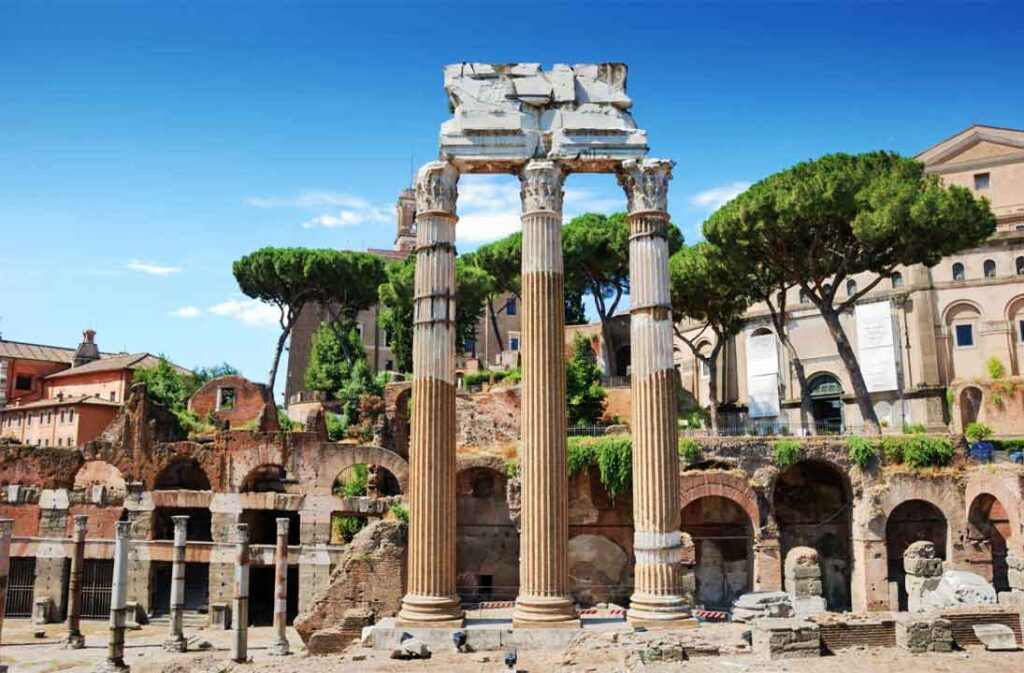
The Temple of Castor and Pollux dates back to 484 B.C. It was built to give thanks for Rome’s victory in the Battle of Lake Regillus. According to legend, Castor and Pollux (the Dioscuri), sons of Zeus, were seen assisting Roman soldiers on the battlefield, thereby heralding victory for Rome. The temple was built on the site where the two were believed to have appeared. The structure also served as a meeting place for the Roman Senate. During the Roman Imperial Period, it was used for administrative purposes. The temple was destroyed in a fire in 14 B.C. and later restored by Tiberius. This temple features eight columns on its short sides and eleven on its long sides. It was built in the peripteral style and in the Corinthian order. There is a gap between the columns on the temple’s façade and the cella. In this respect, the Temple of Castor and Pollux differs from Greek temples.