Some of the fundamental elements of Japanese mythology are creation myths. Understanding these creation myths is vital for grasping the mythological tradition and making sense of the subsequent mythological structure and its impact on society. In Japanese mythology, we will examine the creation of humanity alongside deities such as Amaterasu, Susano and Tsukuyomi.
The two dominant mythological timelines in Japanese philosophy, stemming from Buddhism and Shinto, differ radically from one another in both origin and beginning; yet they ultimately converge into a single progression centered on Japan and the Japanese people. Perhaps one reason Japanese myths have no trouble reconciling with Buddhist and Shinto myths is that all these mythological traditions leave much of their meaning open-ended or, at best, are recounted in a cursory manner so that they can be “filled in” by others. The first stage of the Shinto mythological timeline is the age of the heavenly and earthly deities. This is the age of the creation of the heavens and the earth, their inhabitants, and their order. By the end of this period, the earth was fully formed in every respect, and the earthly deities were brought under the proper authority of the heavenly deities.
Myths of the Beginning: Creation and Unity
The Kojiki states that in the beginning, there were five solitary deities (without spouses). The earth itself was formless, like a jellyfish. After the first five, another generation of deities took form; some of these had spouses as well. The last of the seventh generation were a male and female couple named Izanagi-no-mikoto and his wife Izanami-no-mikoto. The Nihonshoki contains versions that are roughly the same. By the unanimous voice of all the kami, these two were given the Heavenly Jeweled Spear and told to solidify the earth. Standing on the Celestial Flying Bridge, the two stirred the liquid with this spear. When they raised the spear, the droplets that fell from its tip formed islands. The two creator deities descended to the islands and built a celestial pillar and a palace to live within.
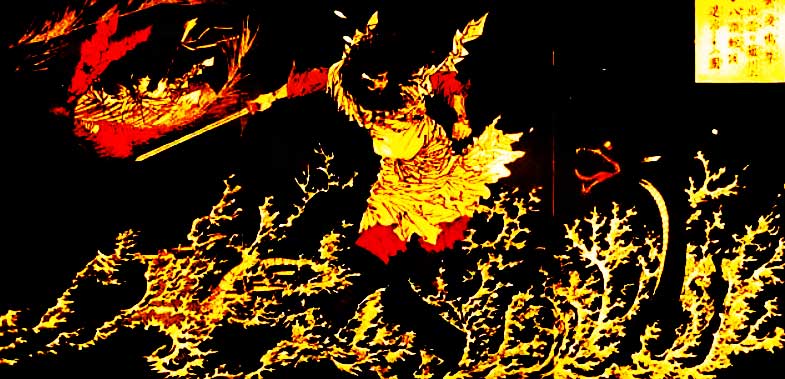
After completing the palace, they realized that their bodies had taken on a different form. It is said that Izanagi spoke to Izanami as follows: “In my newly formed body, there is a place shaped for transmission. For this reason, I wish to take this place within my body that has been formed for transmission and place it into that place within your body that has been inadequately formed, thereby bringing the earth into being.” (Kojiki, as cited in Phillipi, 4:4). Izanami agreed, and the two deities decided to walk along the ledge of the pillar—Izanagi on the left, Izanami on the right—to reunite and engage in sexual intercourse as husband and wife. They circled the pillar, but when they met, Izanami exclaimed, “How wonderful! Ah, what a charming young man!” Izanagi was also very pleased to see her, but he rebuked her, saying it was improper for a woman to speak before a man.
They began the act of procreation; however, they first gave birth to a leech-like child without arms or legs, and then to an island: The *Nihonshoki* recounts that the leech-like child was not the first but the last child. The anxious couple consulted the elder deities, who informed them—after they had circled the pillar—that the problem stemmed from Izanami speaking first, which was improper. They repeated the ritual, this time greeting each other in the correct order. As a result, Izanami gave birth to the eight islands of Japan, followed by many other deities. Izanami died after giving birth to the fire deity, whose flames burned her reproductive organs. At the moment of her death, many other deities were born from her organs and bodily fluids. In total, she brought fourteen islands and thirty-five deities into the world. Enraged, Izanagi killed the newly born fire deity. From the organs of the dead fire deity and the blood collected on Izanagi’s sword, other deities were born.
After his wife’s death, Izanagi wished to visit her in the realm of Yomi (the underworld). Izanagi met her in the great palace of the underworld, and Izanami agreed to return to the realm of the living with her husband, provided the kami of the underworld granted permission. When Izanagi broke his promise to wait patiently and secretly spied on his wife, he discovered that her decaying corpse was being devoured by maggots. As Izanagi fled, Izanami followed him, accompanied by the maggots, who had transformed into the gods of thunder and their servants. Izanagi blocked the path with a boulder; however, Izanami cursed Izanagi and his people, decreeing that a thousand people would die every day. Izanagi countered the curse by blessing humanity with 1,500 births each day.
Izanagi cleansed himself of the filth of the underworld by bathing. From every part of his clothing, many deities were born—some pure and some impure. The same thing happened when he washed his body: a kami was formed from every part he washed. Upon seeing his children, Izanagi appointed them to rule over various regions. Since the last three children—Amaterasu-o-mikami, Tsukiyomi-no-mikoto, and Susano-wo—were especially blessed, they were appointed to rule over heaven, the night, and the ocean, respectively. All the kami, except for Susano-wo, obeyed their father’s commands and assumed their duties. Susano-wo, however, was assigned by his angry father to rule Yomi because he had wept and wailed over the loss of his mother, Izanami. Izanagi then retired to the palace he had built in Izumo.
The Crimes of Susano wo and the Sun Goddess
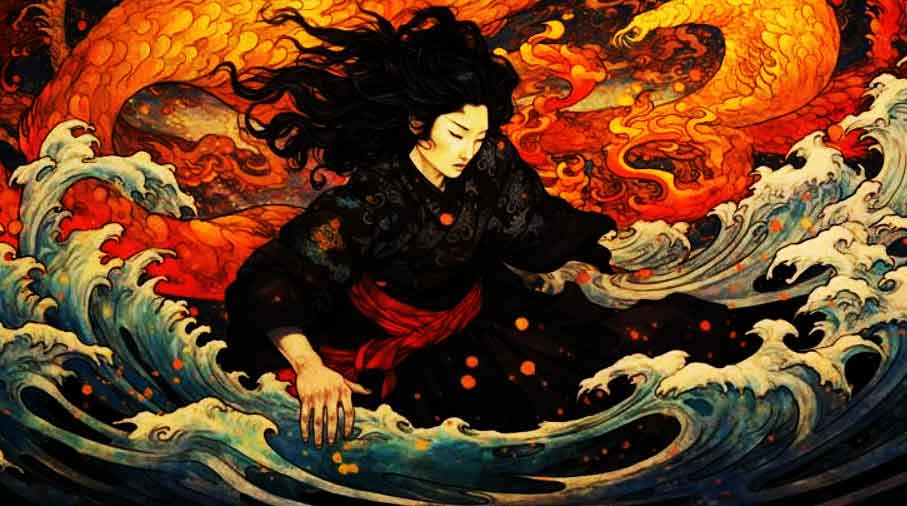
As was customary, Susano-wo came to bid farewell to his sister Amaterasu before setting out for his kingdom in Yomi. Amaterasu was armed and armored in an unusual manner; she had tied her hair back like a man (in ancient times, women left their hair loose while men tied theirs back) and had taken plenty of arrows. As Susano-wo approached, Amaterasu performed a war dance, stomping her feet on the hard ground so hard that the dust and smoke rose, her feet sinking into the ground up to her thighs. Susano-wo objected, insisting he was entirely well-intentioned and that his sister’s suspicions were unfounded. He then added that he would prove his words: the two of them would conduct a trial by torture. Apparently, this was a common practice, and Amaterasu accepted it. He asked for his brother’s sword, broke it into three pieces, washed them in the Celestial Well, chewed them, and then spat them out. Three deities emerged from what spurted from his mouth.
Susano-wo asked for his sister’s magatama jewels; Amaterasu, as clan chief, had been wearing them for battle. Amaterasu gave him the jewels from the right bun in her hair. Her brother washed them, chewed them, and spat them out. A deity emerged from what spurted from his mouth. Susano-wo then took the jewels from the girl’s left bun, her hairband, her left arm, and her right arm; when he chewed and spat them out, a total of five deities emerged. According to the Kojiki, Amaterasu accepted defeat. The first three deities were female, and since they were born from the sword belonging to Susano-wo, they were his children. The account in the Nihonshoki, however, is the exact opposite: since the firstborn were “male” children, victory went to Susano-wo, and the goodness of his intentions was proven. Susano-wo, who was never one for refinement, lost his mind with joy and shouted things like, “I won! I won!” He destroyed the waterways in the rice paddies in the sky, filled in the ditches, and finally defecated in the Hall of First Offerings.
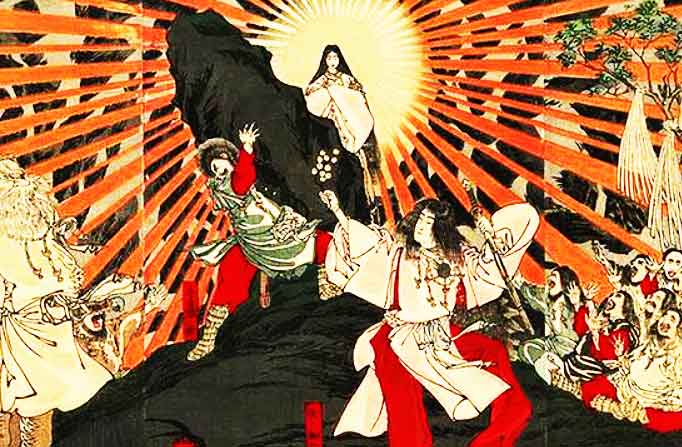
Amaterasu was very forgiving toward her younger brother. “He did this because he was drunk,” she said. “Perhaps he thinks growing rice is a waste of time.” Unfortunately, being lenient with bullies is never a good strategy. Susano-wo’s mischief continued; eventually, one day, he captured a heavenly, spotted pony, flayed it alive, and threw the carcass into Amaterasu’s weaving hall. One of the weavers was so shocked that she struck her own genitals with the loom and died. Amaterasu, whether out of fear or revulsion, shut herself away in a cave. The consequences of the Sun Goddess’s seclusion were severe: the earth and sky grew completely dark. Countless deities were summoned, and the earth was beset by many calamities.
Eight million deities resorted to their usual remedies in times of trouble. They gathered in the dried-up bed of the Celestial River to discuss the matter. Then, after gathering the necessary materials, they tasked the blacksmith kami Amatsumara with forging a metal mirror. They tasked Tamanoya-no-mikoto with making long strands of magatama beads. To ensure the success of their efforts, they ordered the appropriate deities to make prophecies. They uprooted a sacred, evergreen sakaki bush from its roots and replanted it, hanging offerings from its branches: jewels, a mirror, a blue cloth, and a white cloth. They performed the offering rituals. Then the powerful deity Amanotachikara-o-no-kami hid behind a rock blocking the cave’s entrance.
The mischievous deity Ama-no-uzume tied up her arms and hair, bared her chest and genitals, and, climbing onto a beehive, began a raucous dance. Eight million kami burst into laughter. Amaterasu, who found this behavior strange (after all, her seclusion had brought darkness and gloom to both heaven and earth), opened the cave door to find out the reason for this frivolity. Ama-no-uzume, being a better deity than Amaterasu, blurted out that they were happy. Then, two divine ritualists showed Amaterasu her own reflection in a mirror. Her curiosity piqued, Amaterasu opened the cave entrance a little wider and glanced at the mirror. Amenotachikara—whose name means “the power of heaven”—seized Amaterasu’s hand at that very moment and pulled her out of the cave.
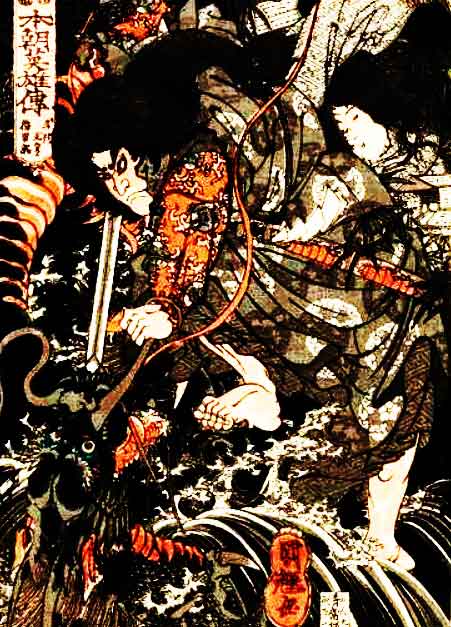
Amenofutotama-no-mikoto, one of the ritual experts, also sealed the entrance to the cave with a sacred rope so that Amaterasu could not pass through. Thus, light returned to the heavens and the earth. Susano-wo, the source of all this trouble, was punished by the assembled kami with a thousand offering tables; his beard was shaved, his hair was pulled out, and he was banished from heaven; according to the *Nihonshoki*, he was also expelled from the “Land of the Reeds,” and according to some accounts, he went to Korea. The thousand offering tables—which, much like those still found in shrines today and in the sere moni prepared for the emperor, contained fabrics, paper, bronze objects, strings of jewels, and food—were likely distributed among the kami.
The Creation of Food and Humanity
Amaterasu had heard of a kami named Ukemochi-no-kami who lived in the Land of the Reeds. She sent her brother, Tsukiyomi-no-mikoto, to seek out this kami. When Tsukiyomi arrived at the kami’s dwelling, Ukemochi-no-kami produced rice and other foods from her mouth, placed them on the offering table, and presented them to the visiting kami. Believing what he saw to be a filthy act, the humiliated Tsukiyomi-no-mikoto killed the goddess of food. Amaterasu became very angry with her messenger, swore she would never look upon him again, and made him the moon god who appears only at night, when the sun sets. She went to look at the body of the slain food goddess. The head of the corpse had turned into cattle and horses. She had oxen on her forehead and silkworms on her eyebrows. Her belly was made of rice, and her reproductive organs were made of wheat. These were offered to Amaterasu, who declared that they would be used to sustain human life.
Although the story is told this way in the *Nihonshoki*, the *Kojiki* recounts it differently. In that version, the humiliated kami is Susano-wo, who sought refuge from Ugetsu-hime during his exile. Ugetsu-hime produced various foods from her nose, mouth, and rectum and offered them to Susano-wo. Humiliated by this apparent filth, Susano-wo kills his host. From the goddess’s eyes and other parts of her body emerge food and items beneficial to the human race. The two myths depict two significant contradictions that were evident to the Japanese people of that era. The first is that growth and the life of the human race are tied to death and decay. With the changing of the seasons, plants die only to bloom again and spread their seeds—just as animals die to make way for their offspring. The sociopolitical interpretation was no less significant.
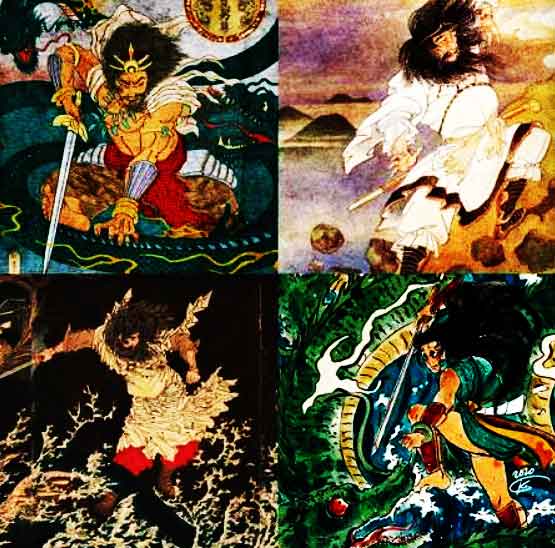
Food was the source of life, yet men were socially dependent on women to prepare it: Consequently, the source of food was the female deities. Nevertheless, in the male-dominated society of early (and modern) Japan, women were considered more impure than men. The food they served to male visitors was suspected of being dirty and impure, as any food might be. This is a clever ploy to diminish women’s value—the kind one might encounter anywhere else. Susano-wo and the Eight-Tailed Dragon During his travels, Susano-wo came upon an elderly divine couple whose seven daughters had been devoured by the eight-tailed dragon Kushi.
Another Article of Ours on Japanese Mythology
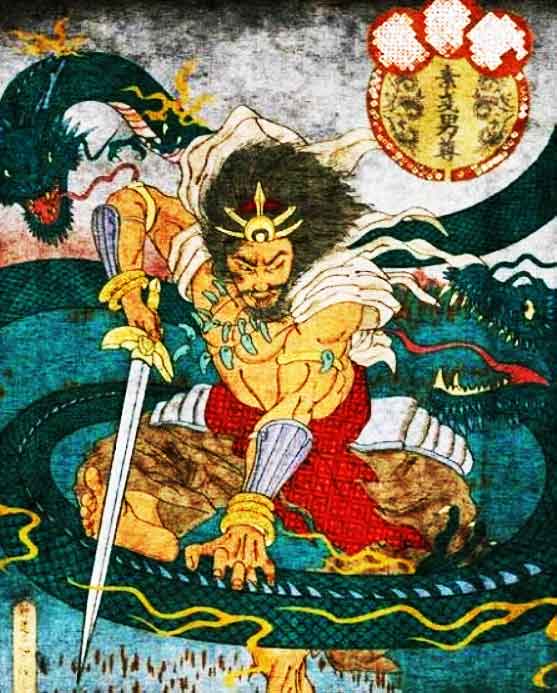
Only the eighth daughter had survived, and Susano-wo had arrived the night before the day the dragon was expected to return. After securing a promise that the remaining daughter would become his wife, Susano-wo volunteered to slay the demon serpent. At his command, they brewed a particularly potent sake, and Susano-wo built a sturdy fence with eight gates. Inside the gates, he placed eight sake barrels, securely fastened to sturdy platforms. The dragon came, stuck its head through each gate to drink the wine, and slumped over in a drunken stupor. Susano-wo drew his sword and cut the dragon to pieces. As he was cutting through the tail in the middle, his sword broke; but when he delved a little deeper, he found the sword Kusanagi, which he had offered to Amaterasu—likely as an apology for his previous misdeeds.
He then built a palace in Izumo, in Suga, and lived there with his wife, Kushinada-hime. He took another wife and became the father of many children; they, in turn, became fathers to their own children. Okuninushi and His Eighty Brothers One of Susano-wo’s descendants was Okuninushi. Although he had eighty brothers and was the least well-known among them, he eventually became the lord of the land (kuni-nushi). This is how it happened: All of his brothers wanted to marry Yagami-hime, the stunningly beautiful princess of Inaba. Taking Okuninushi along to carry their luggage, they set out to woo the girl. In Keta Bumu, they came across a rabbit that had lost its fur. As a joke, they told the rabbit to bathe in the sea and then lie in the sun to dry off. When the rabbit did as they said, its skin cracked, and the salt seeping from the wounds caused excruciating pain. Okuninushi—who was likely still struggling with the suitcases and was still known at that time as 0-Namuji-no-kami—happened to be passing by.
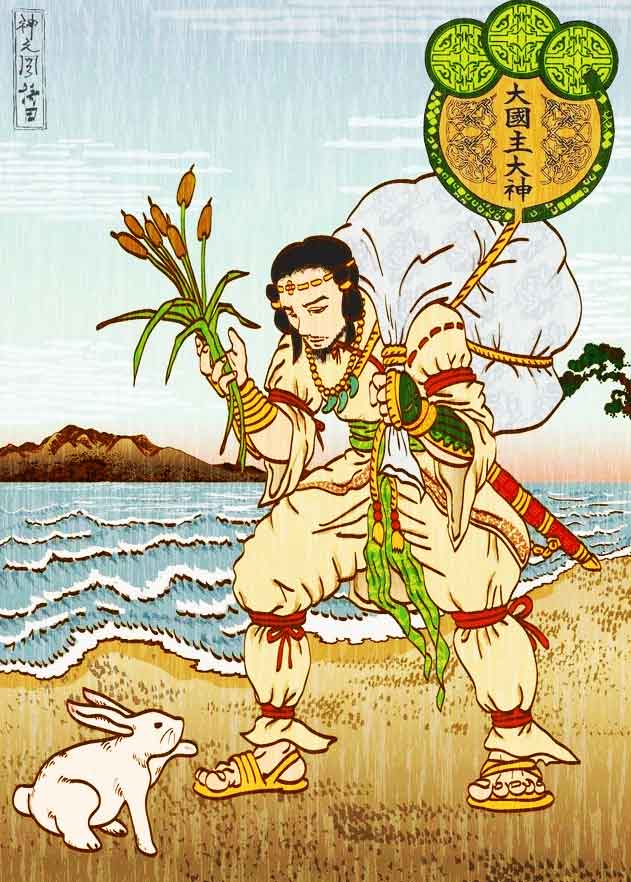
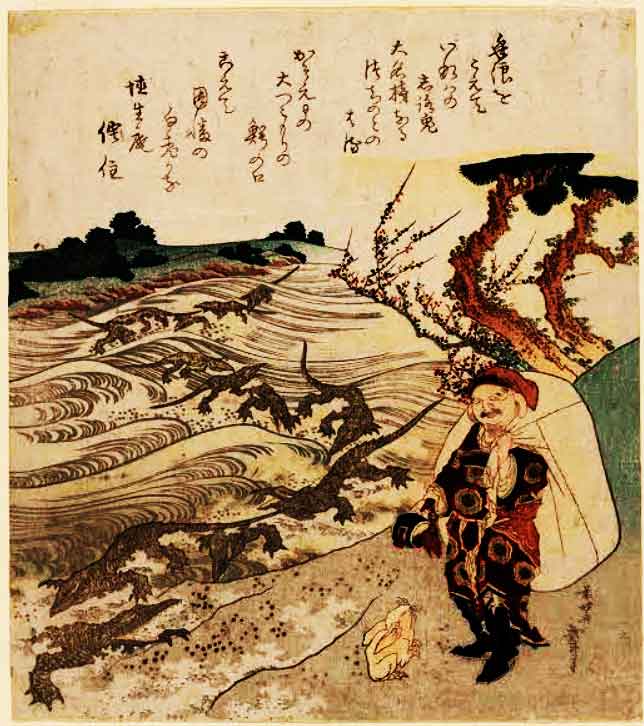
Feeling sorry for the rabbit, he asked what had happened. “I was on Oki Island and wanted to visit the mainland,” said the rabbit. “I tricked the sea crocodile to help me cross the sea. I told him that if he lay down side by side from Oki Island all the way to Keta Bumu (probably to show just how powerful the crocodile clan was), I would count his relatives. Once the crocodiles were lined up side by side, I hopped from one to the next, counting as I went. When I reached the last crocodile, I boasted about how I’d tricked them. The last crocodile caught me and flayed my skin. Then the brothers arrived.” Okuninushi advised the rabbit to take a shower in clean water and then roll in the pollen of a certain kind of grass to regrow his fur. Grateful, the rabbit prophesied that among all the brothers, Okuninushi would be the one to hold Yagam-hime’s hand. And so it came to pass.
This turn of events did not please the eighty brothers at all, and they hatched plans to kill Okuninushi. They tried their luck hunting wild boars beneath Mount Tema; they set a trap for Okuninushi by having him wait in a spot where a red wild boar would fall from the cliff. Instead, they took a huge boulder, heated it until it glowed, and rolled it down from the mountain’s peak. When Okuninushi caught the boulder, he was burned to death. His mother ascended to the heavens and pleaded for her son’s life to be spared. Two female deities were sent, and they brought Okuninushi back to life as a handsome young man. His eighty brothers tried once more to kill him. They split a tree in two, placed him inside, and then removed the spear that was holding the tree open. When the tree snapped shut, Okuninushi was torn apart and died. When his mother revived him again, this time she told him to flee. His brothers pursued him, but just as they were about to strike, Okuninushi managed to escape their grasp.
Okuninushi Is Tested by Susano-wo Okuninushi is advised to go see Susano-wo, his great-great-great-great-grandfather, who lives in a palace in a distant land. When Okuninushi arrived at the palace, he was greeted by Susano-wo’s daughter, Suseri-hime. The two fell in love and married. Suseri-hime then went to speak with her father, who greeted Okuninushi by one of the five names he had been given at birth. Wanting to test his new son-in-law’s courage, Susano-wo invited him to sleep in a room filled with snakes. Suseri-hime gives her new husband a scarf that drives away the snakes. When Okuninushi waves the scarf, the snakes fall asleep, and so does he. The following night, Susano-wo places him in a room filled with centipedes and scorpions. Once again, his wife gives him a scarf, and Okuninushi sleeps peacefully. Then Susano-wo shoots a whistling arrow—which has a bone whistle embedded in its shaft and is used to frighten enemies—and asks Okuninushi to catch it.
While Okuninushi was searching for his arrow in the tall grass, Susano-wo set the grass on fire. A mouse came along and showed Okuninushi a narrow cave where he could hide until the danger had passed; during that time, the mouse was also able to retrieve the arrow for him. Okuninushi brings the arrow to Susano-wo, who graciously allows his new son-in-law to pick the lice from his head. However, the god’s head is teeming with centipedes; after all, Susano-wo is the ruler of the underworld. Okuninushi tricks Susano-wo: He convinces him that he has pulled out the centipedes and killed them by biting them, thereby proving his immunity to their venom. When the old god falls asleep, the young god ties Susano-wo’s hair to the rafters and blocks the door of the room with a boulder. When his father-in-law was asleep and unable to move, Okuninushi grabbed Susano-wo’s sword, bow, and arrow, his jeweled koto (a zither similar to a kanun), and his own wife, and fled with them on his back.
As they fled, the koto struck a tree, and the sound awakened the sleeper. Susano-wo leaped to his feet and dragged the room along with his hair; however, by the time the debris had cleared, the young couple had already fled. Susano-wo pursued them to the very borders of his realm, but they escaped. Blessing them from afar, he wished that Okuninushi would find his own unique name, subdue his brothers using the weapons he had taken, make Suseri-hime his chief wife, and build a great palace. Susano-wo concluded his blessing (either with a cry of approval for this skilled rival and his lineage, or in silence) by exclaiming, “You rascal!” Okuninushi did indeed subdue his brothers, then built a great palace and undertook the task of creating the earth.
Versions of this myth will seem quite familiar to readers of European legends, and there are many variations regarding whether or not there is a giant, a witch, or a god’s daughter involved (for example, Jack and the Beanstalk). Littleton (1995) argued that another widespread Japanese myth, that of Yamato-takeru, bears a strong resemblance to the Arthurian legend and succeeded in tracing the origins of this legend back to the nomads of Central Asia. The legend branched off here and spread east and west through people who migrated to Europe and Siberia. The story of Okuninushi and his father-in-law also supports this idea and may have been first told by the same people.