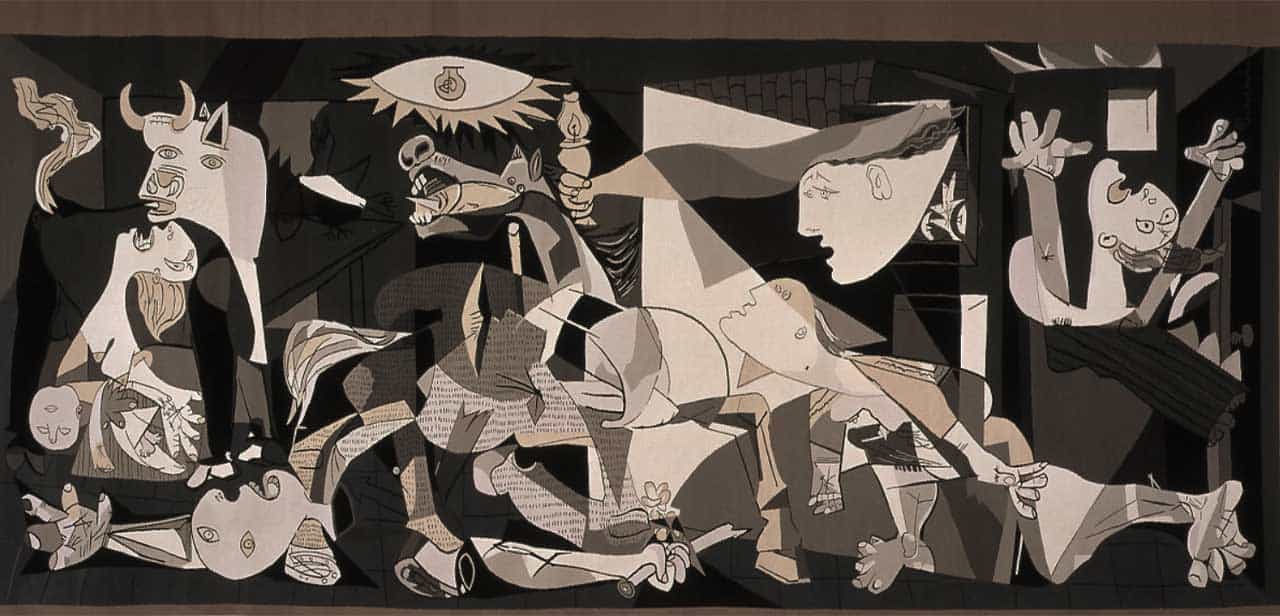
The painting *Guernica*, created by Pablo Picasso under the influence of Cubism, is a work of undeniable symbolic and artistic value. Even today, Guernica painting remains a work capable of revealing the political power of art to all of humanity. In this article, we will take a closer look at the story behind this great work and the symbolic elements it contains.
The Story of Guernica
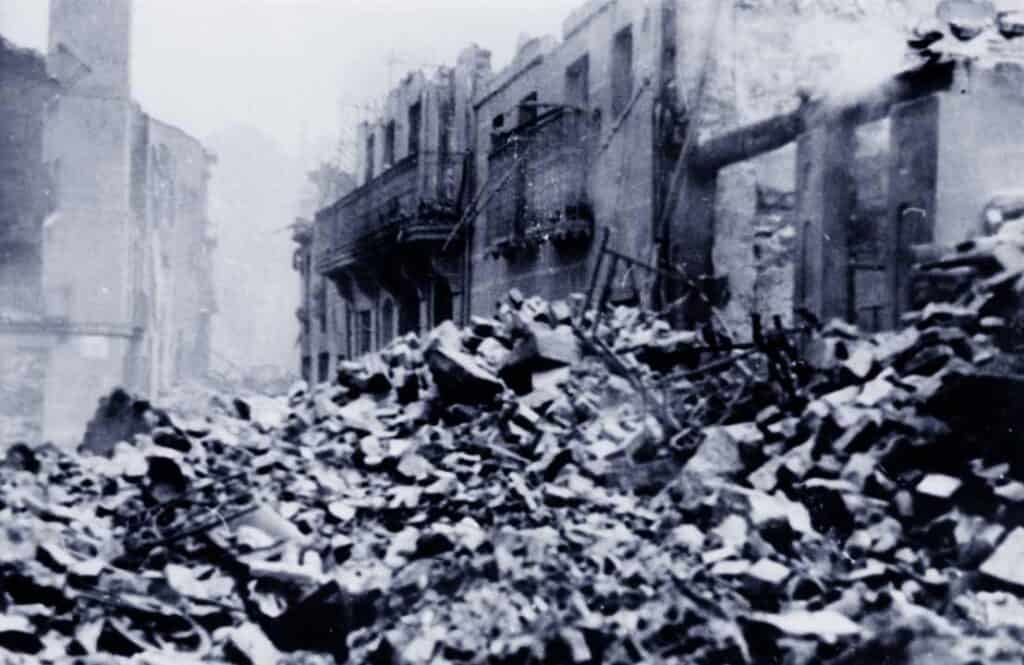
A preview of the struggle between fascism and democracy that would engulf all of Europe between 1936 and 1939 also unfolded in Spain. The Spanish Civil War, which took place during these years, pitted the Republicans—supported by the Soviet Union—against the Nationalists—backed by Nazi Germany and Italy. On Sunday, April 26, 1937, Franco’s air raid caught the defenseless town of Guernica off guard, slaughtering its defenseless population. According to reports from that time, the death toll was at least 1,700, with at least 900 wounded.
While German forces were primarily involved in this bombing, Italian forces also played a role. As a result, nearly half of the town’s population was killed or wounded. Picasso, who was residing in Paris at the time, read about this tragic event in the newspaper and expressed the pain he felt over the events unfolding in his homeland through the painting *Guernica*. Guernica is primarily a mural, and Picasso began working on this mural on May 1, 1937. The painting is a work rich in metaphors and symbols, and its creation process was quite painful.
Symbolic Figures in Guernica
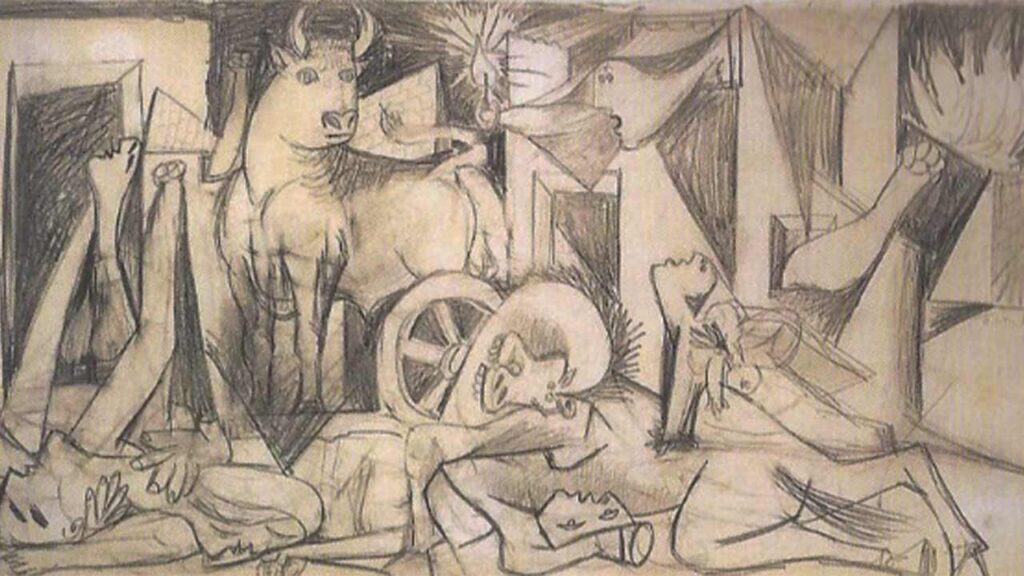
Picasso had already created sketches of the icons featured in the painting. It was only after hearing about the event that he transformed these sketches into a finished work, remaining faithful to the spirit of the event. The painting features symbols characteristic of Spain, such as the bull, the horse, the woman, and the Minotaur. Among these symbols, the “weeping woman” symbol, as depicted in the painting, specifically reflects a Spaniard’s perspective on a political massacre.
Additionally, in the scene depicted in Guernica where a mother carries her dead child, the mother is presented in a distorted form rather than a realistic one, in keeping with Cubism, which beautifully conveys the horror of the moment she is experiencing. Picasso made extensive use of the “bull” image in his works after the 1920s. The Minotaur, a creature from Greek mythology with the head of a bull and the body of a man, lived on the island of Crete.
The Minotaur figure in Guernica specifically symbolizes physical strength, power, and authority. Picasso continued to use this symbol until the end of World War II. Picasso frequently used bullfighting—a major part of Spanish culture—as a symbol in his works. The figure of the horse, depicted alongside the bull, represents the animalistic aspect of humanity. In Guernica, we encounter the same bull and horse figures. Even in his sketches prior to Guernica, he explored themes involving horses, bulls, and the Minotaur.
Our Article on the Dada Art Movement
If we look at the central figure, we see that his body is depicted as a newspaper. If we keep in mind that newspapers are a means of communication, we can say that Picasso has incorporated into the work his idea that the world would learn of the Guernica massacre through the media. When we look behind the bull figure, we see a dove drawn on the wall. The dove can be described as a symbol of peace, purity, and freedom.
For this reason, the dove depicted on the wall in Guernica—with its partially white-lit form—symbolizes salvation and hope. Ultimately, every object and symbol in the work carries distinct meanings. In this regard, the Guernica painting emerges as a visually rich and deeply symbolic work. When we delve into the origins of all this rich narrative, we can see that the traumas and internal conflicts the artist experienced played a central role.
Pablo Picasso’s Lament for Humanity
When Guernica was first exhibited, it was widely mocked and drew little attention. It was first displayed at the 1937 Paris World’s Fair. From 1939 to 1978, it remained at the Museum of Fine Arts in New York, USA. In 1978, it returned to Spain, where fascism had come to an end, though Picasso did not live to see it. He had passed away in France in 1973 due to heart failure.
Afterward, the painting was exhibited successively in Madrid and at the Reina Sofia National Art Museum. Guernica has become one of Spain’s national symbols. As one of the most popular monochromatic works in art history, the Guernica painting possesses a broad narrative both for documenting a specific event in history and for exploring universal values.
However, Picasso rejected the idea of analyzing his painting specifically through symbolism. From this perspective, it could also be said that he simply depicted the scene he witnessed. “Paintings are not made to decorate apartments. They are a tool against violence and darkness,” Picasso emphasizes this aspect of Guernica. As one of the greatest works of the 20th century, etching the era’s crises into art history through various symbols and a rich visual narrative, Guernica stands among Picasso’s most valuable works.